I can't help you with the math. Depends on the horsepower of the boat, the effective boat draft, how hard the skier pulls the boat sideways, prop pitch and size, water surface conditions, ski design, rope length, etc. The greater the angle from the center of the boat to point C, the greater the angle of the ski "blade" otherwise the skier is decelerating.
Trust me, not much application to the golfers release but if you want to do the math, there are plenty of resources to put the puzzle pieces together. Not my cup-o-tea, I was only concerned about rounding the buoy's without dropping an elbow or rope in the water. That takes time off the score and ruins rhythm.
Some are Performers and some are Engineers. Rarely the two meet in a single individual, but we need each other collectively. I appreciate what you are attempting here Jeff.
About that left shoulder movement. Can you quote VJ in context so there is no misunderstanding?
Thanks,
__________________
Bagger
1-H "Because of questions of all kinds, reams of additional detail must be made available - but separately, and probably endlessly." Homer Kelly
Bagger - you wrote-: "The greater the angle from the center of the boat to point C, the greater the angle of the ski "blade" otherwise the skier is decelerating."
I cannot understand this point. If the curve passing through all the points A,B and C is a defined curve of a certain shape, then the angle of the ski blade must be constant at all times during the skier's passage along that curved path - irrespective of the angle of the skier to the boat. The angle of the rope changes, but the skiers blade angle must surely remain constant if he maintains a curved path of constant curvacture.
What do you want me to clear up about the left shoulder movement? I only made the point that the idea that the left shoulder remains "fixed" in space as the center of a circle with a fixed radius is not what happens in a "real life" golf swing in the late downswing - because i) the left shoulder socket is moving upwards, leftwards and backwards in the late downswing and ii) the distance between the left shoulder socket and the clubhead constantly changes as the clubshaft becomes progessively more in-line with the left arm in the late downswing.
I've always wished I could combine my passions but I could never reconcile skiing and golfing.
I'm not interested in discussing the skier analogy, but I am interested in your comment regarding VJ's view of Hogan's left shoulder.
"see the three white dots with interconnecting red lines. VJ's representation of Ben Hogan's left shoulder socket as being a single fixed point in space is an oversimplification, and it doesn't represent true reality. It is a gross over-simplification -"
Just want to make sure that VJ's representation is rooted in reality. I haven't read his book so I'm trusting that this statement is fair and contextually accurate.
__________________
Bagger
1-H "Because of questions of all kinds, reams of additional detail must be made available - but separately, and probably endlessly." Homer Kelly
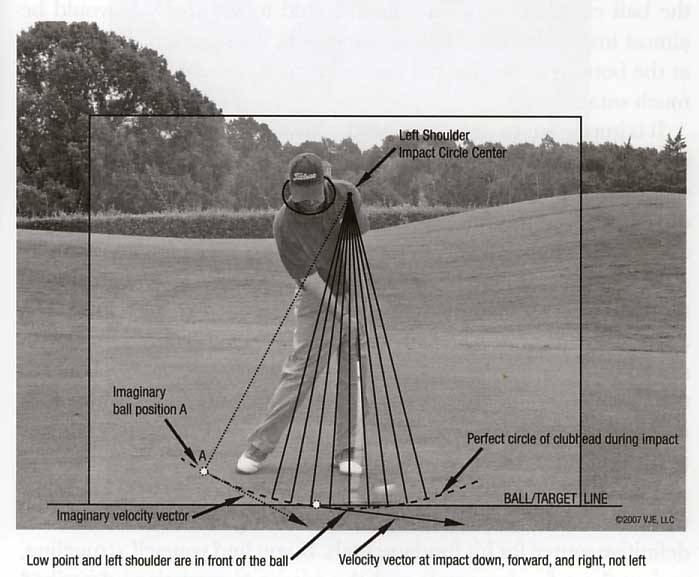
Here is a copy of VJ's Impact Circle photo from his book.
Jeff.
Edit: Unfortunately I am not able to present it as anything else but a link.
I do not like the impact circle consept, because it makes it seem like the rotation centre of the golf swing is at the left shoulder. Which it woould be if the sholder was kept still.
I've added some "momentum" to the drawing.
The centre of rotation is IMO close to the golfer's nose or neck.
The curved arrow around the golfer's head is momentum created by the rotating body and applied to the left shoulder. This momentum results in a pulling force on the left arm and further on the left club. This force is illustrated with the red arrow above the golfer's shoulder.
Since the sholder is offset to the centre of rotation, the pulling force from the shoulder can be decomposed in a component that is purely radial and another component that is purely tangential. That would be the yellow arrows by the clubhead.
The small arrow at the golfer's right hand is some of the force from extensior action. This could also be described as torque applied to the left arm, which is required to deal with clubshaft vs left arm lag.
You don't have to apologize for being blunt. I encourage all forum members to attack my arguments rigorously without restraint, because I believe so strongly in the Popperian falsification principle. My ideas/opinions are only valid to the extent that they cannot be falsified, and I don't know if they can be falsified if people don't vigorously challenge my opinions.
When I stated that my knowledge of physics-terms could be inexact, then it doesn't mean that I am knowingly using those "terms" imprecisely. My understanding of the term "angular acceleration" is totally compatible with the Wikipedia definition. However, I believe that angular acceleration doesn't always refer to a point-object moving around a "fixed" point in a circular motion, but it can also apply to a linear structure (eg. clubshaft) moving around a fulcrum hinge point (eg. hands) which is itself in motion. In nm golfer's mathematical explanation, he is referring to the clubshaft when he talks about angular acceleration, and not solely the clubhead. When I stated that one can see the clubhead progressively moving a greater distance per unit time during the release phase, and that this represents angular acceleration, I really meant that the clubhead is a "marker" for the rate of angular acceleration of the clubshaft, which means that the grip end of the club must be experiencing the same degree of angular acceleration as the clubhead end (because they are both simply point-locations on the same clubshaft).
I therefore don't understand your comment-: "For example in regards to the Bobby Jones photo the end of the clubshaft and the clubhead are picking up angular acceleration but the grip end of the shaft is not picking up angular acceleration."
You also made the following statement-: ""As it's the linear speed of the clubhead that is the real intent of the release and the clubhead can be picking up clubhead linear speed with an extension of the swing radius and at the same time have no increase in the angular acceleration of the clubhead."
I cannot understand your opinion - from the perspective of nm golfer's mathematical explanation of the release phenomenon. You seem to be implying that the clubhead (which is merely a point-location on the clubshaft) can pick up linear speed due to an extension of the swing radius without any angular acceleration of the clubshaft. When you refer to "swing radius" I presume that you are talking about the distance between the left shoulder socket and the clubhead. If my understanding is correct, then I think that you may have your logical argument back-to-front. The swing radius can only increase (in the presence of a left arm of constant length) if the 90 degree angle between the left arm and clubshaft changes toward a 180 degree situation (left arm and clubshaft become more in-line). That happens as a result of the release phenomenon - which is due to the clubshaft acquiring angular acceleration during the release phase. If one accepts my reasoning, then this other statement of yours doesn't make sense - "For example you could have a situation where you have angular deceleration yet with an extension of the radius an increase in the linear speed of the clubhead." How can the swing radius be increasing if angular acceleration of the clubshaft is decreasing.
It is true that we are mainly interested in the linear speed of the clubhead at impact, but I think that the linear speed of the clubhead is derived to a large extent from the fact that the clubshaft is angularly accelerated during the release phenomenon.
Jeff & BerntR, Seems to me that you guys are sticking with
the premiss that the left shoulder is offset to the center of
rotation. This is true, in most cases, with the shift and turn
concept. With the Hogan move, that V.J. Present, the left
shoulder is already even or ahead of the ball at the top of
the swing so that Hogan could have a left shoulder impact
circle center. On pg. 83 of "The Final Missing Piece" V.J.
says: "Review sequences of Hogan's sing in figure 43. From
this vantage point, the white spot above his right hip pocket
actually moves backsward or away from the target at the
start of his downswing. If the hips had moved forward to
start the downswing, this white spot would also move
forward or at least stay in the same position'. The pictures also
indicate that the left was at the ball at the top of the swing.
With shift and turn in the downsing, I can see many of your
points. But using V.J. and Hogans pictures from V.J.'s book to illustrate
what happens in a shift and turn method can certainly be confusing.
V.J. pointed out that his book not a method. It is an explanation of one Man's method.
You don't have to apologize for being blunt. I encourage all forum members to attack my arguments rigorously without restraint, because I believe so strongly in the Popperian falsification principle. My ideas/opinions are only valid to the extent that they cannot be falsified, and I don't know if they can be falsified if people don't vigorously challenge my opinions.
When I stated that my knowledge of physics-terms could be inexact, then it doesn't mean that I am knowingly using those "terms" imprecisely. My understanding of the term "angular acceleration" is totally compatible with the Wikipedia definition. However, I believe that angular acceleration doesn't always refer to a point-object moving around a "fixed" point in a circular motion, but it can also apply to a linear structure (eg. clubshaft) moving around a fulcrum hinge point (eg. hands) which is itself in motion. In nm golfer's mathematical explanation, he is referring to the clubshaft when he talks about angular acceleration, and not solely the clubhead. When I stated that one can see the clubhead progressively moving a greater distance per unit time during the release phase, and that this represents angular acceleration, I really meant that the clubhead is a "marker" for the rate of angular acceleration of the clubshaft, which means that the grip end of the club must be experiencing the same degree of angular acceleration as the clubhead end (because they are both simply point-locations on the same clubshaft).
I therefore don't understand your comment-: "For example in regards to the Bobby Jones photo the end of the clubshaft and the clubhead are picking up angular acceleration but the grip end of the shaft is not picking up angular acceleration."
Jeff.
The way that I measured angular acceleration was to measure the distance between each clubhead (during release) on the Bobby Jones sequence via a paper and pencil on my computer screen. I concluded that there was angular acceleration of the clubhead i.e. the distances between each clubhead was increasing during release but no angular acceleration of the hands or grip end of the club i.e. when I measured the distance between them there was no increase in distance.
Now, if the grip was the center of rotation and the shaft was rotating around the grip end- then in that simple experiment- the whole shaft or any portion of the shaft would have the same angular acceleration. However, in the golf swing with #2 and #3 accumulators releasing and various other mechanical features happening simultaneously- you don't have or don't have to have a situation where both ends of the club have the same angular acceleration. Said another way- in a single center rotating system all points of rotation will have the same angular acceleration. However, in a multiple center(s) rotating system- not all of the points in rotation have to have the same angular acceleration. And the golf swing is a multiple center rotating system.
__________________
Life Goal- Developing a new theory of movement based on Brain Science
Interests - Dabbling with insanity
Hobbies- Creating Quality
I, unfortunately, cannot understand your physics explanation or its applicability to the release phenomenon.
To start with my understanding-problem.
Issue 1:
Consider your diagram, which could be thought of as a shaft that is hinge-centered in the center of the circle, and rotating in a circular motion.
You talk of a tangential acceleration and a radial acceleration. You state that tangential acceleration applies to the direction that the clubhead (which is merely the peripheral end of that centrally-hinged shaft) is moving at any moment in time. I can understand that point and the "correct" applicability of your directional-arrow labelled aT (which is at a 90 degree tangent to the radius of the circle). I cannot understand your term "radial acceleration" as you have drawn the first arrow AR as being directed towards the center of the circle (along the longitudinal axis of the shaft). I can think of that "centrally-directed" force" as being a centripetal force, but not a radially-accelerated force. I can also think of the term "radial acceleration" as being representative of the angular acceleration of the shaft as its rotates around its central hinge-axis point. I particularly cannot understand your use of the two aR arrows drawn at a tangent to the circle at the 9 o'clock and 3 o'clock position - what do those aR arrows (drawn at a 90 degree tangent-angle to the circle) represent?
Issue 2:
I still cannot understand your concept of a swing center. Are you referring to the upper swing center of the body?
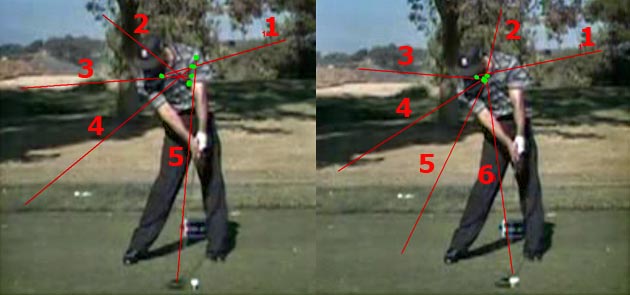
Here is an image showing the movement of Tiger Woods left shoulder socket and upper swing center during his downswing.
In image 1, the green dot shows the position of the left shoulder socket at different time-points during the downswing, while the red line is a straight line drawn from the left shoulder socket to the clubhead. One can see how the left shoulder socket moves in space during the evolution of the downswing.
In image 2, the green dot is drawn at the upper swing center (midway point between the two shoulder sockets as seen in a frontal-view). The red line is a straight line drawn between the clubhead and the upper swing center. One can see that the upper swing center stays very centralised during the downswing.
So, in conclusion (using my concept of an upper swing center), the left shoulder socket's sequential movement in space during the downswing has no relationship to the stable movement of the upper swing center (which remains very centralised during the downswing).
Issue 3:
You state that tangential acceleration and radial acceleration forces are applied to the clubhead via the hands. I don't understand this point at all. I can understand the concept of the terms "tangential/radial" as being applicable to the circular motion of the left arm around a "fixed" point (left shoulder socket). However, in a "real life" golf swing, the left shoulder socket is constantly moving in space during the downswing, and therefore the final speed/direction of movement of the hands during the downswing is the end-product of two interlinked movements - i) the speed of rotation of the left arm at the shoulder socket, and ii) the rate/direction of curvilinear movement of the left shoulder socket in space. The beauty of nm golfer's "release phenomenon" explanation is that he doesn't need to know what moves the hands. He simply states that movement of the hands has two components - i) a constantly-variable direction of movement; and ii) a constantly-variable speed of movement; and that these two variables produce angular acceleration of the clubshaft because the COG of the clubshaft is not in-line with the constantly-varibale directional movement of the hands. nm golfer doesn't have to use the terms "tangential" or "radial" in his explanation of the "release phenomenon", and his explanation makes sense whether the hands travel in a circular, or elliptical, or C-shaped/J-shaped curvilinear manner.






 Hybrid Mode

