drewitgolf,
Was an older version of kinetic linking not that it has change, this came from the god father of biomechanics, A biomedic engineer who help create the software for force data, motion data and EMG data, which T.P.I are using EMG data software , according to the creator , that their software is very debatable to how accurate their software is. To be put nicely, more was said : )
This guy founded golf biomechanics and put it the map.
But Sir Jeff still wants to debate this. Unqualified VS God Father?
Biomechanic - seeing that you are new to this forum, perhaps you should notify the forum members here that you work for a company that is competing with TPI. That will allow them to evaluate your comments with special care.
There are two approaches to this issue. The first issue is what represents the correct measurement data and the second issue relates to the issue of biomechanical plausibility.
I will first deal with the issue of the correct measurement of angular velocity.
The TPI researchers describe their methodology in this pdf paper and they contrast it with the technology used by Zenolink.
If one reads the paper, one can see that the TPI researchers use a totally different methodology of measuring angular velocity in the sense that they do not relate it to the PTS plane, which is apparently a requirement of Welch's zenolink technique. It would be interesting to see both measurement techniques used on the same golfer to see whether the graphs produced by the two different systems are radically different.
I find the Zenolink's results problematic for a number of reasons.
Here is a link to a golf instructor who is using the Zenolink system, and you can see the type of graph produced by Zenolink.
That graph is near-identical to the graph that was published in David Leadbetter's book on the "Fundamentals of Hogan" (which I posted). One can see that the pelvis rotates faster than the shoulders in the early downswing and that the shoulders eventually rotate about twice as fast as the hips, and the arms eventually rotate twice as fast as the shoulders. This result is very different to the TPI researchers' findings.
Why should there be a doubling of the maximum rotational speed as one proceeds from pelvis => shoulders => arms? I cannot think of a plausible biomechanical reason for this reputed-to-occur phenomenon. Can you?
Note that the text states-: "Once the hips segment reaches maximum speed, deceleration begins to occur. This “braking” action transfers speed to the shoulders segment, which accelerates to a maximum value usually twice that of the hips." The statement implies that the "braking" action of the hips transfers energy and therefore increases the speed of the rotating shoulders. Can anyone provide a rational biomechanical explanation for this amazing assertion that pelvic deceleration in the early-mid downswing will cause the upper torso to rotate faster?
Here is another link to a Zenolink-connected website.
Note that it has the following series of statements-: "A normal effective pattern would be one in which the hips segment accelerates first. The hips segment would accelerate to a peak speed at which time it would be rapidly decelerated from within the system. The shoulders segment would accelerate through the point of hips segment peak speed. Through conservation of momentum and the summation of speed the shoulders segment would reach a higher peak speed than that of the hips segment at which time it too would be decelerated."
What do you understand by this claim - "through conservation of momentum and the summation of speed the shoulder segment would reach a higher peak speed"? That statement would seem to imply that COAM is involved in energy transfer between the rotating pelvis and rotating shoulders. However, I cannot understand how COAM can be involved in a system that is actively producing more energy. The concept of COAM only applies to a system where the amount of energy inputted into the system is fixed and the entire system either slows down or speeds up dependent on the distance of the mass of the revolving object from its central axis.
Here is a nice U-tube demonstration of COAM.
Note that the experimenter spins the rotating object until it acquires a certain speed and the system is then left to spin at a certain speed. If the friction at the end points is small, then the rotational speed of the rotating structure will remain constant for a finite period of time. However, during that finite period of time, the rotational speed of the rotating object can be slowed if its shape changes so that it becomes wider (like an Olympic ice skater moving the arms away from her rotating core axis). The key issue is that the system has a "fixed" amount of energy and its rotational speed depends on its physical shape (like an iceskater who is spinning on the ice). COAM has nothing to do with the transfer of energy from one body part to another body part in the early-mid downswing. COAM may affect the speed of movement of the central arm in a double pendulum swing model during the release phase of the peripheral arm, because when the peripheral arm releases the radius of the double pendulum structure (central and peripheral arms) increases, and this must slow the speed of rotation of the central arm - presuming that no more energy is inputted into the double pendulum system after it is torqued by the central torque generator at the start of the pendular swing action. In that sense, one can understand how COAM may cause the arms to slow in the late downswing when the club passively releases (after all the power accumulators have released their energy). COAM cannot be operant in a hitter's action because the hitter is actively driving the clubshaft all the way into impact. The major point that I am making is that the principle of COAM surely cannot be relevant in the early-mid downswing when torso muscles are actively contracting thereby causing active rotation of the pelvis and shoulders, and I have no idea what the author means by the statement "through conservation of momentum and summation of speed".
The second issue relates to the rough accuracy of the TPI researchers' measurement of angular velocity and their general assertion that the shoulders rotate slightly faster than the hips in the early downswing.
I think that there is substantial evidence that this is true. Here are three confirmatory evidentiary sources.
Source 1.
Here is a table from a research study that measured the angular velocity of the pelvis and shoulders at different time points throughout the downswing.
One can readily see that the shoulders turn faster than the hips at the very start of the downswing and turn much faster than the pelvis at the end of the early downswing (lead arm parallel position) - and these results confirm the findings of the TPI researchers.
Source 2
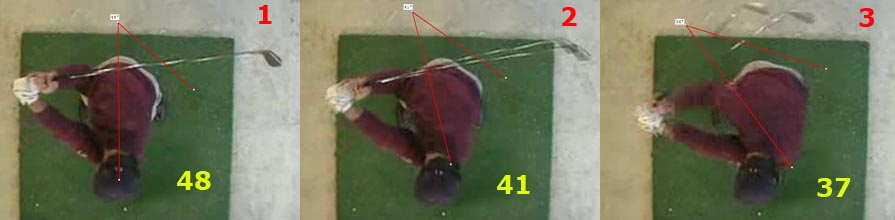
Here is a series of capture images from a birds-eye view swing video of a very good golfer and I measured his torso-pelvis separation angle throughout the early downswing.
Note that the torso-pelvic separation angle decreases from 48 degrees (at the end-backswing) to 37 degrees (at the end of the early downswing) and that is due to the fact that the shoulders are rotating faster than the pelvis throughout the early downswing - as predicted by the TPI graph and the other research study.
Source 3
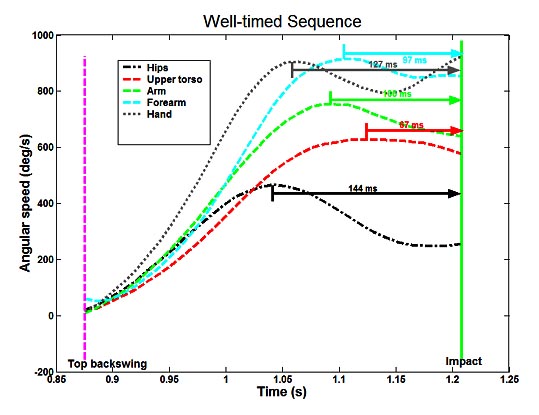
Here is another graph from an independent laboratory (Jim McLean' laboratory in Florida run by Rob Neal)
Note that this graph is much more similar to the TPI graph than the kinetic link graph - in the sense that the shoulders start rotating fast from the start of the downswing and travel at roughly the same speed as the pelvis (slightly slower in this measured sequence) while the kinetic link graph predicts that the shoulders don't turn at all in the early downswing.
Quote By Jeff "However, I cannot understand how COAM can be involved in a system that is actively producing more energy. The concept of COAM only applies to a system where the amount of energy inputted into the system is fixed and the entire system either slows down or speeds up dependent on the distance of the mass of the revolving object from its central axis."
Just a clarification- For anyone studying movement and getting the wrong impression of the above quote.
1) When you consider the concept of Conservation of Angular Momentum as the total angular momentum always staying the same in a closed system and therefore, if you move mass further from the center of rotation then there is a slowing of the rotational speed- then you might agree with Jeff's quote and say " That doesn't exist in a system where you ARE adding energy.
2) When you consider the aspect of Conservation of Angular Momentum - that in ANY rotating system - when you move mass further from the center of rotation- that has a slowing effect on the rotational speed- you'll see that the principle stands true whether you are in a closed system or system where you are adding energy. The only issue is - how much mass has moved, how much slowing is that creating and when, where and how is the added energy affecting the overall result. When you keep that perspective in mind - then Jeff's quote can be very mis-leading, confusing, etc.
In summary, your thoughts on this thread Jeff are definitely worthwhile areas to explore - I just thought I would attempt to clarify this one area that stood out for me. The principle of conservation of angular momentum exists in every rotating system.
__________________
Life Goal- Developing a new theory of movement based on Brain Science
Interests - Dabbling with insanity
Hobbies- Creating Quality
Biomechanic - seeing that you are new to this forum, perhaps you should notify the forum members here that you work for a company that is competing with TPI. That will allow them to evaluate your comments with special care.
I gather the man's credentials are being questioned by someone who has NO credentials ..I believe this man has spent years working with TPI KVest and Zenolink systems and is Qualified
There are two approaches to this issue. The first issue is what represents the correct measurement data and the second issue relates to the issue of biomechanical plausibility.
I will first deal with the issue of the correct measurement of angular velocity.
The TPI researchers describe their methodology in this pdf paper and they contrast it with the technology used by Zenolink.
If one reads the paper, one can see that the TPI researchers use a totally different methodology of measuring angular velocity in the sense that they do not relate it to the PTS plane, which is apparently a requirement of Welch's zenolink technique. It would be interesting to see both measurement techniques used on the same golfer to see whether the graphs produced by the two different systems are radically different.
So measuring from a vertical plane is superior. I did not read any Evidence ..all i read was TPI version of events
I find the Zenolink's results problematic for a number of reasons.
Here is a link to a golf instructor who is using the Zenolink system, and you can see the type of graph produced by Zenolink.
That graph is near-identical to the graph that was published in David Leadbetter's book on the "Fundamentals of Hogan" (which I posted). One can see that the pelvis rotates faster than the shoulders in the early downswing and that the shoulders eventually rotate about twice as fast as the hips, and the arms eventually rotate twice as fast as the shoulders. This result is very different to the TPI researchers' findings.
Why should there be a doubling of the maximum rotational speed as one proceeds from pelvis => shoulders => arms? I cannot think of a plausible biomechanical reason for this reputed-to-occur phenomenon. Can you?
Note that the text states-: "Once the hips segment reaches maximum speed, deceleration begins to occur. This “braking” action transfers speed to the shoulders segment, which accelerates to a maximum value usually twice that of the hips." The statement implies that the "braking" action of the hips transfers energy and therefore increases the speed of the rotating shoulders. Can anyone provide a rational biomechanical explanation for this amazing assertion that pelvic deceleration in the early-mid downswing will cause the upper torso to rotate faster?
It seems to me that this graph is showing up in waves so its a lot more complicated than this assessment
Here is another link to a Zenolink-connected website.
Note that it has the following series of statements-: "A normal effective pattern would be one in which the hips segment accelerates first. The hips segment would accelerate to a peak speed at which time it would be rapidly decelerated from within the system. The shoulders segment would accelerate through the point of hips segment peak speed. Through conservation of momentum and the summation of speed the shoulders segment would reach a higher peak speed than that of the hips segment at which time it too would be decelerated."
What do you understand by this claim - "through conservation of momentum and the summation of speed the shoulder segment would reach a higher peak speed"? That statement would seem to imply that COAM is involved in energy transfer between the rotating pelvis and rotating shoulders. However, I cannot understand how COAM can be involved in a system that is actively producing more energy. The concept of COAM only applies to a system where the amount of energy inputted into the system is fixed and the entire system either slows down or speeds up dependent on the distance of the mass of the revolving object from its central axis.
Here is a nice U-tube demonstration of COAM.
Note that the experimenter spins the rotating object until it acquires a certain speed and the system is then left to spin at a certain speed. If the friction at the end points is small, then the rotational speed of the rotating structure will remain constant for a finite period of time. However, during that finite period of time, the rotational speed of the rotating object can be slowed if its shape changes so that it becomes wider (like an Olympic ice skater moving the arms away from her rotating core axis). The key issue is that the system has a "fixed" amount of energy and its rotational speed depends on its physical shape (like an iceskater who is spinning on the ice). COAM has nothing to do with the transfer of energy from one body part to another body part in the early-mid downswing. COAM may affect the speed of movement of the central arm in a double pendulum swing model during the release phase of the peripheral arm, because when the peripheral arm releases the radius of the double pendulum structure (central and peripheral arms) increases, and this must slow the speed of rotation of the central arm - presuming that no more energy is inputted into the double pendulum system after it is torqued by the central torque generator at the start of the pendular swing action. In that sense, one can understand how COAM may cause the arms to slow in the late downswing when the club passively releases (after all the power accumulators have released their energy). COAM cannot be operant in a hitter's action because the hitter is actively driving the clubshaft all the way into impact. The major point that I am making is that the principle of COAM surely cannot be relevant in the early-mid downswing when torso muscles are actively contracting thereby causing active rotation of the pelvis and shoulders, and I have no idea what the author means by the statement "through conservation of momentum and summation of speed".
Well this should be left to Real Scientists but I can't imagine Biomedical Engineer Chris Welch using invalid methods
The second issue relates to the rough accuracy of the TPI researchers' measurement of angular velocity and their general assertion that the shoulders rotate slightly faster than the hips in the early downswing.
I think that there is substantial evidence that this is true. Here are three confirmatory evidentiary sources.
Source 1.
Here is a table from a research study that measured the angular velocity of the pelvis and shoulders at different time points throughout the downswing.
One can readily see that the shoulders turn faster than the hips at the very start of the downswing and turn much faster than the pelvis at the end of the early downswing (lead arm parallel position) - and these results confirm the findings of the TPI researchers.
Source 2
Here is a series of capture images from a birds-eye view swing video of a very good golfer and I measured his torso-pelvis separation angle throughout the early downswing.
Note that the torso-pelvic separation angle decreases from 48 degrees (at the end-backswing) to 37 degrees (at the end of the early downswing) and that is due to the fact that the shoulders are rotating faster than the pelvis throughout the early downswing - as predicted by the TPI graph and the other research study.
This player has very little Angular Action in his swing so whether its Optimal in terms of Biomechanical Effeciency is of course going to be a debate
Source 3
Here is another graph from an independent laboratory (Jim McLean' laboratory in Florida run by Rob Neal)
Note that this graph is much more similar to the TPI graph than the kinetic link graph - in the sense that the shoulders start rotating fast from the start of the downswing and travel at roughly the same speed as the pelvis (slightly slower in this measured sequence) while the kinetic link graph predicts that the shoulders don't turn at all in the early downswing.
Jeff.
I see evidence presented from a TPI perspective. Unfortunately i can't see Kinetic Link and Chris Welch giving away their information and how they measure the science behind it for Obvious reasons.
If you are really interested ..go and get yourself tested by both of them and compare what each are offering
Mike - I generally agree with your position that COAM could theoretically be acting on a rotating system while energy is still being inputted into the system - like that rotating structure in the U-tube demo. However, it would be very difficult to quantify the effect of COAM on the speed of rotation of the entire system while the person is actively spinning the rotating system. Secondly, the principle of COAM applies to the entire rotating unit (how its overall speed of rotation is affected by the distance its mass moves away from its central axis of rotation) and it has nothing to do with the transfer of energy from one moving body part to another body part. In the kinetic link theory expounded on the Xenolink website, there is an evidence-unsupported belief that energy is transferred from the pelvis => shoulders => arms via "a conservation of momentum" principle that involves a braking phenomenon whereby the slowing of rotation of one body part causes another body part to speed up. . Can you understand the physics/biomechanics that could underlie such a "belief". I can understand the kinetic link working in a snapping whip, whereby the sudden braking action of the rope handle of the whip transfers energy down the length of the whip to its peripheral end thereby causing the peripheral end to speed up. However, the whip is a totally inert physical structure that doesn't generate power within itself - it simply responds to the hand movement of the person wielding the whip. During a golf downswing, a golfer is actively contracting a multiplicity of muscles that cause the pelvis and shoulders to independently turn at a certain rotational speed. There is certainly an interaction between the rotating pelvis and the rotating upper torso - in the sense that the movement of the lower torso transmits physical forces to the upper torso via the spine and truncal musculature/ligaments. However, the golfer is also actively rotating the upper torso during the downswing and it would require some very sophisticated experimental testing (using muscle probes in a variety of truncal muscles) to determine how much of the upper torso's rotational speed is due to active torso muscle contracting versus passive physical forces transmitted from the rotating lower torso. I have never heard of any researcher performing that type of experimental testing. Have you?
Regarding your concept of the TGM pivot-stroke swing - do you think that the pelvis/shoulders/arms are rotating at roughly the same speed in the early downswing - before the lead arm reaches the parallel-to-the-ground position; or do you believe in the kinetic link theory where there is a time-sequential transfer of energy that causes the pelvis to move first, the shoulders second, and the arms third with each sequentially moving part maximally rotating at exactly twice the speed of the preceding moving part?
I think that the critical issue is not Welch's proprietary software program that measures the angular velocity of different body parts during the downswing. I think that the critical issue is the underlying physics/biomechanical principles that underlie Welch's thinking when he eventually interprets his measured results. That's what bothers me! It is his underlying ideas regarding "conservation of momentum and summation of speed" due to a braking phenomena that bother me, and his consequent idea that each rotating body part must get sequentially accelerated to exactly twice the speed of its preceding rotating body part via this braking phenomenon.
I think that the critical issue is not Welch's proprietary software program that measures the angular velocity of different body parts during the downswing. I think that the critical issue is the underlying physics/biomechanical principles that underlie Welch's thinking when he eventually interprets his measured results. That's what bothers me! It is his underlying ideas regarding "conservation of momentum and summation of speed" due to a braking phenomena that bother me, and his consequent idea that each rotating body part must get sequentially accelerated to exactly twice the speed of its preceding rotating body part via this braking phenomenon.
Jeff.
I see your arguement Jeff but like I said ..the best bet is to go and check him and his system out and get the information ..then make a "scientific review" of his concepts rather than present a TPI view of possible weaknesses in his system
Regarding your concept of the TGM pivot-stroke swing - do you think that the pelvis/shoulders/arms are rotating at roughly the same speed in the early downswing - before the lead arm reaches the parallel-to-the-ground position; or do you believe in the kinetic link theory where there is a time-sequential transfer of energy that causes the pelvis to move first, the shoulders second, and the arms third with each sequentially moving part maximally rotating at exactly twice the speed of the preceding moving part?
Jeff.[/quote]
The problem i see here is it depends on the definition of when a backswing has finished and a downstroke has started ..Kinetic Link may have a different view on this opposed to TPI..and which player is tested.
For instance ..the hips can have a running start on the shoulders due to the pressure being moved to the reAR foot and the center of mass being in front of the pressure being shifted to the rear foot and this can occur in the backswing..so the shoulders have some catching up and then of course so do the arms due to how Far they have to travel
Pistol - you wrote-: "The problem i see here is it depends on the definition of when a backswing has finished and a downstroke has started ..Kinetic Link may have a different view on this opposed to TPI..and which player is tested."
Your belief about different definitions of the end-backswing may be true, and that's why I believe in standardised definitions. Cheetham, of TPI, has recently accepted what I regard as the only scientifically-supportable definition for the end of the backswing - when the club changes direction. All the latest TPI graphs now use that strict definition for the top/end of the backswing - rather than vague criteria eg. when the shoulders stop turning or when the pelvis reverses direction and starts to move forward (a phenomenon which actually may occur during the backswing in many good golfers).




 Linear Mode


