Yoda - very good point about Hogan. That demonstrates my foolishness and yet again demonstrates to me that I should never make strict rules that are not 100% biomechanically solid. Hogan slides his pelvis quite a lot left-laterally in my photo series and that moves his torso/head slightly leftwards. That's obviously not a problem for the golfer who is without doubt one of the greatest ball strikers in the history of golf.
It is interesting that VJ Trolio shows in his book that Hogan didn't have that much slide later in his career. In fact, he states that Hogan didn't have any slide during the downswing because he moved his pelvis left-laterally in the backswing. I am still conflicted by this issue and I wonder if there was a major change in his pelvic movements later in his life, or whether we are having a problem with camera angle distortion issues.
I think that BM and BR are performing the same pelvic rotational movement from a biomechanical perspective, except that BM is deliberately allowing his head and upper torso to rotate as far as possible to the right (head is outside his inner right foot) to exaggerate the drill effect and to get that clubshaft perpendicular to the ball-target line. By contrast, BR is probably attempting to keep his head more stationary and within the boundaries of his stance.
Jeff.
I'm confused Jeff . . . could we clear up exactly where we stand here . . . are we moving our head or not? We have one post where we've got people moving their head to their right foot . . . then we have posts where we should leave the head where it is . ..
I'm lost . . . what was the point of the deal with the head moving over the right foot? What exactly is the biomechanic "optimum" . . . and "optimum" to what end?
I think I got lost in all the spine talk as to what the point of this is . . . would you mind restating your position? Sorry to be such a doofus.
I'm confused Jeff . . . could we clear up exactly where we stand here . . . are we moving our head or not? We have one post where we've got people moving their head to their right foot . . . then we have posts where we should leave the head where it is . ..
I'm lost . . . what was the point of the deal with the head moving over the right foot? What exactly is the biomechanic "optimum" . . . and "optimum" to what end?
I think I got lost in all the spine talk as to what the point of this is . . . would you mind restating your position? Sorry to be such a doofus.
. . . BM is deliberately allowing his head and upper torso to rotate as far as possible to the right (head is outside his inner right foot) . . .
This is called a "Sway", Jeff.
A Sway.
It robs the Pivot Motion of its Center; disrupts the ideal Centered Arc of the Clubhead; and deserves well its exalted status as the 4th Snare (3-F-7-D). Absent its necessary Center, the Pivot fails to maintain its essential geometric alignments and is thus "only superficially correct" (7-12).
Hang in there, Kevin. You're on the right track. Study 1-L #1 and #2. Be extremely skeptical of novel ideas -- from whatever pulpit preached -- that don't square with these axioms.
Hang in there, Kevin. You're on the right track. Study 1-L #1 and #2. Be extremely skeptical of novel ideas -- from whatever pulpit preached -- that don't square with these axioms.
1-L #1 and #2 WOW, talk about back to square one. The BM drill is about as far away from that tenant as you can get!
I'm here to learn some TGM structure. Thanks Yoda for keeping us on the proper path!
Kevin
__________________
I could be wrong. I have been before, and will be again.
You wrote-: "Not sure how that drill encourages the base of the neck to be still but whatever . . . ."
I don't think that you understand why he proposes that drill.
I think that many beginner golfers tend to reverse pivot. One cause is a tendency to "fixedly" keep the head still while swaying the pelvis right-laterally (as demonstrated by Brady Riggs). That causes the upper torso to sway to the left in order to keep in balance. All these lower and upper torso motions are lateral swaying motions without any rotary component.
What both BM and BR are saying is that one needs to rotate the pelvis during the backswing. I believe that the natural result will be the production of a reverse K position - as previously described. Therefore, a golfer must have the distinct feeling that his upper torso is slanted to the right. BM was presumably promoting that exaggerated drill so that a beginner golfer would get the "feel" of how the upper torso slant-rotates to the right when the pelvis rotates 45 degrees back. That doesn't mean that a golfer should have that amount of right slant-rotation of the upper torso in his "real swing". I think that it is better to minimise the slant-rotation of the upper torso so that it doesn't move the head back more than 1-3". I believe that any unnecessary movement of the head or upper swing center is a disadvantage because it means that the golfer has to move back again in the downswing.
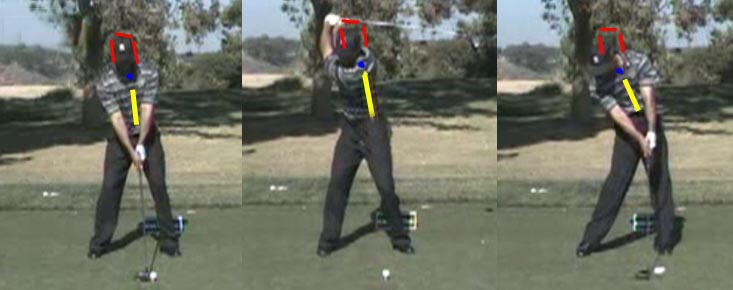
It is possible to keep the head back and not move it forward to where it was at address and still hit the ball well. Tiger Woods does that - see next image.
Note that his head moved down-and-back in the downswing. I think that it doesn't affect his swing because his upper swing center (blue dot) remains in the "correct" position.
I am not at all promoting any unnecessary movement of the head. My favorite swings are of golfers who keep their head stationary despite acquiring a reverse-K position at the end of the backswing.
The first video shows that he gets a lot of rightwards slant-rotation of his upper torso by the end of the backswing. Also, one can learn a lot about spine movements by watching that second view. Note how his mid-upper thoracic spine gets torqued by his large shoulder turn and how its verticalizes his mid-upper thoracic spine, and therefore allows him to keep his head stationary. That is optimum from my perspective. He doesn't allow his head to move as far rightwards as BM.
You wrote-: "Not sure how that drill encourages the base of the neck to be still but whatever . . . ."
I don't think that you understand why he proposes that drill.
I think that many beginner golfers tend to reverse pivot. One cause is a tendency to "fixedly" keep the head still while swaying the pelvis right-laterally (as demonstrated by Brady Riggs). That causes the upper torso to sway to the left in order to keep in balance. All these lower and upper torso motions are lateral swaying motions without any rotary component.
What both BM and BR are saying is that one needs to rotate the pelvis during the backswing. I believe that the natural result will be the production of a reverse K position - as previously described. Therefore, a golfer must have the distinct feeling that his upper torso is slanted to the right. BM was presumably promoting that exaggerated drill so that a beginner golfer would get the "feel" of how the upper torso slant-rotates to the right when the pelvis rotates 45 degrees back. That doesn't mean that a golfer should have that amount of right slant-rotation of the upper torso in his "real swing". I think that it is better to minimise the slant-rotation of the upper torso so that it doesn't move the head back more than 1-3". I believe that any unnecessary movement of the head or upper swing center is a disadvantage because it means that the golfer has to move back again in the downswing.
It is possible to keep the head back and not move it forward to where it was at address and still hit the ball well. Tiger Woods does that - see next image.
Note that his head moved down-and-back in the downswing. I think that it doesn't affect his swing because his upper swing center (blue dot) remains in the "correct" position.
I am not at all promoting any unnecessary movement of the head. My favorite swings are of golfers who keep their head stationary despite acquiring a reverse-K position at the end of the backswing.
The first video shows that he gets a lot of rightwards slant-rotation of his upper torso by the end of the backswing. Also, one can learn a lot about spine movements by watching that second view. Note how his mid-upper thoracic spine gets torqued by his large shoulder turn and how its verticalizes his mid-upper thoracic spine, and therefore allows him to keep his head stationary. That is optimum from my perspective. He doesn't allow his head to move as far rightwards as BM.
Jeff.
What is a "reverse pivot"? I'd like to define terms please . . .
How would you teach those reverse pivoting beginners to hit a draw?
Most folks see movements of the whole spine differently or similarly depending on what it is that they agree upon to see. There are three academically agreed upon sections of the spine that can manoeuver independently from each other or in concert with each other. If any or all of these sections pivot from a starting condition then there can be no sway (or bob). Each section can likewise sidebend, flex, or extend in concert or independently. The lumbar joints are typically less flexible and offer less range of motion than the thoracic joints, and thoracics likewise are less flexible and mobile compared to cervicals. Things get mighty complicated when the three sections are connected and thereby influenced by movements of scapulas, shoulders with humeral heads, pelvises with femoral heads, etc.
Regardless of the inherent complexity of observed spinal movements, if any section of the spine pivots from an original vertical, sidebent, flexed, or extended condition, then that section will retain its original condition. Otherwise the section or sections in question did not pivot. Most golfers start with a bit of sidebend away from the target with all three sections of the spine. If they truly pivot then the original sidebends are retained.
Perhaps "pivot" needs to be redefined for golf swing observations and resultant commentary. Perhaps golf swing observations and commentary concerning pivots are intrinsically too difficult for the human eye to accurately perceive because in the pivoting of any object with girth, the frontal view of a point on that object will move in the opposite direction of a point 180 degrees away on the backside of the same pivoting object.
If all agree that any segment of the spine is tilted or sidebent away from the target at address then all must agree that that segment will remain in that tilt or sidebend if it truly pivots thereafter, even though it may not look like it is truly pivoting from a different point of view. Otherwise we need to call segmental movements of the spine during the golfswing something else as we tend to do when we observe that at least a portion of the spine sidebends a bit more away from the target(secondary axis tilt) to facilitate a good downswing.
By the way, I'm probably like most experienced video teaching pros in that I have never witnessed what I could honestly diagnose as a pure backswing or downswing pivoting of the segments of a given spine in any given swing I have ever analyzed.
I think that BM was using that drill to teach golfers not to sway the pelvis laterally, but to rotate the pelvis.
Brady Riggs is teaching the same basic principle is this swing video lesson.
Jeff.
Jeff,
In your posted video, the excellent instructor Brady Riggs is advising (and executing) a pure, gyroscopic Pivot Motion. He is teaching golfers to rotate in a centered fashion -- "create space" -- and that instruction is correct. To even imply that what he is doing in any way represents the BM "Guardsman Head Sway" drill you posted above -- and are now defending in arrears as a "pelvis rotation" drill -- is an abomination to the sensibilities of intelligent golfers everywhere.
We encourage debate on the fine points, Jeff, and we welcome your contributions. We also can handle being patronized (as long as we feel we are being educated). But, don't continue to insult us with obvious contradicitons.
That tactic does nothing to further the objectives of this fraternity and destroys your own credibility within it.




 Hybrid Mode

