Pivot center
Golf By Jeff M
|

12-19-2008, 02:39 AM
|
|
Senior Member
|
|
Join Date: Feb 2007
Posts: 701
|
|
Yoda - you wrote-:
"As I've already explained twice in this thread, the Clubshaft is responding to the Sweetspot's Centrifugal Line of Pull. It is NOT creating it (as you continue to insist). In fact, this 'bass-ackwards' thinking is your fundamental error.
The Sweetspot is orbiting, and in so doing, is creating a Centrifugal Force (Clubhead Inertia resisting a change in its direction). The Clubshaft is supplying the Centripetal Force that enables that orbit."
I appreciate your input, but I have a different explanation for observed events.
I agree that the clubshaft is not creating the centrifugal line of pull. (The clubshaft is creating another force - which I will explain later).
I think that you are wrong to state the clubshaft is supplying the centripetal force. The CP force is created by the hands holding the clubshaft, and the clubshaft is simply the connecting structure between the clubhead and the hands.
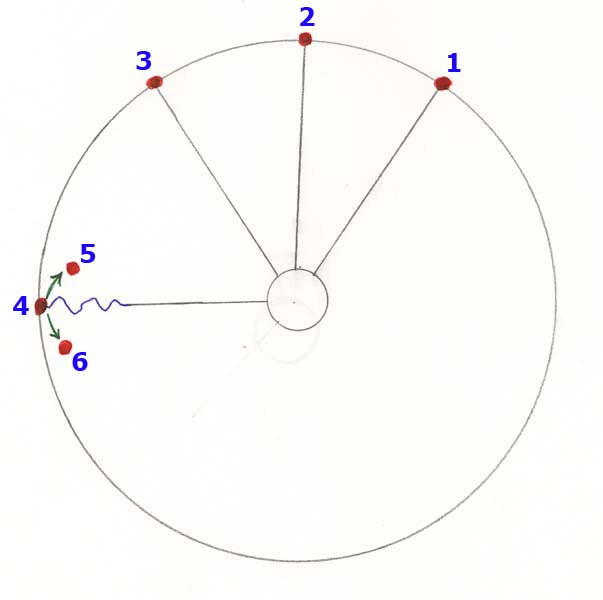
Here is my explanation. I created this model.
Imagine that a person is twirling a ball (attached to a piece of string) around his head. Imagine that he grasps the string between his right index finger and his thumb in a pincer grip and imagine that he holds his right hand vertically above his head and moves his right hand in a constant small circular motion. That circular motion is represented by the small inner circle.
Imagine that the string length is 18" and the red ball is attached to the end of the string.
The ball will travel in a constant circular path (represented by positions 1 and 2 and 3). The CP pull is exerted by the hands and the pull is along the length of the string and the CP force is at right angles to the ball position (right angles to a tangent at the circumference) at any point in time. The ball wants to travel in a straight line (at a 90 degree tangent to the circumference of the circle) at every moment in time, but it is prevented from that action by the CP force that is directed towards the center of the circle. The string transmits the CP pulling force from the ball to the hands (inwards pull towards the center). The string doesn't create the CP force. The ball travels in a perfect circular motion because the CP force (directed inwards towards the center via the string) balances the CF force (hypothetical outward -directed force).
Now consider placing a 6" long rigid structural object (that could be made of metal or rigid plastic) between the ball and the hands. The string length would now be reduced to 12" and it would be attached to the central end of that 6" structure which has a snake-like shape. The presence of that rigid structure, and its snake-like shape, would have no effect on the ball's path in space. The ball would continue to travel in a circle (position 4) and its motion would only be dictated by the CP force exerted by the right hand's circular twirling motion. The 6" structural unit would have no effect on the ball's path of motion - despite its snake-like shape.
Now consider what one would have to infer if the ball suddenly appeared at position 5 or 6 - where the ball is no longer on its circular path. One would have to infer that another force is at play that affected the ball's "expected" position.
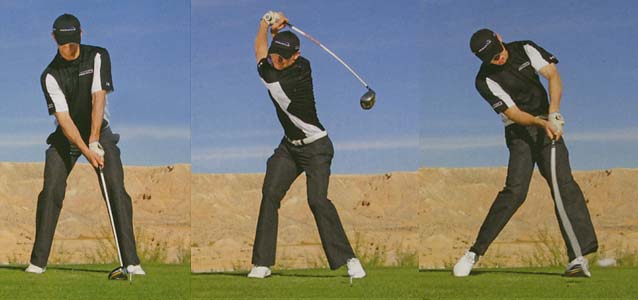
That is what I believe is happening in those photographs. I believe that there is a CP force exerted by the hands on the grip end of the club. However, I believe that there is another force (derived from the flexible clubshaft's elastic properties) that kicks the clubhead off its CP-induced orbit. In other words, when I look at Jamie Sadlowski's clubhead post-impact in this next photograph - I believe that the clubshaft's flexibility (elastic properties) is causing a displacement of the clubhead off its "expected' orbit ("expected" in the sense of the clubhead only being propelled by the CP force passing through the clubshaft from the hands-to-the-clubhead).
If the clubhead was in that position only due to the CP force, then a straight line drawn between the hands and the sweetspot should be perpendicular to a tangent line drawn at the clubhead's position on its circular orbit. However, that straight line is not perpendicular to the clubhead's circular orbit in space. I think that the clubhead is equivalent to being at position 6 in my orbiting ball-on-a-string model.
Jeff.
Last edited by Jeff : 12-19-2008 at 02:44 AM.
|
|

12-19-2008, 02:42 AM
|
|
Senior Member
|
|
Join Date: Feb 2007
Posts: 701
|
|
|
KOC
That clubhaft-shape should not affect one's ability to execute a perfect shot - if the shaft doesn't provide an additional force that interferes with the CP-CF force relationship between the hands and the clubhead.
Jeff.
|
|

12-19-2008, 02:47 AM
|
 |
Administrator
|
|
Join Date: Jan 2005
Location: Atlanta, Georgia
Posts: 10,681
|
|
|
Gravity and Satellites
Originally Posted by Jeff
|
I think that you are wrong to state the clubshaft is supplying the centripetal force. The CP force is created by the hands holding the clubshaft . . .
|
Oh, please, Jeff.
Try swinging the Clubhead without the "connecting" Clubshaft. Let's see what kind of orbit you can create.

__________________
Yoda
|
|

12-19-2008, 06:09 PM
|
 |
Administrator
|
|
Join Date: Jan 2005
Location: Atlanta, Georgia
Posts: 10,681
|
|
|
Dating Game
Originally Posted by Jeff
|
Yoda - you wrote-:
"As I've already explained twice in this thread, the Clubshaft is responding to the Sweetspot's Centrifugal Line of Pull. It is NOT creating it (as you continue to insist). In fact, this 'bass-ackwards' thinking is your fundamental error.
The Sweetspot is orbiting, and in so doing, is creating a Centrifugal Force (Clubhead Inertia resisting a change in its direction). The Clubshaft is supplying the Centripetal Force that enables that orbit."
I appreciate your input, but I have a different explanation for observed events.
I agree that the clubshaft is not creating the centrifugal line of pull. (The clubshaft is creating another force - which I will explain later).
I think that you are wrong to state the clubshaft is supplying the centripetal force. The CP force is created by the hands holding the clubshaft, and the clubshaft is simply the connecting structure between the clubhead and the hands.
Here is my explanation. I created this model.
Imagine that a person is twirling a ball (attached to a piece of string) around his head. Imagine that he grasps the string between his right index finger and his thumb in a pincer grip and imagine that he holds his right hand vertically above his head and moves his right hand in a constant small circular motion. That circular motion is represented by the small inner circle.
Imagine that the string length is 18" and the red ball is attached to the end of the string.
The ball will travel in a constant circular path (represented by positions 1 and 2 and 3). The CP pull is exerted by the hands and the pull is along the length of the string and the CP force is at right angles to the ball position (right angles to a tangent at the circumference) at any point in time. The ball wants to travel in a straight line (at a 90 degree tangent to the circumference of the circle) at every moment in time, but it is prevented from that action by the CP force that is directed towards the center of the circle. The string transmits the CP pulling force from the ball to the hands (inwards pull towards the center). The string doesn't create the CP force. The ball travels in a perfect circular motion because the CP force (directed inwards towards the center via the string) balances the CF force (hypothetical outward -directed force).
[Bold emphasis by Yoda.]
|
Jeff,
You have made two statements that are in direct conflict:
Behind Door #1:
"The CP pull is exerted by the hands and the pull is along the length of the string . . . " Behind Door #2:
"The string transmits the CP pulling force from the ball to the hands (inwards pull towards the center)." So which is it, Jeff?
Does the hand -- it really should be singular as defined by your model -- create the CP pull (hand to ball) or does the ball create it (ball to hand).
Hint:
We need a third door.
We are concerned here with a mass orbiting about an axis of rotation and exhibiting both a centripetal force (a force 'seeking the center' and whose origin we are now debating) and a centrifugal force (a force 'fleeing the center' and that is reactive to the centripetal force). An orbiting mass constantly accelerates towards its axis of rotation. This centripetal acceleration demands an equal and opposite force that opposes the centripetal force and creates an outward centrifugal reaction directed away from the axis.
In your model, the ball is the orbiting mass and the hand is the axis of rotation. The hand is not the centripetal force (as you incorrectly state). It is, after all, the axis! Instead, the centripetal force (acceleration) is exerted on the ball by another object (in your model, the string). Then, the centrifugal reaction is exerted by the ball on the object that originated the centripetal acceleration ( the string).
The string, Jeff.
The string.

__________________
Yoda
|
|

12-19-2008, 07:31 PM
|
|
Senior Member
|
|
Join Date: Feb 2007
Posts: 701
|
|
Yoda - I think that this debate is getting unnecessarily complicated and unproductive.
I think of it this way.
The orbiting ball receives all its energy via the string. The source of the energy is the hand moving in a circular manner. The energy travels outwards from the hand to the orbiting ball- along the string. That energy is required to perform two roles - i) keep the ball moving at a constant speed and ii) keep the ball moving in a circle at its constant surface speed.
When a orbiting object travels at a constant speed it may not need much energy to keep it moving at a constant speed (if there is little frictional resistance to its movement in space), but it requires constant energy input to constantly change direction (in order to move in a circular path). In other words, although the orbiting ball is traveling at a constant surface speed, it needs a constant source of energy to centripetally accelerate (accelerate towards its center of rotation). That energy comes from the hands and it is transmitted via the connecting string.
If you understand that viewpoint - then door 1 is correct.
Door 1
Behind Door #1:
"The CP pull is exerted by the hands and the pull is along the length of the string . . . "".
However, one can look at this orbiting ball scenario from a different perspective, and look at the scenario from the orbiting ball's perspective. Then door 2 applies.
Door 2
Behind Door #2:
"The string transmits the CP pulling force from the ball to the hands (inwards pull towards the center)."
The ball experiences a centripetal force that pulls it towards its center of rotation. The pull is in the direction of centripetal acceleration. The ball doesn't know where the CP force is coming from - it only knows that it is being pulled by the string, and it happily thinks that the string is providing a CP force that keeps it a state of constant centripetal acceleration.
However, ultimately the centripetal force that keeps the orbiting ball traveling in a circle is derived from the orbiting hand's movement in space, and the energy must travel from the hands to the ball - travels outwards along the string. Some of that energy makes the ball move, and some of that energy supplies a centripetal force that conceptually travels back down the string and keeps the orbiting ball from flying into space. I find it meaningless to think of the string providing that CP force - because the string doesn't really create energy. It only allows part of the energy created by the orbiting hands to be translated into a CP force that pulls the orbiting ball towards the center.
I actually try to avoid using the terms "centripetal" and "centrifugal" in my thinking about the golf swing. It gets way too semantic and too complicated. The idea of a centrifugal force is merely a conceptual idea used to see the CP force as being balanced by an equal and opposite force. Many people state that it not really a force - because it cannot exist alone. I am sympathetic to the idea that it is not useful to conjure up the idea of a CF working in the opposite direction to a CP force.
I much prefer to think in terms of vectors of movement and force, and not use the terms CP force or CF force if I can avoid the terms. That's why I like nmgolfers explanation of the release phenomenon.
See - http://perfectgolfswingreview.net/Ne...%20Science.htm
When I think of the golf swing, I never think of a rotational center. I simply see different body parts moving in 3-D space, and I simply think of the forces that move those body parts and their vector of movement. I think the same way with respect to the golf club. The golf club is only moved by pull-forces or push-forces exerted at grip level.
Jeff.
|
|

12-19-2008, 08:20 PM
|
|
Senior Member
|
|
Join Date: Feb 2007
Posts: 701
|
|
|
Here is another perspective on the orbiting ball situation.
I prefer not to even think of CP forces and/or CF forces.
I simply know that the hand moves in a small circle, and that the orbiting ball rotates in a larger circle, and that they rotate at the same rpm. I know that they are connected together by a piece of string. I know that the energy source is the hands (rotating in space). In that sense, the hands are pulling the ball via the string. I know that the orbiting ball follows a circular path because the hands follow a circular path, and that the string will remain taut if the hands move smoothly and at an even pace. I know that the whole system breaks down if the hands suddenly accelerate, or suddenly decelerate, or if the hands move in a straight line.
I don't need to invoke concepts of CP force or CF force to understand what is happening in this orbiting ball situation.
The same applies to the pivot. I don't need to think of a pivot center or a pivot axis. I simply think of how the body moves in 3-D space.
Jeff.
|
|

12-19-2008, 08:58 PM
|
 |
Administrator
|
|
Join Date: Jan 2005
Location: Atlanta, Georgia
Posts: 10,681
|
|
|
A Whole New World . . . A Whole New Different Point Of View!
Originally Posted by Jeff
|
Yoda - I think that this debate is getting unnecessarily complicated and unproductive.
|
Jeff . . . this praise . . . coming from you . . . I'm not worthy.  But thanks anyway . . . you've made my day!
Originally Posted by Jeff
|
I think of it this way.
The orbiting ball receives all its energy via the string. The source of the energy is the hand moving in a circular manner. The energy travels outwards from the hand to the orbiting ball- along the string. That energy is required to perform two roles - i) keep the ball moving at a constant speed and ii) keep the ball moving in a circle at its constant surface speed.
When a orbiting object travels at a constant speed it may not need much energy to keep it moving at a constant speed (if there is little frictional resistance to its movement in space), but it requires constant energy input to constantly change direction (in order to move in a circular path). In other words, although the orbiting ball is traveling at a constant surface speed, it needs a constant source of energy to centripetally accelerate (accelerate towards its center of rotation). That energy comes from the hands and it is transmitted via the connecting string.
If you understand that viewpoint - then door 1 is correct.
Door 1
Behind Door #1:
"The CP pull is exerted by the hands and the pull is along the length of the string . . . "".
|
Buzzer Sound: EEEEEEEEEEEEEEEEEEEENNNNNNNNNNNNNNNHHHHH!!!!
Sorry, Jeff.  Door #1 is not the correct answer. It never has been the correct answer, and it never will be the correct answer, despite your heroic attempts to obsolete every physics text ever written. Simply put, the axis of rotation is not the centripetal force. Try again . . .
|
Originally Posted by Jeff
|
However, one can look at this orbiting ball scenario from a different perspective, and look at the scenario from the orbiting ball's perspective. Then door 2 applies.
Door 2
Behind Door #2:
"The string transmits the CP pulling force from the ball to the hands (inwards pull towards the center)."
The ball experiences a centripetal force that pulls it towards its center of rotation. The pull is in the direction of centripetal acceleration. The ball doesn't know where the CP force is coming from - it only knows that it is being pulled by the string, and it happily thinks that the string is providing a CP force that keeps it a state of constant centripetal acceleration.
However, ultimately the centripetal force that keeps the orbiting ball traveling in a circle is derived from the orbiting hand's movement in space, and the energy must travel from the hands to the ball - travels outwards along the string. Some of that energy makes the ball move, and some of that energy supplies a centripetal force that conceptually travels back down the string and keeps the orbiting ball from flying into space. I find it meaningless to think of the string providing that CP force - because the string doesn't really create energy. It only allows part of the energy created by the orbiting hands to be translated into a CP force that pulls the orbiting ball towards the center.
|
Buzzer Sound: EEEEEEEEEEEEEEEEEEEENNNNNNNNNNNNNNNHHHHH!!!!
Sorry, Jeff.  Door #2 is not the correct answer. The string doesn't transmit the centripetal force -- as you continue to maintain and would have us believe -- the string is the force! Try again . . .
|
Originally Posted by Jeff
|
I actually try to avoid using the terms "centripetal" and "centrifugal" in my thinking about the golf swing. It gets way too semantic and too complicated. The idea of a centrifugal force is merely a conceptual idea used to see the CP force as being balanced by an equal and opposite force. Many people state that it not really a force - because it cannot exist alone. I am sympathetic to the idea that it is not useful to conjure up the idea of a CF working in the opposite direction to a CP force.
I much prefer to think in terms of vectors of movement and force, and not use the terms CP force or CF force if I can avoid the terms. That's why I like nmgolfers explanation of the release phenomenon.
See - http://perfectgolfswingreview.net/Ne...%20Science.htm
|
Buzzer Sound: EEEEEEEEEEEEEEEEEEEENNNNNNNNNNNNNNNHHHHH!!!!
Sorry, Jeff.  Attempting to divert the argument is poor tactics and just plain bad manners. Besides, the usual smoke and mirrors won't work here. Try again . . .
|
Originally Posted by jeff
|
When I think of the golf swing, I never think of a rotational center.
|
Bad idea.
|
Originally Posted by Jeff
|
I simply see different body parts moving in 3-D space, and I simply think of the forces that move those body parts and their vector of movement. I think the same way with respect to the golf club. The golf club is only moved by pull-forces or push-forces exerted at grip level.
|
Yes, I can see how such a simple approach might work.  After all, this whole centripetal-centrifugal thing is way too complicated. Especially when we're confronted with the truths taught in Physics 101. Best that we redefine the way the world works, right Jeff?

__________________
Yoda
|
|

12-20-2008, 03:57 PM
|
|
Senior Member
|
|
Join Date: Feb 2007
Posts: 701
|
|
mb6606
You sent me a link to this video of Jason Zuback's swing which has a number of slow mo sections.
I made the following series of images of his downswing
First of all, regarding the clubshaft. I see this problem of double images frequently - even when examining slow mo videos. This makes it difficult to know what is real versus camera distortion. Image 4 shows two images - one of the images has forwards shaft lean. Image 5 shows double images at impact with the shaft bent back in the one image, which would be expected post-impact.
I therefore do not know whether Jamie Sadlowski's forwardly bent shaft post-impact is "real" (possibly due to using a more flexible shaft) or due to camera distortion.
Secondly, look at Jason's swing. He has a centralised pivot action, and he reverse pivots slightly with a large hip turn (like Sam Snead) by the end-backswing - image 1. Note how he then has to reverse his spine tilt in the downswing so that he acquires a rightwards tilt-secondary axis tilt in the early downswing - image 3. I don't think that it is a biomechnaically efficient action. Note how he loses his clubhead lag angle - image 3. I think that it is due to the fact that he has to throw his upper torso and therefore arms backwards (away from the target) at the start of the downswing to reverse the spine tilt. The reversal of hand movement (going backwards away from the target) predisposes to an early release.
Here is another example of that phenomenon in an excellent golfer.
In the first swing, he reverse pivots slightly. Note his loss of clubhead lag angle. In his second swing I think he has a better pivot action with a reverse-K look, and a much better retention of his clubhead lag angle in the early downswing.
That's why I prefer Jamie's swing over Jason's swing. Jamie has a traditional swing with a reverse-K look at the end of his backswing, and he retains his clubhead lag angle well into the downswing.
Jeff.
Last edited by Jeff : 12-20-2008 at 04:01 PM.
|
|

12-20-2008, 04:35 PM
|
|
Senior Member
|
|
Join Date: Feb 2007
Posts: 701
|
|
|
Yoda - I have been deciding whether to respond to your last post. Your tone is demeaning and ill-conducive to an ongoing debate. Why can't you simply state your disagreements without pontificatiing, and implying that you are the final arbiter of the "truth"?
I don't think that you understand my perspective.
I will rephrase it.
The hand's movement is the source of energy that gets the ball to move in space. The string transmits that energy to the ball by means of a continuously taut string - any hand movement in a circular manner causes the ball to move in a circular manner (at the same rpm but along a wider circle of greater radius). The energy imparted to the ball gets the ball to perform two actions - i) acquire a surface speed of a finite value; and ii) centripetally accelerate - which merely represents a constant change in direction so that the ball follows a circular path.
The string is continously taut. That is necessary to counteract the tendency of the ball to fly away (due to centrifugal forces). Therefore, you are correct to state that the taut string represents the centripetal pull towards the center to counteract the tendency of the ball to fly away in a straight line direction at a tangent to the circle. However, the centripetal pull is not created by the string - the string is merely reactive to the dynamic situation of an orbiting ball that has acquired enough energy to fly away unless the string remains taut and provides a centripetal pull towards the center.
My personal perspective is focused on the following facts.
1) The source of energy for the orbiting ball is the continuous movement of the hand in a circular motion.
2) The hand constantly pulls the orbiting ball via a taut string - so that the orbiting ball revolves at the same rpm as the hand.
3) The ball acquires motional energy from the hand via the taut string, and this energy includes a centrifugal tendency which requires an equal counteracting centripetal pull by the taut string to ensure that the orbiting ball moves in a circular orbit.
4) It is true that the taut string is a constant reflection of the centripetal pull towards the center. However, the string doesn't independently create that centripetal force. The centripetal force only becomes necessarily operant because the ball has acquired motional energy from the motion of the hand that would cause it to fly off into space unless there was a centripetal pull from the taut string to counteract/equalize that centrifugal tendency.
Jeff.
Last edited by Jeff : 12-20-2008 at 04:38 PM.
|
|

12-20-2008, 05:20 PM
|
 |
Administrator
|
|
Join Date: Jan 2005
Location: Atlanta, Georgia
Posts: 10,681
|
|
|
Tough Love
Originally Posted by Jeff
|
Yoda - I have been deciding whether to respond to your last post. Your tone is demeaning and ill-conducive to an ongoing debate. Why can't you simply state your disagreements without pontificatiing, and implying that you are the final arbiter of the "truth"?
I don't think that you understand my perspective.
|
Yes, Jeff, I suppose my post was a bit much. But, you know what? For some reason, you inspire that in me!
Oh, and I completely understand your perspective on centripetal force, both from the 'hand's' point of view (Door #1) and the 'ball's' point of view (Door #2). Goodness knows you've spent enough time educating me. And your writings do indicate that you understand the essence of the forces involved. Yet, you then totally deep-end and restate to your own end basic laws of physics that have been accepted since the time Isaac Newton wrote his Philosophić Naturalis Principia Mathematica (1687). You put up a lot of good stuff, Jeff, but man, you make it difficult to sit idly by as you reinvent concepts that have served mankind well for centuries.
To me, that's arrogance.
And when I see it, I call it.
Then again, that's why I've created this Golf By Jeff Forum and given you domain. Here you can pick things apart to your heart's content and enjoy relative freedom from my comment. But, it's also why I've put a 'caveat emptor' sign at the front door and stated that your presence here does not imply endorsement of your opinions by LBG.

__________________
Yoda
|
|
| Thread Tools |
|
|
| Display Modes |
Hybrid Mode
|
Posting Rules
|
You may not post new threads
You may not post replies
You may not post attachments
You may not edit your posts
HTML code is Off
|
|
|
All times are GMT -4. The time now is 05:21 AM.
|
| |