My comment about a centripetal force moving outwards along the string was plain stupidity!!!
I believe that there is no centripetal force moving in either direction along the string. I believe that centripetal force is better defined as a force that causes an orbiting object to travel in a circular path rather than a straight line path.
Consider my orbiting ball example again.
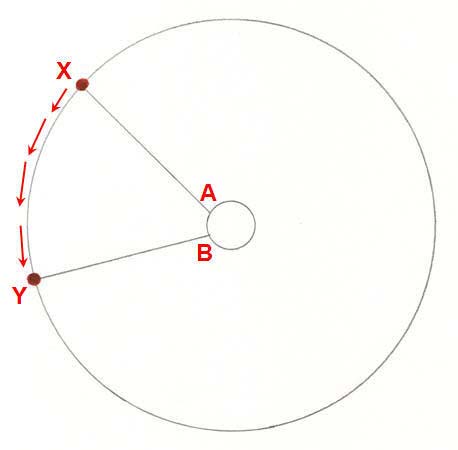
Consider the orbiting ball at position X. If the hand (positioned at point A) abruptly stopped moving, then the hand would no longer pull on the string. What would happen to the ball in the absence of a pull force. It would veer off in a straight line direction at an tangent to the circumference of the circle (orbiting path). Now what would happen if the hand continued to move at its constant rate of speed from position A to position B. It would continue to exert a constant pull on the orbiting ball via the continuously taut string. The direction of the pull (transmitted via the taut string) is circular - from position X to position Y. The string is not directly pulling the orbiting ball to the center of the circle. That central pull to the center (a centripetal pull) is only a mental concept. One can see the orbiting ball being pulled from position X to position Y and we can mentally/conceptually divide the forces pulling the ball into two components - a force that pulls the ball forward in a straight line direction, and a force that causes centripetal acceleration (causes the ball to move along a circular path rather than a straight line path).
Note that the string is angled relative to the circumference of the orbiting ball's circle of rotation - where the axis of rotation is in the dead center of the circle.
You wrote-: " In your model, the ball is the orbiting mass and the hand is the axis of rotation. The hand is not the centripetal force (as you incorrectly state). It is, after all, the axis!"
Wrong! The axis of rotation is the dead center of the circle - both the hand's circle of rotation and the orbiting ball's circle of rotation. The hand is in orbit around the axis of rotation (dead center of the circle) like the ball - the only difference being that the radius of the hand's orbit is much smaller than the radius of the ball's orbit. As the hand moves in a circular fashion, it inherently is exhibiting a centripetal force that keeps it moving in a circular manner. The ball is moving at exactly the same rpm speed as the hand (due to it being pulled by a continuously taut string). In that sense, the hand's centripetal acceleration is transmitted to the ball by the taut string (which is inert) and the ball therefore also centripetally accelerates. In other words, if the hand centripetally accelerates (by the act of rotating in a circular manner), then the ball has to centripetally accelerate - because the connecting string is continuously taut and the taut straight string passively transmits the pull force from the hand to the ball.
My comment about a centripetal force moving outwards along the string was plain stupidity!!!
No, Jeff, you just made a mistake. We all make mistakes. It's the way we learn.
Originally Posted by jeff
I believe that there is no centripetal force moving in either direction along the string.
More yet to learn.
Originally Posted by jeff
I believe that centripetal force is better defined as a force that causes an orbiting object to travel in a circular path rather than a straight line path.
Gettin' there now.
Originally Posted by jeff
Consider my orbiting ball example again.
Thanks, Jeff, but no thanks. I'll leave that privilege for others.
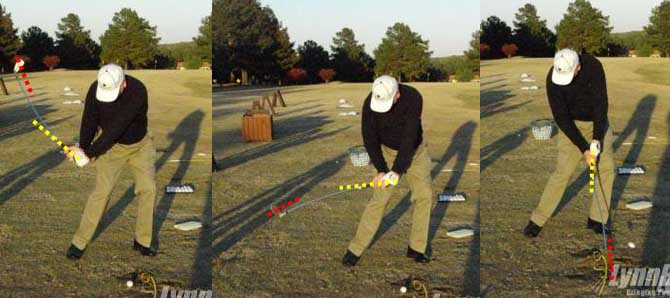
The clubhead sweetspot line (red dotted line) is lagging behind the hand pull line (yellow dotted line). I believe that this is due to clubhead inertia, and this phenomenon is only possible with a flexible shaft.
Image 1: This "whip lag" is quite normal.
A lot of good players have a "two burst" swing, where the shaft is seriously bent in this part of the swing, and where something similar happens around impact. It's related to lag pressure.
The combination of lag pressure excerted by right hand - and rope handling pull from the left arm - will put a significant amoung of Newtonian moment to the grip end of the club. (Force x length). And the work from this moment stresses and bends the shaft. And increase the clubhead sped as well. AND ENERGY IS STORED.
Image 2:
While it is biomechanical possible to maintain the clubhead speed through impact it is impossible to maintain the brute force moment from image 1 all the way through. And when the moment decreases , the shaft starts to release. And since the club is a highly resonant system with moderate inner damping, the club will now whip forward - as it does here. This is not an ideal occurence since it means that stored energy is released long before impact. It is kind of similar to the dreaded throwaway. But given how we are built it is perhaps unavoidable in a swing that starts hard and fast down.
Image 3:
Strange things may happen to the shaft at impact. But it seems to me like this player has a two-burst swing. That he was reloading the shaft. Or at least was trying to. But the forward bend of the bottom half of the shaft will work against his effort of adding an extra ooomph at impact.
All this shaft bending and releasing business is about stored energy. If the shaft doesn't fit the swing, chances are that the energy stored in the shaft is released at the wrong moment. Further, the s- shape of the shaft just before impact here suggests there's no chance that all the stored energy will be used to send the ball far away. The shaft seems to be loaded and unloaded at the same time at impact.
I believe this is the kind of image that proves that the shaft manufacturers still have an interesting challenge in securing a proper and controlled sequence of energy storage and release through the swing.
Other people have a "one burst" swing, where the moment applied at the club shaft increases gradually through impact. But we aren't able to load the shaft as much at impact and therefore the biggest shaft bends are usually seen in strokes like image 1-3 with a big wrist cock and aggressive down swing.
And then some people are using an almost pure rope handling technique throughout without any of these shaft loading bursts. In addition to the extensive shaft loading we see above, the rope is pulling the center of gravity. And since this isn't on the shaft axis it will cause shaft bend as well. In which case the mechanical properties of the shaft will have less influence on distance, but perhaps on direction.
The stiffness of the shaft has a profound influence of the timing of the shaft rebound. A stiff shaft will release faster than a whippy shaft, and every player that applies some moment to the shaft (lag pressure) at impact would want a shaft that releases in juust the right moment.
I am not sure whether I understand everything that has been said about centripetal force & accelleration in this thread.
But there is one thing I know: Centripetal force doesn't produce swing speed. It only keeps it. It's an excellent energy storage device that enables us to keep what we have already put in there while we add some more....
But even a rope handling technique is more than centripetal force. We are not pulling our rope from the swing centre. We are pulling from a point that is forward of the swing centre (from left shoulder or left hand, depending on which part of the swing we look at).
The total force applied to the club at any point prior to impact can be decomposed in a radial (centripetal) component and a tangential component. And the little tangential force component has the same direction as the ball at - at least in an uncompensated swing. And that's the part that increases swing speed and adds energy to the swing.
PS:
I tried to post an illustration, but wasn't successful. Hope the text is clear without it.
I don't see how you can definitively conclude that his his clubshaft will get under the handplane in the later downswing. I can agree that he may have a problem with his pelvis outracing his upper torso and arms and that he may not be able to easily square the clubface, which will result in pushed shots.
I do not know the golfer personally. He merely wrote and stated that he tended to loss his lag on certain swings and he thought that it mainly occurred when he reverse pivoted.
I agree that having a large amount of lag (like him) is not necessarily advantageous if he cannot complete his swing on-plane in a perfectly synchronised manner.
I don't see how you can definitively conclude that his his clubshaft will get under the handplane in the later downswing. I can agree that he may have a problem with his pelvis outracing his upper torso and arms and that he may not be able to easily square the clubface, which will result in pushed shots.
I do not know the golfer personally. He merely wrote and stated that he tended to loss his lag on certain swings and he thought that it mainly occurred when he reverse pivoted.
I agree that having a large amount of lag (like him) is not necessarily advantageous if he cannot complete his swing on-plane in a perfectly synchronised manner.
Jeff.
I agree with you about what your stating. I think people just get in love with the look of lag. Lag in the right places is what we would be loooking for.
A lot of good players have a "two burst" swing, where the shaft is seriously bent in this part of the swing, and where something similar happens around impact. It's related to lag pressure.
The combination of lag pressure excerted by right hand - and rope handling pull from the left arm - will put a significant amoung of Newtonian moment to the grip end of the club. (Force x length). And the work from this moment stresses and bends the shaft. And increase the clubhead sped as well. AND ENERGY IS STORED.
Image 2:
While it is biomechanical possible to maintain the clubhead speed through impact it is impossible to maintain the brute force moment from image 1 all the way through. And when the moment decreases , the shaft starts to release. And since the club is a highly resonant system with moderate inner damping, the club will now whip forward - as it does here. This is not an ideal occurence since it means that stored energy is released long before impact. It is kind of similar to the dreaded throwaway. But given how we are built it is perhaps unavoidable in a swing that starts hard and fast down.
Image 3:
Strange things may happen to the shaft at impact. But it seems to me like this player has a two-burst swing. That he was reloading the shaft. Or at least was trying to. But the forward bend of the bottom half of the shaft will work against his effort of adding an extra ooomph at impact.
All this shaft bending and releasing business is about stored energy. If the shaft doesn't fit the swing, chances are that the energy stored in the shaft is released at the wrong moment. Further, the s- shape of the shaft just before impact here suggests there's no chance that all the stored energy will be used to send the ball far away. The shaft seems to be loaded and unloaded at the same time at impact.
I believe this is the kind of image that proves that the shaft manufacturers still have an interesting challenge in securing a proper and controlled sequence of energy storage and release through the swing.
Other people have a "one burst" swing, where the moment applied at the club shaft increases gradually through impact. But we aren't able to load the shaft as much at impact and therefore the biggest shaft bends are usually seen in strokes like image 1-3 with a big wrist cock and aggressive down swing.
And then some people are using an almost pure rope handling technique throughout without any of these shaft loading bursts. In addition to the extensive shaft loading we see above, the rope is pulling the center of gravity. And since this isn't on the shaft axis it will cause shaft bend as well. In which case the mechanical properties of the shaft will have less influence on distance, but perhaps on direction.
The stiffness of the shaft has a profound influence of the timing of the shaft rebound. A stiff shaft will release faster than a whippy shaft, and every player that applies some moment to the shaft (lag pressure) at impact would want a shaft that releases in juust the right moment.
Very interesting and insightful post.
I took these pictures of Yoda and remember the procedure he was displaying. Ill leave it to Yoda to discuss in full but your observations are
very perceptive. He was laying it on real hard in release with an active right arm. The pictures dont reveal what the naked eye saw and ears heard. Like a war on the practice field.
While it is biomechanical possible to maintain the clubhead speed through impact it is impossible to maintain the brute force moment from image 1 all the way through. And when the moment decreases , the shaft starts to release. And since the club is a highly resonant system with moderate inner damping, the club will now whip forward - as it does here. This is not an ideal occurence since it means that stored energy is released long before impact. It is kind of similar to the dreaded throwaway. But given how we are built it is perhaps unavoidable in a swing that starts hard and fast down.
Thanks for your post, BerntR. Once again, I want to respond to this very important point.
1. The Clubshaft has inertia. Tipped-stiff or senior flexible, it has inertia.
2. At the same time, Centrifugal Force has a Line of Pull. That invisible line is from the #3 Pressure Point (first joint of the right forefinger) to the Sweetspot. This Lag Pressure Point Pressure (1-L #7) is what is driving the Club, not the Clubshaft.
3. The inertia of the clubshaft cannot keep up with the Centrifugal Line of Pull. Hence, it lags behind. This 'reverse' parabola (reverse in that the forward bend is counter-intuitive) made a dramatic appearance in Ben Hogan's first book, Power Golf. With the exception of Elbow Postion (Pitch versus Punch), the photo on page 97 of that book (hardcover version) is virtually identical with Image #2 (below) in your post.
If somebody could put that up, I'd appreciate it. Thanks!
Yoda - you wrote-: "At the same time, Centrifugal Force has a Line of Pull. That invisible line is from the #3 Pressure Point (first joint of the right forefinger) to the Sweetspot. This Lag Pressure Point Pressure (1-L #7) is what is driving the Club, not the Clubshaft."
Could you please expand on your argument?
I believe that CF is primarily driving the clubhead and the peripheral end of the club (where the COG is located) and not the entire club (which consists of a clubhead, peripheral shaft, central shaft and grip end of the shaft). I believe that the hands are simultaneously driving the grip end of the club while CF is driving the clubhead and peripheral end of the club.
Your argument seemingly presumes that when the club starts to release and CF comes into play, that the hands are no longer driving the club. However, the hands are still moving the grip end of the club during the process of club release and they are applying a pull force on the club (in a swinger) while the club is in the process of releasing - and this pull force (which is at an angle to the COG of the club) adds supplementary angular velocity to the clubhead and peripheral end of the club during the release process.
HK's endless belt keeps moving while the belt moves around the end pulley, and the club is still attached to the endless belt and therefore subject to its continuous motional forces.
-----------------------------------
Add additional point - I was writing my post and I didn't see that Yoda was simultaneously modifying his post to read as follows-: "the lag pressure point is what is driving the club" (see next post #204). I originally thought that Yoda was stating that CF was driving the club.
I then have to slightly modulate my argument. I cannot understand what it means when one states that PP#3 is driving the club in a swinger's action. I thought that PP#3 only senses/monitors clubhead lag pressure and that it doesn't drive the club. The club is driven in a drag loading manner by the left hand pulling on the club in a swinger's action. The right hand doesn't apply push-pressure drive via PP#3 in a swinger's action.
By the way, we are presumably talking about a swinger's action because there is no centrifugal pull in play in a hitter's action.
Yoda will independently decide whether he wants to expand on his post - per my request.
Jeff.
Last edited by Jeff : 12-21-2008 at 11:52 PM.
Reason: add additional comment in response to Yoda's modified post.
Yoda - you wrote-: "At the same time, Centrifugal Force has a Line of Pull. That invisible line is from the #3 Pressure Point (first joint of the right forefinger) to the Sweetspot. This is what is driving the Club, not the Clubshaft."
Could you please expand on your argument?
I already did. Immediately after posting, I added the following text (in red) to my post:
"At the same time, Centrifugal Force has a Line of Pull. That invisible line is from the #3 Pressure Point (first joint of the right forefinger) to the Sweetspot. This Lag Pressure Point Pressure (1-L #7) is what is driving the Club, not the Clubshaft."
You could not have known this as you were responding, and I have so notified you by Private Message. Therefore, as I've advised, please take the added text into consideration and amend/edit your post as you see fit. Thank you.






 Hybrid Mode

