I don't know you personally, and I have every reason to believe that you are a very nice person, who I would very much like to meet someday.
Jeff.
And, based on your posts, I would love to meet you. I'm sure we could talk for hours about all of these subjects. We do it at all of our schools, as I'm sure anyone that's been to one can attest to sleep deprivation.
One of the things that I appreciate most about Lynn is that I could tell that he was a seeker of the truth. It's a quality that I have found in very few of the "top" teachers. Most have arrived at a personal opinion and will not openly discuss alternate points of view.
If anyone in the world wants to help people learn, it's Lynn, and I consider him a father figure. So, any negative comment directed at him makes me want to droop somebody's lip or dot their eye.
You wrote-: "One of the things that I appreciate most about Lynn is that I could tell that he was a seeker of the truth. It's a quality that I have found in very few of the "top" teachers. Most have arrived at a personal opinion and will not openly discuss alternate points of view."
We agree. That's also what I like about Yoda. He is a "seeker of the truth", and he will openly discuss alternate points of view. Giving me a personal forum on his personal website is an overt manifestation of that enlightened attitude.
I also can easily understand why you want to protect your "father figure".
I just want your "father figure" to lay off a little and not give me such a hard time. Attack my arguments, but do not belittle my serious intentions as another (imperfect) person who is also a "seeker of the truth".
Yoda - I cannot address your first question re: post #123 because I cannot locate that post. Post #123 was not your post.
My mistake, Jeff. It should have read #129. To prevent confusion for future readers of this thread, I have corrected the error. Also, I've corrected #129 to read that the photo referenced was Photo #4 from Post #127, the very obvious sequence just a few inches down on the same page as #123 (and the only photos of me in this thread).
So, with this correct identifying information, please proceed with your answer.
You asked-: "Assume a tethered ball in orbit around an axis. Does the tether (and its tension) serve as the centripetal force of that action? . . ."
I do not think that the tether (and its tension) of the tethered ball in orbit represents as the centripetal force.
. . .
The string . . . is not a source of the centripetal force. It is only the conduit whereby the centripetal force (the force that keeps the orbiting ball traveling in a circle) is transmitted from the hand to the ball.
[Bold emphasis by Yoda.]
Jeff,
As you know (and I know you do because you have so written elsewhere in this thread), centripetal force operates inward and not outward. In this instance, that means inward from the ball to the hand and not -- as you inexplicably state -- outward from the hand to the ball. This is why I earlier said (post #160) that you first acknowledge Newton's laws and then proceed to distort them to your own ends. In your post #169, you said that you "resent" that assessment, but your quote above is indisputable evidence of its truth.
For the rest of us, the object acting on the ball to cause this phenomenon is the string. Hence, the string supplies the centripetal force and not the hand. From my post #154:
We are concerned here with a mass orbiting about an axis of rotation and exhibiting both a centripetal force (a force 'seeking the center' and whose origin we are now debating) and a centrifugal force (a force 'fleeing the center' and that is reactive to the centripetal force). An orbiting mass constantly accelerates towards its axis of rotation. This centripetal acceleration demands an equal and opposite force that opposes the centripetal force and creates an outward centrifugal reaction directed away from the axis.
In your model, the ball is the orbiting mass and the hand is the axis of rotation. The hand is not the centripetal force (as you incorrectly state). It is, after all, the axis! Instead, the centripetal force (acceleration) is exerted on the ball by another object (in your model, the string). Then, the centrifugal reaction is exerted by the ball on the object that originated the centripetal acceleration (the string).
Until you accept the above, you contradict conventional scientific wisdom that has been in place for more than three centuries. Hence, there is no use in further exploring these ideas as they relate to the Golf Stroke.
I will offer you a reply, that represents my "best" understanding of the shaft bend phenomena.
I am going to presume that the shaft bend is "real" and not a camera artifact.
Let me start with the orbiting ball.
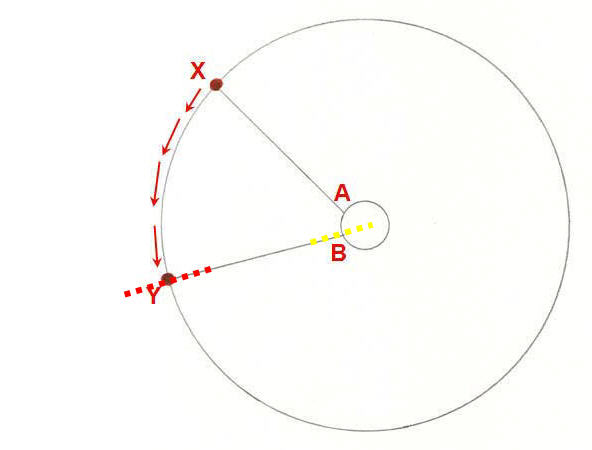
I have modified this diagram by adding dotted yellow/red lines. The red dotted line is in a perfect straight line relationship with the yellow dotted line - which means that there is an instantaneous relationship between cause-and-effect. If the hand (cause) moves in a circular arc, then the orbiting ball (effect) will respond instantaneously and also move in a circular arc (due to centripetal forces). There is no delay in this system when the string is continuously taut, and the system is in a state of balanced motion.
Now consider the golf swing.
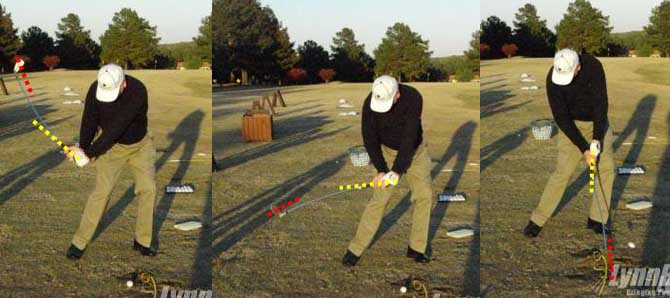
I have placed yellow dotted lines and red dotted lines (as previously placed on other images) on your photos.
Starting with image 1
The clubhead sweetspot line (red dotted line) is lagging behind the hand pull line (yellow dotted line). I believe that this is due to clubhead inertia, and this phenomenon is only possible with a flexible shaft.
Image 2
The clubhead sweetspot line is ahead of the hand pull line. I believe that this is due to the fact that the hands are going through the tight radius turn of the small pulley of the endless belt - the time point where the club releases very fast. The fast releasing clubhead manages to get slightly ahead of the hand pull point - only because the shaft is flexible.
Image 3
I believe that the shaft has a double bend. The first bend (seen at the top of the shaft) is due to the same phenomenon as seen in image 2 where the central part of the shaft gets bent forward because the clubhead's speed is fractionally faster than the hand pull - during the pre-impact phase of the downswing. Then impact occurs, which slows the clubhead down. That causes the clubhead to get pushed back secondary to the collision - and that causes the peripheral end of the clubshaft to bend backwards while the central part of the clubshaft is still bent forwards. This snake-like bend phenomenon is only possible because the clubshaft is flexible.
I do not agree with either your observations or conclusions in your post #185 immediately above. However, I do appreciate your thoughtful reply and its visuals (even though your photo lines as identified are drawn incorrectly and thus misrepresent the invisible reality of Centrifugal Pull).
My comment about a centripetal force moving outwards along the string was plain stupidity!!!
I believe that there is no centripetal force moving in either direction along the string. I believe that centripetal force is better defined as a force that causes an orbiting object to travel in a circular path rather than a straight line path.
Consider my orbiting ball example again.
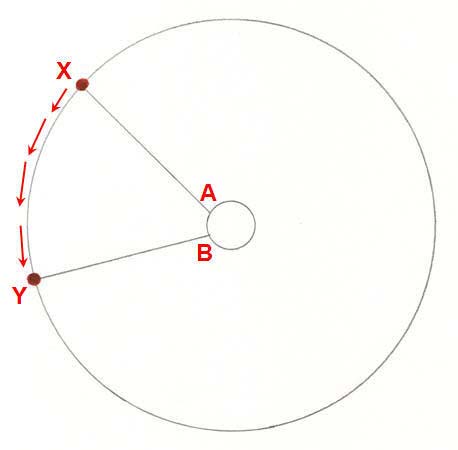
Consider the orbiting ball at position X. If the hand (positioned at point A) abruptly stopped moving, then the hand would no longer pull on the string. What would happen to the ball in the absence of a pull force. It would veer off in a straight line direction at an tangent to the circumference of the circle (orbiting path). Now what would happen if the hand continued to move at its constant rate of speed from position A to position B. It would continue to exert a constant pull on the orbiting ball via the continuously taut string. The direction of the pull (transmitted via the taut string) is circular - from position X to position Y. The string is not directly pulling the orbiting ball to the center of the circle. That central pull to the center (a centripetal pull) is only a mental concept. One can see the orbiting ball being pulled from position X to position Y and we can mentally/conceptually divide the forces pulling the ball into two components - a force that pulls the ball forward in a straight line direction, and a force that causes centripetal acceleration (causes the ball to move along a circular path rather than a straight line path).
Note that the string is angled relative to the circumference of the orbiting ball's circle of rotation - where the axis of rotation is in the dead center of the circle.
You wrote-: " In your model, the ball is the orbiting mass and the hand is the axis of rotation. The hand is not the centripetal force (as you incorrectly state). It is, after all, the axis!"
Wrong! The axis of rotation is the dead center of the circle - both the hand's circle of rotation and the orbiting ball's circle of rotation. The hand is in orbit around the axis of rotation (dead center of the circle) like the ball - the only difference being that the radius of the hand's orbit is much smaller than the radius of the ball's orbit. As the hand moves in a circular fashion, it inherently is exhibiting a centripetal force that keeps it moving in a circular manner. The ball is moving at exactly the same rpm speed as the hand (due to it being pulled by a continuously taut string). In that sense, the hand's centripetal acceleration is transmitted to the ball by the taut string (which is inert) and the ball therefore also centripetally accelerates. In other words, if the hand centripetally accelerates (by the act of rotating in a circular manner), then the ball has to centripetally accelerate - because the connecting string is continuously taut and the taut straight string passively transmits the pull force from the hand to the ball.
I know that you have this little area for your own stuff, a good idea - but I would advise you to look at some of this stuff about artifact on video camera footage:-
It may or may not be relevant to the above debate...but it must be worth you looking into in your usual thorough way ...it may save you some brain cells in the long run.... trying to use physics to explain an artifact is fairly fruitless...so I would want to make sure that image is real or artifact first.
My comment about a centripetal force moving outwards along the string was plain stupidity!!!
No, Jeff, you just made a mistake. We all make mistakes. It's the way we learn.
Originally Posted by jeff
I believe that there is no centripetal force moving in either direction along the string.
More yet to learn.
Originally Posted by jeff
I believe that centripetal force is better defined as a force that causes an orbiting object to travel in a circular path rather than a straight line path.
Gettin' there now.
Originally Posted by jeff
Consider my orbiting ball example again.
Thanks, Jeff, but no thanks. I'll leave that privilege for others.





 Linear Mode


