NM - you agree with Jorgensen re. shaft flex behaviour in downswing?
He concludes (from examining the shaft behaviour of one golfer) that the "flexing of the shaft forward as the clubhead comes in to hit the ball is a general characteristic of the golf swing. Photographs made with the use of a focal plane shutter must be ignored in this context. There are few photgraphs in the golf literature made with stroboscopic light sources, but of those I have examined, all of them show clubs flexed in this manner"
So exclude focal plane shutters and some video cameras ...before theorising too much about shaft flex photos .
Well........ (deep subject I know)
I think Ted jorgensen did a good job and I strongly agree with is concern re interpreting photographs... but its been a while since I read his book... I'm not sure what he means by that statement.
On the matter of club shaft flexing I agree with Wishon (inertial loading from the top is generally speaking in the wrong plane to contribute CH speed at impact due to "snapping back" and I agree with Sasho MacKinsey : http://library2.usask.ca/theses/avai...ted/Thesis.pdf
who says basically shaft bend is mostly toe down and forward (which adds dynamic loft to the club head) as a result of the centripetal force pulling towards the instantaneous center of rotation against the club head's inertia . Its act on the CG of the clubhead. Imagine you could tie a string to the CG of your clubhead and then you did a tug of war.... the shaft would bend like we see in the pictures (toe down and forward)
Post impact all bets are off.... other dynamics come into play as the club rapidly decelerates. But we should not care what happens after the ball is gone IMHOP.
BTW... I'd sure like to see some equip mfg.s do that (design a driver that had the hossel in-line with cg of the clubhead.... There would be whole lot less bending going on I bet... more consistent shots for sure... No more toe down , closing of the face, dynamic lofting etc. .... just a thought. Probably would look funny though and nobody would buy it..
Last edited by no_mind_golfer : 12-22-2008 at 06:03 PM.
Reason: adding some stuff.
Gents, it is about the TORQUE of the shafts, not about the FLEX. If someone witnesses a shaft phenomenon that looks like Hogan's in 'Power Golf' it mainly means that the torque index of such a shaft is too high for the swing parameters. Granted, usually, the flexier the shaft, the higher is the torque, even nowadays, but if the technology permits someday to invent a flexible shaft with a very low torque - why not soon as we are in the nanotechnology era - it would be a dream for clubfitters.
Such a shaft won't look like this as well as late Hogan's "telephone pole" shafts never looked like his pre-secret shafts. IMHO, what Hogan really wanted was low torque, not overhuman stiffness - but in his times it was impossible to tear those two issues apart and he ended with extremely stiff shafts that gave him the torque low enough.
Associate this with the clubheads CoG in relation to the shaft end in a rapid rotary motion and you will have the answer why the clubhead motion can simultaneously rotate and bend the shaft.
Torque is axial.... Bending is longitudinal Are you saying you see torsion in this photos? I'm not following you.
Originally Posted by Dariusz J.
Gents, it is about the TORQUE of the shafts, not about the FLEX. If someone witnesses a shaft phenomenon that looks like Hogan's in 'Power Golf' it mainly means that the torque index of such a shaft is too high for the swing parameters. Granted, usually, the flexier the shaft, the higher is the torque, even nowadays, but if the technology permits someday to invent a flexible shaft with a very low torque - why not soon as we are in the nanotechnology era - it would be a dream for clubfitters.
Such a shaft won't look like this as well as late Hogan's "telephone pole" shafts never looked like his pre-secret shafts. IMHO, what Hogan really wanted was low torque, not overhuman stiffness - but in his times it was impossible to tear those two issues apart and he ended with extremely stiff shafts that gave him the torque low enough.
Associate this with the clubheads CoG in relation to the shaft end in a rapid rotary motion and you will have the answer why the clubhead motion can simultaneously rotate and bend the shaft.
Try to imagine what would happen with a shaft that is subject to the head's CoG movement that is located where it is in relation to the axis of the shaft = each other are not in line in any of the three dimensions. Pay special attention to where the clubhead's CoG is in relation to the shaft.
That's why I said to try to associate those two things together in a 3-D reality.The shaft always is re-torquing in the downswing, same as torquing up in the backswing (due to the forearm rotation). Somewhere in the motion (depending on the ability of maintaining lag, I guess) the shaft must re-torque down and it dos not stop in the original position but goes further due to the inertia, making the shaft turn around its axis and bow simultaneously.
While it is biomechanical possible to maintain the clubhead speed through impact it is impossible to maintain the brute force moment from image 1 all the way through. And when the moment decreases , the shaft starts to release. And since the club is a highly resonant system with moderate inner damping, the club will now whip forward - as it does here. This is not an ideal occurence since it means that stored energy is released long before impact. It is kind of similar to the dreaded throwaway. But given how we are built it is perhaps unavoidable in a swing that starts hard and fast down.
Originally Posted by O.B.Left
Here you go.
Now this looks excessive.
Originally Posted by no_mind_golfer
Boy Howdy.... That's some massive toe down deflection.. was he playing hickory?
Thanks, O.B. Left. We will use your upload and contrast with my own image in my post #202 (and its exception).
I live on a different planet. That limits my ability to intelligently communicate with you regarding this topic.
nmgolfer
What do you think of his centripetal arrow pointing towards the swing center in his diagram?
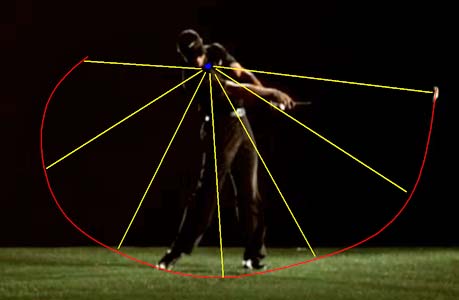
The presumption is that the swing center is the center of the clubhead's arc of travel. However, it is nowhere near the center of a circle transcribed by the clubhead arc.
Here is Tiger Woods clubhead arc - only roughly outlined in red. Blue is the swing center. Yellow is the radial distance to different points on the clubhead arc.
What do you think of Bernt's statement "that centripetal force conserves speed and stores energy"?
Surely centripetal force is only relevant to the clubhead's circular motion at each instantaneous moment in time - as it constantly changes direction in a circular manner, and moves from one point on the clubhead arc (point X) to another point (point Y), and the centripetal force is the force needed to centripetally accelerate the clubhead from point X to point Y. The direction of the centripetal force is surely drawn towards the center of the instantaneous circle of rotation, which changes from moment-to-moment because the clubhead arc is not perfectly circular.
I was a bit surprised by your reaction because I don't se any major disagreement with what you wrote. And I have no problem with the pump action works.
But the pumping up is very similar to what's happening when the shoulder rotates in the sketch I posted. Where the shoulder is pulling up. But I believe that pump-up as in the piston-driven experiment doesn't shifts the center of rotation in a way that provides a longitudinal force.
In any case, we seem to a gree om some very important basics here.
Christmas Gift - Understanding causation in a golf swing
I have produced a 2 minute swing video lesson on "what powers a swinger's golf swing". If you understand this simple double pendulum swing model demonstration, then you will understand what powers the golf swing in a swinger's action.
Consider what I have demonstrated. One powers the golf swing by moving the left arm (central arm) in a circular manner. That "cause" produces an "effect". The "effect" is the circular motion of the left wrist/hand (peripheral hinge joint) in space. That "effect" becomes a "causal agent" with respect to releasing the club ("effect"). The circular movement of the left wrist/hand in space causes the release of the club.
If you understand what I have stated, there are only two possible causative agents in this sequence.
1) The left arm moves in a circular manner (due to the release of PA#4).
It produces an effect - the circular motion of the left wrist/hand in space.
2) The left wrist/hand unit moves in a circular manner in space.
It produces an effect - the release of the club.
The club release phenomenon is an "effect" and not a cause. I therefore think that it is nonsensical to state that an "effect" drives the golf club (via the lag pressure point at PP#3).
Note that I don't need to use the word centripetal or centrifugal in my description of "how the golf swing is powered" in a swinger's action.
I certainly think that it is nonsensical to believe that a centripetal force is necessary to "conserve speed and store energy".
I live on a different planet. That limits my ability to intelligently communicate with you regarding this topic.
nmgolfer
What do you think of his centripetal arrow pointing towards the swing center in his diagram?
The presumption is that the swing center is the center of the clubhead's arc of travel. However, it is nowhere near the center of a circle transcribed by the clubhead arc.
Here is Tiger Woods clubhead arc - only roughly outlined in red. Blue is the swing center. Yellow is the radial distance to different points on the clubhead arc.
What do you think of Bernt's statement "that centripetal force conserves speed and stores energy"?
Surely centripetal force is only relevant to the clubhead's circular motion at each instantaneous moment in time - as it constantly changes direction in a circular manner, and moves from one point on the clubhead arc (point X) to another point (point Y), and the centripetal force is the force needed to centripetally accelerate the clubhead from point X to point Y. The direction of the centripetal force is surely drawn towards the center of the instantaneous circle of rotation, which changes from moment-to-moment because the clubhead arc is not perfectly circular.
Jeff.
Would you say the arc of the hands is closer to a true arc?




 Linear Mode


