I agree that many pros are like 10-23-C/D. However, that only means that they have a rounded section at the top of their swing. That is followed by a straight section. I am interested in learning whether forum members have any idea what causes that straight section.
I have started another thread to deal with this subject. Interested forum members can post their opinions in that thread.
HB - you wrote-: "Circle path is a hand path. Endless belt is about #2. They are related but not the same thing."
I do not understand this point. I believe that circle path is left hand path, and that the endless belt is also left hand path. The clubshaft touches the endless belt at the position of the left hand which is fixedly attached to the endless belt, and during the straight line directional movement of the endless belt the left hand (which is fixedly attached to the endless belt) is moving in a straight line.
You wrote-: "Are you saying that there is no wrist cock with a circle path? Whatever the size of the pulley, if the left wrist cocks, there is a pulley."
I have no idea what you are describing. I do not think that the statement "if the left wrist cocks there is a pulley" makes sense. My understanding of the endless belt analogy is that the pulley has no necessary causal connection with the degree of left wrist cock. My idea of the pulley is the shape of the hand arc at the bottom of the swing.
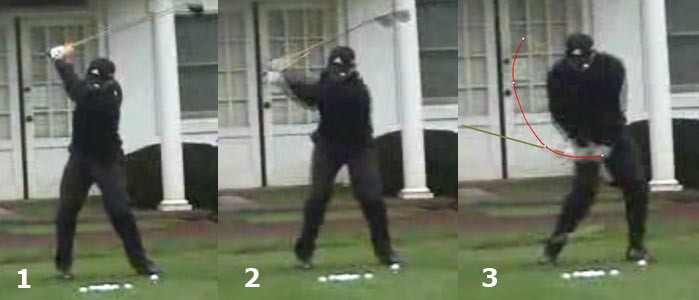
So in this photo of Sergio Garcia's hand arc - the pulley section of the endless belt is the lower rounded part of the U-shaped hand arc where the radius is smallest (tightest curve).
Surely the pulley relates to the hand arc's tight curve at the bottom of the hand arc, and not the degree of left wrist cock that may/may not be present when the hands pass through that section of the hand delivery path.
You wrote-: "How can the club path in the downswing be more circular when the left wrist is cocked for a large portion of the downswing (shrinking the radius from shoulder to clubhead) while the left arm remains straight (maintaining the radius from shoulder to hand)?"
Why not?
Here is the visual evidence?
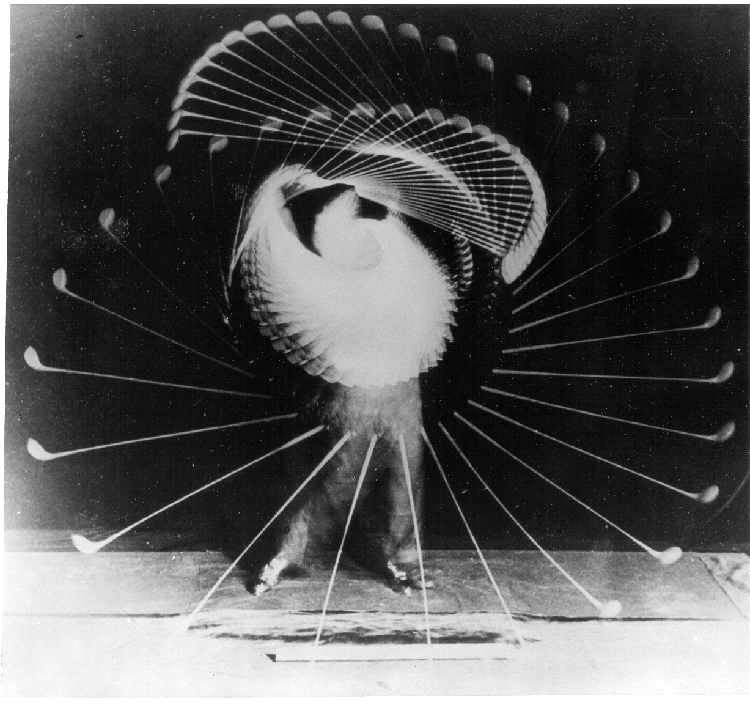
In this strobe photograph of Bobby Jones swing, isn't the clubhead arc as circular when the left wrist is cocked as it is when the left wrist becomes uncocked?
By the way, do you do not agree that many professional golfers have a 10-23-A or a 10-23-B hand path? Both those hand paths have a straight line portion (the only difference being that the angled line hand path requires a vertical drop of the hands down to the elbow plane before the hands move along its straight line path section).
Also, in Yoda's Alignment Golf DVD -disc 2 - he shows how to perform a straight line thrust action down towards the ground (down towards an aiming point on the ground). Do you think that his straight line thrust action is compatible with a perfectly circular hand path? What is the purpose of teaching that action - if not to produce a 10-23-A type hand delivery path?
Jeff.
Interesting that these two cats have VERY centered pivots . . . and look like the hands go in a circle to me?
Here's about one of the straightest line deals you'll see . . . . and MAJOR axis tilt to get it . . . connect the dots here and see what you get on the delivery path . . .
You asked-: "But I like Henny am wondering why anyone would want to have a compensated swing that held his head back in fix etc. To what end? Why not manage low point better and move the ball up in the stance with the head or pivot center in its uncompensated alignment?"
That's a good question. I will express my biased opinion, which is based on human biomechanics.
I agree with Yoda that the ideal swing is to stay centered within one's stance. As Yoda pointed out in a previous post, look at the great three players - Player, Palmer, Nicklaus - and note how they pivot around an imaginary pivot axis that is centralised between the feet. I think that approach works very well for ALL golfers for iron shots and most golfers for driver swings.
However, if a very flexible golfer, who has a lot of hula hula flexibility, wants to drive the ball a very long way, then there is a mechanical advantage to having a great deal of secondary axis tilt at impact.
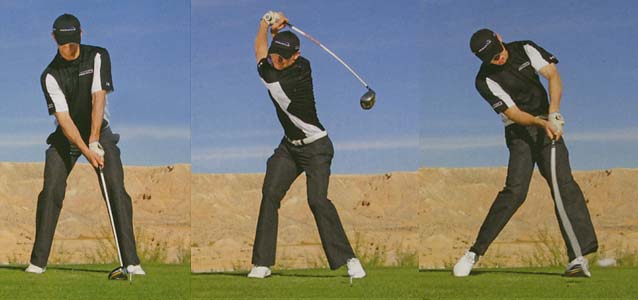
Here are a series of photos of Jamie Sadlowski from the latest issue of GD magazine. He recently won the 2008 Long Drive Competition with a drive of 418 yards.
Note how much secondary axis tilt he has at impact. I think that he needs that much secondary axis tilt to stay in balance - considering the force of forward momentum of his arms/clubshaft that are swinging towards the target. I previously argued that a golfer needs to have a braced skeletal structure (from the top of the stationary head -through the spine-through the pelvis-down the left leg to the left foot) at impact. I think that Sadlowski anticipates the need for that braced skeletal structure, and its shape, at impact, and he therefore sets his head behind the center of his stance at address. Then he simply needs to keep his head stationary as he swings into impact against a firm supportive (braced) left leg and a braced rightwards-tilted spine that is kept braced by a stationary head.
That's why I think that HK was very wise to allow for that need in special circumstances - by stating that one should start with one's head at the anticipated impact location. Most of the time that will mean a stationary head centralised in the stance, but under special circumstances (as above) it may be better to have one's head right-of-center.
Jeff.
p.s. The Gulbis photo was posted as a joke - and it is equivalent to recommending Furyk's steep off-plane backswing clubshaft movement as a role model for the average golfer. Although HK catalogued that backswing variation in his book, I presume that he would recommend a backswing plane in the steepness range that is some where between the elbow plane and the turned shoulder plane.
Jeff,
Can I chim in here?
I like were this whole post is going, read a bunch of it for the second time. Thought I would write something, however guys smarter than me have done so.
Great picture you posted of Jamie here. I have to say however, one of my good friends took 7th over all in the Remax with jamie. Said that kids is amazing at such a young age. However he did say he almost did not make it because one out of four of his balls curves more than anyones out there.
I will say however he will win more Remax LD deals in the future, he has a ton of talent.
I think for the average golfer they can learn alot from what he does in his swing, but must pick and choose what part. It fully a pure power stroke rather than a control stroke.
I think you nailed that one well.
I think that it is a mistake to causally equate a large amount of secondary axis tilt with hitting upwards at a teed ball when using a driver.
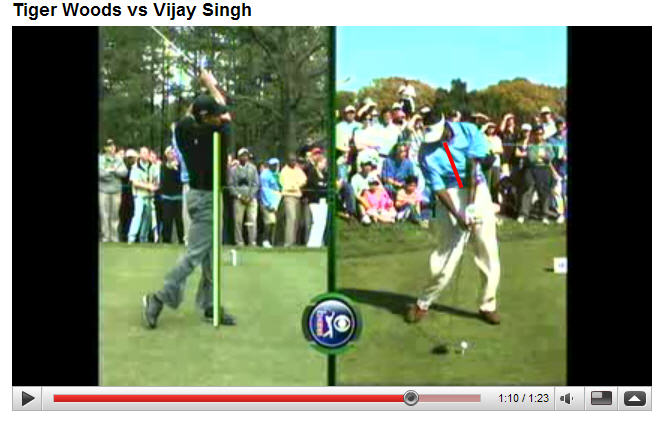
Here is a capture image of VJ Singh from a swing video.
VJ Singh always hits down with his driver - note the forward clubshaft lean. However, he has a large amount of secondary axis tilt.
I think that a large amount of secondary axis tilt in long hitters (like Tiger Woods and VJ Singh) better correlates with a need to keep in balance when swinging at fast arm speeds.
I think that it is a mistake to causally equate a large amount of secondary axis tilt with hitting upwards at a teed ball when using a driver.
Here is a capture image of VJ Singh from a swing video.
VJ Singh always hits down with his driver - note the forward clubshaft lean. However, he has a large amount of secondary axis tilt.
I think that a large amount of secondary axis tilt in long hitters (like Tiger Woods and VJ Singh) better correlates with a need to keep in balance when swinging at fast arm speeds.
Jeff.
Jeff,
both of them are great on power.
But, what about middle of the short grass. Thats what I was getting at.
IMHO the large secondary axis tilt is because he tees it high and hits up with the driver. It wouldn't work with a 5 iron off the ground.
I know it is anti TGM but the long drivers hit up on the ball and Trackman confirms the video below.
go to the 3:26 mark
Not necessarily anti TGM, as there is room for special procedures, for special purposes. Like a super high launch angle for the long shot guys.
But, for the record, the ball is only hit on the upswing if it is forward of low point, the left shoulder, at impact. VJ's left shoulder and others are not so and therefore they are hitting down.
OB Left - you are presuming that the low point must always be opposite the left shoulder. That may apply most of the time, but not necessarily all of the time. I don't think that it applies to Jamie's driver swing. It is possible to get the hands ahead of the left shoulder at impact with forward shaft lean - which means that the clubhead is on a descending path and not an ascending path. In Jamie's photo, the central end of the clubshaft near the hands has forward shaft lean at impact - even though the hands are ahead of the left shoulder. Note the bend in his left elbow at impact - which makes this possible.





 Linear Mode


