At the Top, your right palm is facing outward, as if you were a traffic cop saying "Stop!" As a golfer, do you think this is the proper alignment of the palm to the Inclined Plane? How will this affect your Left Wrist? How will your Clubface and Clubshaft be aligned should the palm actually achieve this alignment?
Precisely boss . .. a ROLLED right forearm at Top = clubshaft shoots across the line.
Yes. Fanning and bending like a hand clap. The RFT is a great and consistent way of taking the club away. I used to push things away with my shoulders and left arm, rocking the triangle. It caused all sorts of problems for me. RFT pulls the rest along in a reliable , consistent and perfectly aligned manner. The right arm pulls the left , the left arm pulls the left shoulder the perfect amount. Remember the distinction between upper and lower body as in the McDonald drills however. The right hip goes back and the right arm goes up.
With extensor action, a frozen right wrist and a cleared right hip the RFT alone seems to accomplish most everything for me on the backswing. Maybe Id add hinge action to the list here and alignments, flashlights etc.
The only thing Id add about your photos is that with your left arm off the club and therefor no check rein action you are obviously not employing extensor action here. Need to turn that extensor action on when both arms are attached for the full benefit of the RFT: Extension, the right elbow cocking the left wrist etc.
Its gets so simple, so easy to repeat. Like you are just taking that frozen right wrist to top.
IF you stood inside Homer's plastic plane board would the right forearm lay on the plane as it goes up and and down?
MB
Id love to stand in a plane board and observe things like this. Homer said something to the affect that we would all be surprised by our findings.
Id say that now that I am hitting I seem to feel or perceive my RFFW being on plane longer. Maybe this is angled hinging, I dunno. For sure the RFFW feels more intact throughout now. To answer your question more directly Id say that it is on plane through impact or after the release swivel.
You wrote-: "IF you stood inside Homer's plastic plane board would the right forearm lay on the plane as it goes up and and down?"
It is my understanding that the right forearm is only on plane at address/impact and as it paddlewheels into impact. During the backswing, it moves off the inclined plane and ends up perpendicular to the inclined plane at the top of the swing. The left arm flying wedge is on-plane at the top of the backswing, but the right forearm flying wedge is at a 90 degree angle to the left arm flying wedge.
OB left - you wrote-"Yes. Fanning and bending like a hand clap. The RFT is a great and consistent way of taking the club away. I used to push things away with my shoulders and left arm, rocking the triangle. It caused all sorts of problems for me. RFT pulls the rest along in a reliable , consistent and perfectly aligned manner."
I agree.
When I started my personal golf instructional website 2 years ago (as a pet hobby interest) I used David Leadbetter's and Jim McLeans books as a guide.
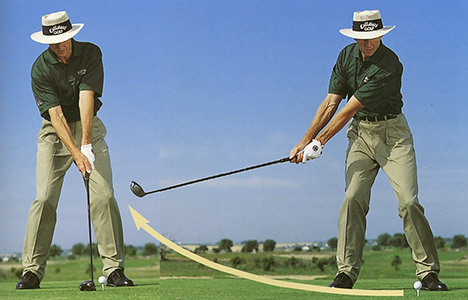
This is the photograph that I use in my backswing chapter - from one of David Leadbetter's books.
He recommended an one piece takeaway while keeping the clubhead low to the ground and he also encouraged a golfer to separate the right arm from the torso by a few inches to acquire width.
I now believe that this stiff two-arm takeaway is a mistake. I also think that this it is a mistake to try and keep the clubhead low to the ground. I agree with Yoda's advice regarding the right forearm takeaway in his DVD instruction - that the clubhead should move up-and-inside immediately as one start the right forearm takeaway. Keeping the club low to the ground is an artificial maneuver that doesn't make sense from a mechanical perspective.
I also believe that my right clap hand motion may be the "best" (easiest) way of thinking how to perform a right forearm takeaway. The only minor modification required is that one also needs to apply extensor action when performing the right clap hand maneuver - which automatically causes the width of the right clap hand action to increase to ensure that the left arm is pulled straight. Yoda demonstrates this extensor action movement very well in his DVD lesson. I love his extensor action drills. I think that he thoroughly clarifies the extensor action motion in his DVD lesson.
After playing this game for 38 years I am now not sure what a one piece takeaway is. I used to think I knew, but now think I had it wrong maybe.
For me it was a movement of the shoulders and arms away in one piece. Pivot to hands. No right elbow bending early. This is now about the worst thing I sometimes fall back into. This isnt to say that some may like or use it to their advantage. Probably some major winners who employed it, but for me it didnt work consistently.
I used to turn the shoulders and extend both arms , long and low, with the triangle maintained. You can even keep the right arm straight if you move the left shoulder back off the get go. You get angled hinging or maybe a dead shut clubface and no or little left wrist cock. I spent a lot of time trying to actively cock my wrists, both of them.
No longer. Now, with the shoulders non active the right arm pulls the left arm which in turn pulls the left shoulder around. This component lag, I think, allows or encourages the check rein action of the left arm to fold the right elbow which cocks the left wrist. This is "magic", eh? Or one aspect of it anyways.
Still inside the incubator on all of this but thats where I am at now. No active shoulder turning or right elbow bending or left wrist cocking. It all just sort of happens. But you need extensor action to tie it all together.
Lynn or others may come in and tell me this is not quite right. I invite that 'cause it will only make my takeaway all the better.
It is my understanding that the right forearm is only on plane at address/impact and as it paddlewheels into impact.
Agreed . . . The Right Forearm can be On Plane only when the Right Elbow is On Plane.
Originally Posted by Jeff
. . . it [the Right Forearm] . . . ends up perpendicular to the inclined plane at the top of the swing.
The alignment you've described requires a 90 degree bend of the Right Wrist. Though this extreme is possible, it is not normal. See my last comment below.
Originally Posted by Jeff
The left arm flying wedge is on-plane at the top of the backswing . . .
No way (except with Zero #3 Accumulator and its theoretical Left Shoulder Plane Angle). The two Wedges describe respective Arm-and-Clubshaft alignments. Neither is On Plane at the Top. See Photos 9-3-6 and 10-6-B #2.
Originally Posted by Jeff
. . . but the right forearm flying wedge is at a 90 degree angle to the left arm flying wedge.
Agreed, but this alignment long has been misunderstood by TGM students. What it means is that the respective Wedges with their own unique alignments are brought together in a 90 degree relationship (as in palm-to-palm). It does not mean that the Right Forearm is perpendicular to the Left (at the Top or otherwise). Instead, it comes in at the angle dictated by the Right Wrist Bend (as established at Impact Fix), just as a supporting strut angles into an airplane's wing. Only a 90 degree bend -- possible, but extreme -- will produce a 90 degree relationship between the Forearms.
You write-: "I used to turn the shoulders and extend both arms , long and low, with the triangle maintained."
When you state "extend both arms" I think that it correctly describes the mental picture that many golfers have in their mind when they think of the one piece takeaway. However, as Yoda accurately demonstrated in his DVD lesson, the right forearm at address must be held in a certain manner with respect to the left arm, so that the right elbow can start to fold and the right forearm can start to fan (as if performing a right clap hand action) very soon after the right forearm takeaway commences. The main purpose of the takeaway is to simply carry one's hands (and clubshaft) to the "correct" end-backswing position where the left arm flying wedge and right arm flying wedge are correctly aligned (and the entire power package assembly is correctly loaded).
Standing stiffly with extended arms leads to all sorts of incorrect backswing actions - like this frequently performed one piece takeaway action that leads to reverse pivoting.
I was incorrect to state that the left arm flying wedge is on-plane. I should have stated that the back of the left hand is on-plane because it is the only part of the left arm that approximates the inclined plane.
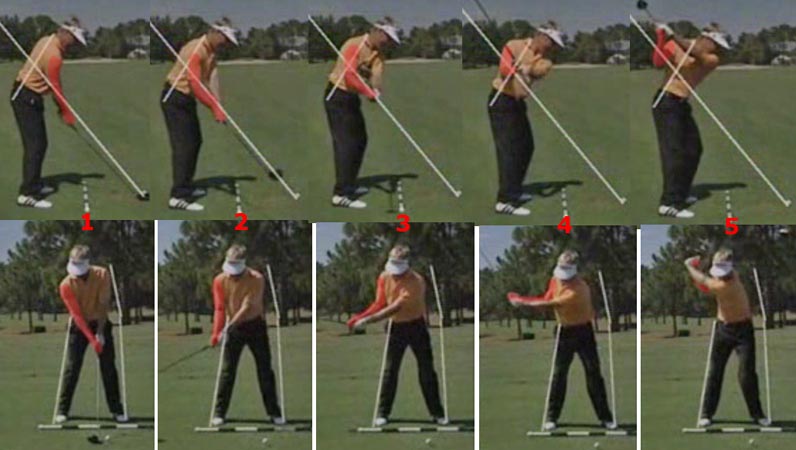
Consider this composite photo of Stuart Appleby.
His clubshaft is on-plane at the top of his backswing, which means that the flat left wrist and right palm are alongside, and
parallel to the inclined plane. However, the left arm is angled slightly off-plane in the direction of the left shoulder socket.
Yoda - this issue made me think of another question, which I have now added.
If a golfer has flexible wrists, and he can bend his right wrist back to 90 degrees at the end-backswing position so that he can get his right forearm angled closer to 90 degrees relative to the clubshaft at the end-backswing position, is that a disadvantage? In other words, I can understand the right forearm flying wedge acting as a supporting strut to the left arm flying wedge at the end-backswing position, but I was wondering whether it is disadvantageous to allow the right wrist to bend back fully by the end of the backswing - thereby altering the angular relationship between the right forearm and the left arm flying wedge?
Jeff.
Last edited by Jeff : 01-03-2009 at 12:00 PM.
Reason: added another question






 Linear Mode


