I hope that this "Golf by Jeff" forum will be a forum where any LBG forum member can test his radical (or less radical) ideas using i) "objective reality" and ii) "logical coherency" and iii) "degree of concordance with well known biomechanical/mechanical facts" rather than authority-based dictums as the "gold standard" for estimating success.
I have tried to foster that attitude by never censoring any forum member who put forward an alternative opinion that contradicted my personal opinion - as long as the expressed opinion is related to mechanical or biomechanical "issues" relating to the golf swing (and as long as the expressed opinion is not an overt ad hominem attack). As long as this forum continues to exist and as long as I have the power to be a moderator, then I plan to maintain those high standards. I will never claim that I am an "expert" and therefore automatically "right" or accept any ideology that proposes that any other self-appointed "expert" is automatically "right". I expect every LBG forum member, irrespective of his knowledge and experience, to defend his opinions via the mechanism of a logical counterargument and I do not expect him to have to kow-tow to any authority figure. This "Golf by Jeff" forum welcomes all enterprising LBG forum members who are willing to argue passionately on behalf of their opinions and who refuse to give "authority-based" opinions any special consideration.
My greatest admiration goes towards those forum members who disagree with my opinions, and who then take the trouble to pen a detailed counterargument. As long as that type of forum member continues to post in this "Golf by Jeff" forum, them my personal interest and participation will not wane. I hope to learn from them.
Jeff.
Keep it coming Jeff...i renamed you though..check out the link
There is one problem in your analogy - Darth Vader represents the "dark side".
I believe in the "light side". By staunchly encouraging an "open forum" where all serious opinions regarding the mechanics and biomechanics of the golf swing are given equal weight is metaphorically equivalent to opening the curtains in front of a window and letting in the light!
I do not recall VJ referring to the head as the pivot center. In one drawing, his pivot axis goes up the left leg and then through the cylinder to exit centrally at the top of the cylinder (equivalent to a torso with an exit point at the level of the base of the neck). On another page, he draws the pivot axis through the left side of the torso - well left of the spine and head.
I personally do not think that the head acts as a counterbalancing force, and/or that it will necessarily create wobble of the torso if slightly offset.
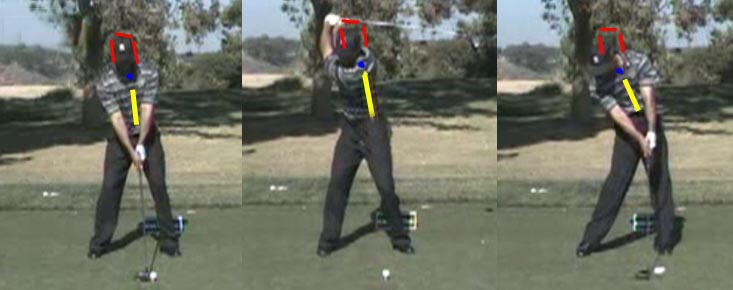
Here is a capture image from a Tiger Woods swing video - his head falls back-and-downwards during the downswing. However, I don't think that it affects his swing.
Whether one describes the base of the neck or the head as the pivot center, I can accept the implications of your posted HK-definition of a pivot center - "SOME POINT on the body kept stationary throughout the Stroke, to stabilize the motion."
However, I cannot understand the concept of a centralised pivot center (being centrally located in the body or centrally located in the stance) with a vertical pivot axis going through that pivot center point.
Jeff.
Tiger's head moving back and down does not affect his swing? Or do mean you can't tell from the ball flight, as in, he hits it good even though he makes this move? Surely, it has a effect, for which he must account.
Instead of centralized pivot center, what if we thought of it as point that the power package moves around? If we don't bob or sway the point between the shoulders, we don't have to compensate for that movement.
I personally do not believe that a small mount of head-dropping will affect Tiger's swing as long as the upper swing center (blue dot area) remains stationary during the torso's rotational movement. If one conceives of the upper swing center as being a 8-12" cubic-shaped area within Tiger's torso - located centrally between the shoulder sockets and located in front of the upper thoracic spine - then if that upper swing center remains stationary (doesn't bob up-or-down, and doesn't sway left-to-right) during the swing, then it acts like HK's "SOME POINT on the body kept stationary throughout the Stroke, to stabilize the motion.". That's my personal idea of a pivot stabilising point that allows the torso's rotational movement and the arm swinging movement to be stabilised. However, there is no biomechanical imperative to have the pivot stabilising point perfectly centralised between the feet. I think that it will be perfectly centralised in a S&T swing style - like Badd's new swing style. However, it will be slightly left-centralised (slightly left-of-center) in a swing style like VJ Trolio's driver swing style and it will be slightly right-centralised (slightly right-of-center) in a swing style like Tiger Woods driver swing style.
Tiger's head moving back and down does not affect his swing? Or do mean you can't tell from the ball flight, as in, he hits it good even though he makes this move? Surely, it has a effect, for which he must account.
Instead of centralized pivot center, what if we thought of it as point that the power package moves around? If we don't bob or sway the point between the shoulders, we don't have to compensate for that movement.
Nice one Henny
That blue dot doesnt move very much but for him to be perfect he must compensate for whatever movement there is, however small. As the blue dot moves so does the left shoulder, the levers fulcrum, the radius etc.
Jeff, I dont think Vj mentioned pivot center either. (Just got my vj book back). Again VJs "axis of rotation, TGM's "pivot center". They are different but related.
Consider this then, in your drawing above. Cant you see the blue dot or there abouts as being ideally stationary, centrally located and the yellow line as being VJ's axis of rotation, its bottom being left, near the left foot? The COG over the left foot , axis tilt, via a "Hula Hula Flexibility", which tilts the shoulders, which allows the right shoulder to move down plane. This axis tilt as shifting the axis of rotation from vertical to diagonal from a front on perspective. The down the line perspective showing the inclined plane and forward leaning axis of rotation. Need some 3D modeling maybe.
Page 53 of Vj's book figure 22. The axis of rotation is tilted diagonally via axis tilt and runs from a centrally located pivot center to the left foot.
Bucket, Im struggling with this one a little. The vertical vs inclined plane thing seems great, please elaborate.
Does this relate to CF throwing the hands to a position that is OUT irrespective of the inclined plane? Cool. Is this what you mean? The science behind the need for axis tilt, the on plane right shoulder and therefore the hands all from a lateral hip slide action?
You're deep dude.
"I gots to know". (Dirty Harry)
OB
OK . . . . stick your arms out from your shoulders parallel to the ground . . . .
Now make your hands move parallel to the ground in a cicle by turning like you were a helicopter. . . . your spine is ONLY required to twist to keep them on that horizontal plane . . .
Now do the same thing only add waist bend to get your helicopter dealie moving on an inclined plane . . . your objective to keep your hands and arms moving in the same inclined plane . . . to do this notice what your hips and spine have to do . . . . there is a lot of stuff going on below your shoulders to keep your hands moving in that orbit without disrupting it . . . and alot of it is hips sliding and spine flexing and extending . . . . on the way back and through.
That blue dot doesnt move very much but for him to be perfect he must compensate for whatever movement there is, however small. As the blue dot moves so does the left shoulder, the levers fulcrum, the radius etc.
Jeff, I dont think Vj mentioned pivot center either. (Just got my vj book back). Again VJs "axis of rotation, TGM's "pivot center". They are different but related.
Consider this then, in your drawing above. Cant you see the blue dot or there abouts as being ideally stationary, centrally located and the yellow line as being VJ's axis of rotation, its bottom being left, near the left foot? The COG over the left foot , axis tilt, via a "Hula Hula Flexibility", which tilts the shoulders, which allows the right shoulder to move down plane. This axis tilt as shifting the axis of rotation from vertical to diagonal from a front on perspective. The down the line perspective showing the inclined plane and forward leaning axis of rotation. Need some 3D modeling maybe.
Page 53 of Vj's book figure 22. The axis of rotation is tilted diagonally via axis tilt and runs from a centrally located pivot center to the left foot.
OB
That is a very good image. And that axis deal hits behind you further down plane for different type of patterns . . . .I'd say the further downplane the more draw bias.
OK . . . . stick your arms out from your shoulders parallel to the ground . . . .
Now make your hands move parallel to the ground in a cicle by turning like you were a helicopter. . . . your spine is ONLY required to twist to keep them on that horizontal plane . . .
Now do the same thing only add waist bend to get your helicopter dealie moving on an inclined plane . . . your objective to keep your hands and arms moving in the same inclined plane . . . to do this notice what your hips and spine have to do . . . . there is a lot of stuff going on below your shoulders to keep your hands moving in that orbit without disrupting it . . . and alot of it is hips sliding and spine flexing and extending . . . . on the way back and through.
When I mentally envisage an axis of rotation in the downswing, then I actually do imagine that the axis of rotation is a diagonal line drawn between the left foot and the upper swing center. In other words, I can more easily imagine an axis of rotation that is diagonally aligned rather than vertically aligned (and which is also centralised between the feet).
On page 53 of his book, VJ drew a diagonally slanted line going through the torso - that follows the diagnonal line that I just described.
However, then on page 37 of VJ's book - figure 11 shows a pivot axis line (in white) at impact that is vertically oriented, going from the left inner foot to the left shoulder socket. That's why I don't know what to make of VJ's pivot axis concept, where the pivot axis apparently changes its axis of rotation during the downswing.




 Linear Mode


