I still remain unconvinced by any argument that supports the idea of a pivot center and/or a pivot axis, but I will consciously remain open to any "new" thoughts regarding the issue.
Jeff.
Hey Jeff
So given your statement in your last post that you now do "imagine that the axis of rotation is a diagonal line drawn between the left foot and the swing center" can we take from that you now acknowledge the existence of the axis of rotation and the pivot center (or swing center)?
Have you found two new concepts to adopt? Can we go to the "tote board". One TGM one VJT (or is axis of rotation somewhere in the yellow booK? I dunno)
In regard to whether the pivot center is directly between the feet. I like Henny's note that if it isnt it requires compensations and Bucket's that if it is back of center it is draw or pull biased. Good observations there. The "uncompensated" swing will have the pivot center in the middle of the feet.
As for your note about the diagram on page 37 of Vj's book, illustration 11, I understand your confusion. I wonder if anyone has noted this before. Interesting.
I think it is a typo. That the line drawn from Hogan's left shoulder to low point should be labeled as the Impact Circle Radius. Page 49 ; "The true radius of Hogan's impact circle is a line from his left shoulder (at impact) to a point in front of the his ball (the low point of his swing)". Brackets by the author.
No. I do not believe that there is an axis of rotation between the left foot and the upper swing center.
I think that the idea of a pivot axis is merely a mental construct imposed on a human being's 3-D torso movement in space during the downswing. In that sense - in the sense of a mental construct - it makes more sense to me to imagine why a person would imagine a "hypothetical" pivot axis between the upper swing center and the left foot rather than between the upper swing center and a point on the ground midway between the feet.
Either way, I don't personally find the mental construct of a pivot axis helpful. I simply cannot understand how this "mental construct" could help a golfer move his torso better in space. I think that one merely needs to position one's head in a "desired' position at address, and then start the downswing with a hip shift-rotation movement that produces secondary axis tilt, that allows the right shoulder to move downplane. Then, by keeping the head stationary, the torso will spiral in a rotary manner towards impact, and beyond impact.
I don't understand why an upper swing center that is slightly right-of-center should predispose to a draw, or why it should be described as a compensated swing rather than an uncompensated swing.
I have recently posted two driver swing sequences - Tiger Woods and Stuart Appleby - where the head/upper swing center is marginally behind the center of the stance. I cannot understand why their swings would be labeled "compensated" or "draw biased". I don't believe that a small amount of right-of-center positioning of the pivot stabiliser point should predispose to a draw - if the golfer can easily shift his lower body forward onto the lead leg during the downswing and avoid a "hanging back" problem. I think that a "hanging back" problem will only occur in a good golfer if the head is positioned very far right-of-center (where the golfer is overtly leaning to the right).
No. I do not believe that there is an axis of rotation between the left foot and the upper swing center.
I DO, ASSUMING THERE IS AXIS TILT. FOR NON SHIFTING STROKES THEN THE AXIS OF ROTATION IS CENTERED , ASSUMING THE HEAD OR CENTER IS CENTERED.
I think that the idea of a pivot axis is merely a mental construct imposed on a human being's 3-D torso movement in space during the downswing. In that sense - in the sense of a mental construct - it makes more sense to me to imagine why a person would imagine a "hypothetical" pivot axis between the upper swing center and the left foot rather than between the upper swing center and a point on the ground midway between the feet.
I THINK THAT AXIS TILT (WHICH REFERS TO THE SHOULDER AXIS) ALSO TILTS THE TORSO, ASSUMING THE CENTER IS HELD STEADY AND THEREFOR TILTS THE AXIS OF ROTATION OF THE PIVOT.
Either way, I don't personally find the mental construct of a pivot axis helpful. I simply cannot understand how this "mental construct" could help a golfer move his torso better in space.
KNOWLEDGE MUST BE WORTH SOMETHING. YOU OF ALL PEOPLE SHOULD ADMIT THIS. YOU BEING SO FAR FROM "GRIP AND RIP IT" PRACTICALITY.
I think that one merely needs to position one's head in a "desired' position at address, and then start the downswing with a hip shift-rotation movement that produces secondary axis tilt, that allows the right shoulder to move downplane. Then, by keeping the head stationary, the torso will spiral in a rotary manner towards impact, and beyond impact.
FINE ME TOO. I DESIRE IT TO BE CENTERED UNLESS I NEED TO DO SOMETHING SPECIAL THAT REQUIRES A SLIGHT COMPENSATION.
I don't understand why an upper swing center that is slightly right-of-center should predispose to a draw, or why it should be described as a compensated swing rather than an uncompensated swing.
ITS ALL ABOUT MANAGING LOW POINT VIS A VIS THE BALL POSITION. WHY POSITION YOUR HEAD BACK AND THEREFOR YOUR WEIGHT BACK WHEN YOU CAN JUST MOVE THE BALL FORWARD AND SWING IN BALANCE? THIS IS THE UNCOMPENSATED SWING. BALANCE MUST BE WORTH SOMETHING NO?
IT IS IN EVERY OTHER SPORT.
I have recently posted two driver swing sequences - Tiger Woods and Stuart Appleby - where the head/upper swing center is marginally behind the center of the stance.
MINOR COMPENSATIONS ARE OH SO COMMON. THIS IS SHOT MAKING. FOREGOING A MARGINAL AMOUNT OF BALANCE FOR AN ADVANTAGE OF SOME SORT, IN THIS CASE PROBABLY LAUNCH ANGLE. WHICH THEY COULD ARGUABLY ACCOMPLISH IN AN UNCOMPENSATED MANNER BY MOVING THE BALL MORE FORWARD VIS A VIS THEIR LEFT SHOULDER OR LOW POINT.
I cannot understand why their swings would be labeled "compensated" or "draw biased". I don't believe that a small amount of right-of-center positioning of the pivot stabiliser point should predispose to a draw - if the golfer can easily shift his lower body forward onto the lead leg during the downswing and avoid a "hanging back" problem.
THE DRAW OR PULL BIAS COMES WHEN THE LEFT SHOULDER OR LOW POINT MORE CLOSELY APPROACHES OR MOVES AFT OF THE BALL POSITION. IT GIVES THE CLUBFACE MORE TIME TO CLOSE AS THE CLUBHEAD APPROACHES ITS UP AND IN PATH POST LOW POINT. I THINK THIS IS HOW I USED TO HIT A HOOK WHEN I WAS 16 YEARS OLD ANYWAYS.
I think that a "hanging back" problem will only occur in a good golfer if the head is positioned very far right-of-center (where the golfer is overtly leaning to the right).
A GOOD GOLFER WOULD ONLY OVERTLY DO THIS FOR A SPECIAL SHOT , SAY A LONG DRIVE GUY TRYING TO LAUNCH IT SUPER HIGH , WITH LOW SPIN.
Jeff.
My comments above in caps.
We're going in circles. Lets hurry up and get to the debate about the flat left wrist.
All your comments about low point relative to ball position have no necessary causal connection with the "mental construct" of a pivot axis.
Each individual golfer can simply choose the biomechanical parameters that allow him to hit the ball with the clubhead still moving on a descending path at impact (ball positioned behind the low point) while remaining in good balance during the downswing. Some golfers, like Tiger Woods, swing their arms very fast across the front of their rotating torso in the downswing, and they may prefer to have a greater amount of secondary axis tilt at impact so that they feel that they are in better balance. Therefore, they will have to position their stationary head right-of-center at address when using a driver.
Also, some professional golfers prefer to have a rightwards-centered backswing where their weight distribution at the end of the backswing is right-of-center when they use a driver - because they prefer to have the ability to shift their pelvis left-laterally at the start of the downswing so that they can acquire their desired degree of secondary axis tilt by impact.
All these biomechanical choices are individual choices that do not require the golfer to think in terms of a centralised pivot axis, and I do not think that I have learnt anything useful if somebody chooses to define their swing as being "compensated" rather than "uncompensated" simply because that person harbors a hypothetical "mental construct" of a pivot center and a centralised pivot axis.
The only point regarding the pivot action that I believe is an essential requirement is the idea of a pivot stabilising point (eg. head or upper swing center), but there is no mandatory requirement that the pivot stabilising point has to be perfectly centralised between the feet. The desired position of the pivot stabilising point depends on the desired degree of secondary axis tilt at impact - that will allow the individual golfer to swing his arms very fast while remaining in good balance.
I personally do not believe that a small mount of head-dropping will affect Tiger's swing as long as the upper swing center (blue dot area) remains stationary during the torso's rotational movement. If one conceives of the upper swing center as being a 8-12" cubic-shaped area within Tiger's torso - located centrally between the shoulder sockets and located in front of the upper thoracic spine - then if that upper swing center remains stationary (doesn't bob up-or-down, and doesn't sway left-to-right) during the swing, then it acts like HK's "SOME POINT on the body kept stationary throughout the Stroke, to stabilize the motion.". That's my personal idea of a pivot stabilising point that allows the torso's rotational movement and the arm swinging movement to be stabilised. However, there is no biomechanical imperative to have the pivot stabilising point perfectly centralised between the feet. I think that it will be perfectly centralised in a S&T swing style - like Badd's new swing style. However, it will be slightly left-centralised (slightly left-of-center) in a swing style like VJ Trolio's driver swing style and it will be slightly right-centralised (slightly right-of-center) in a swing style like Tiger Woods driver swing style.
Jeff.
Jeff,
I'm not going to argue centered head. I like it. My point is the point between the shoulders bobbing or swaying requires a compensation. Lots of guys do it. Does not make it right. Left, center, or right centalized all work. Some better than others.
I agree with you. If we agree that the upper swing center is the pivot stabilising point, then the pivot stabilising point must not bob or sway.
The idea of a pivot stabilising point (whether it is the head or upper swing center) remaining stationary is a very sound concept. I have only questioned the belief that the pivot stabilising point has to be perfectly centralised between the feet and the idea that a golfer pivots around a vertical pivot axis that is centralised between the feet. I think that if the pivot stabilising point is slightly left-of-center, or slightly right-of-center, that it can still perform its stabilising role efficiently - as long as it does not bob or sway.
There is no bobbing-or-swaying of Tiger Woods' and Stuart Appleby's upper swing center (pivot stabilising point) even though it is not centralised between their feet.
Although I personally prefer to keep my pivot stabilising point more centralised - like Aaron Baddeley - I think that it is a personal swing preference, and not a mechanical/geometrical imperative.
I agree with you. If we agree that the upper swing center is the pivot stabilising point, then the pivot stabilising point must not bob or sway.
The idea of a pivot stabilising point (whether it is the head or upper swing center) remaining stationary is a very sound concept. I have only questioned the belief that the pivot stabilising point has to be perfectly centralised between the feet and the idea that a golfer pivots around a vertical pivot axis that is centralised between the feet. I think that if the pivot stabilising point is slightly left-of-center, or slightly right-of-center, that it can still perform its stabilising role efficiently - as long as it does not bob or sway.
There is no bobbing-or-swaying of Tiger Woods' and Stuart Appleby's upper swing center (pivot stabilising point) even though it is not centralised between their feet.
Although I personally prefer to keep my pivot stabilising point more centralised - like Aaron Baddeley - I think that it is a personal swing preference, and not a mechanical/geometrical imperative.
Jeff.
There are ball flight implications . . . . based on the clubhead path's that can result all things being equal.
The idea of a pivot stabilising point (whether it is the head or upper swing center) remaining stationary is a very sound concept. I have only questioned the belief that the pivot stabilising point has to be perfectly centralised between the feet and the idea that a golfer pivots around a vertical pivot axis that is centralised between the feet. I think that if the pivot stabilising point is slightly left-of-center, or slightly right-of-center, that it can still perform its stabilising role efficiently - as long as it does not bob or sway.
[Bold italic emphasis by Yoda.]
Jeff,
You write as if you have discovered some new 'wahoo' information. The FACT is that I have written on this subject many times, including in at least one thread where you were active.
Check my archives: Homer Kelley recommended 'central' axis but said that the important thing was that the golfer set his Head at Fix -- central, left or whatever -- and then leave it there. How many times to I have to reiterate this truth? Please, tell me: How many times?
Stop revisiting this burial ground of old news. Especially since you apparently delight in using it as a gambit to 'disprove' the work of THE "authority figure" -- using your words -- on this site.
Find something new to "question" -- I'm sure you will -- but get off this bus.
I think that there can be ball flight implications as you claim - if a golfer doesn't know where to position his ball (for a given position of the pivot stabilising point).
That's why each individual golfer needs to know where his low point is going to be on the ground - based on the position of his pivot stabilising point in space - and he should then position the ball accordingly.
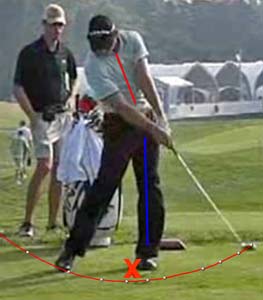
Here is Aaron Baddeley's clubhead swingarc and point "X" shows where the low point of his clubhead swingarc is located. Knowing that fact, he can simply position his ball behind the low point to ensure a descending clubhead path at impact.
The blue line represents the braced/straightened left leg. The red line represents the braced spine (and the degree of secondary axis tilt) at impact. By keeping the pivot stabilising point stationary, and having a braced skeletal structure (spine and left leg), the low point of the clubhead swingarc should always be at the same point - point "x". That allows him to place his ball just behind the low point to consistently ensure optimum impact alignments.
Yoda - I take delight in acquiring greater insights regarding the golf swing.
Since this thread started, I have gained greater insights regarding this issue of the "pivot axis and pivot center".
In particular, I have gained two new insights.
The first new insight was gained from your post which stated that HK asserted that one should position the head at its impact fix location and then keep it there - without automatically implying that the head had to be centralised at address. At the start of this thread I was under the distinct impression that the head had to be centralised between the feet.
The second new insight that I gained came from OB Left when he stated with respect to HK's definition of a pivot center -: "SOME POINT on the body kept stationary throughout the Stroke, to stabilize the motion".
I didn't initially realize that the definition of a pivot center didn't automatically imply that the pivot stabilising point has to be centralised to efficiently perform its function - stablise the motion. In other words, I think that the phrase "pivot stabilising point" may therefore be a more exactingly correct definition of that "SOME POINT".
Then, in conclusion, I have learnt that HK primarily implied that a golfer needs a pivot stabilising point that does not necessarily have to be centralised between the feet. That's a different perspective than the perspective expressed by many TGMers at the start of this thread. So, hopefully, I am not the only LBG forum member who has gained new insights as a result of this prolonged, but fruitful, discussion.




 Linear Mode


