You know whats weird? Here we are two middle aged guys who've spent most of our lives thinking about golf and neither of us really knows how the club gets over our right shoulder......
What kind of insanity is this? There's probably somebody logging on for the first time whose reading this and thinking he'd better get the heck out of here and quick. "Those TGM guys are whacked, dude .........just take your right wrist to shoulder height man, WTHeck."
Hey guys, isn't that what is so wonderful about TGM? If you have a flat left wrist, lag pressure, and the club on plane, the options are limitless. No right or wrong!
Great discussion, I am learning a lot from you both...
Kevin
__________________
I could be wrong. I have been before, and will be again.
Hey guys, isn't that what is so wonderful about TGM? If you have a flat left wrist, lag pressure, and the club on plane, the options are limitless. No right or wrong!
Great discussion, I am learning a lot from you both...
Kevin
If I had a flat left wrist, lag pressure, and the club on plane at impact I would play golf on Thursdays, Fridays, Saturdays and Sundays.
I missed these posts at the time, this enticing Sneak Preview, Trailer for a "Moses at The Parting" movie for TGM ers on the Right Forearm Pickup.
Yoda, If time doesnt allow for the making of a movie, would you please type us a little note on the "Pickup" and right elbow bending? This is something we are all probably struggling with. How do we get the Magic Of The Right Forearm to work on the backswing? You need Extensor Action I'd imagine, like Bambam.
Regards
Ob
PS Here is a video of your pal Billy Casper showing us his takeaway, down the line this time. How bout this elbow bending?
Yoda is on assignment, I think. Hope he answers this. We all need it and "how".
Extensor Action unlocked a better understanding of the magic of the right forearm. Earlier I got carried away with the right forearm karate chopping deal. I misunderstood Tomasello's explanation. It dawned on me (again kinda like the dowels and dragging a wet mop)when I actually worked on the extensor action drills it suddenly hit me that without extensor action there can be no precision bending of the right elbow (among other things) A below plane (with #3 acc. angle) pull of the left arm by the right, an on plane right forearm with a precision bend of the right elbow to accomplish this alignment, then trying to straighten the right arm against the checkrein of the left arm will determine the precise amount of right arm bend. It is not good enough to simply bend the right elbow willy-nilly! When I felt the right elbow bending in response to my concerted effort to straighten it...I began to understand the depth of Homer's contribution to golf! I have a fighting chance to reproduce that unmistakable feel...EVERYTIME!
Extensor Action unlocked a better understanding of the magic of the right forearm. Earlier I got carried away with the right forearm karate chopping deal. I misunderstood Tomasello's explanation. It dawned on me (again kinda like the dowels and dragging a wet mop)when I actually worked on the extensor action drills it suddenly hit me that without extensor action there can be no precision bending of the right elbow (among other things) A below plane (with #3 acc. angle) pull of the left arm by the right, an on plane right forearm with a precision bend of the right elbow to accomplish this alignment, then trying to straighten the right arm against the checkrein of the left arm will determine the precise amount of right arm bend. It is not good enough to simply bend the right elbow willy-nilly! When I felt the right elbow bending in response to my concerted effort to straighten it...I began to understand the depth of Homer's contribution to golf! I have a fighting chance to reproduce that unmistakable feel...EVERYTIME!
I will describe my preferences in performing the "right forearm takeaway" for golfers who may be interested in my opinion.
I prefer Stuart Appleby's "right forearm takeaway" action.
See this swing video
Here are capture images from that swing video.
There are three biomechanical motions that are of major relevance in dictating the path of the right forearm takeaway.
1) The path of rotation of the right shoulder socket in space.
2) The path of external rotation of the right humerus in the right shoulder socket (while the right shoulder socket is in motion).
3) The amount of right elbow bending per unit time.
Starting with 1) - The path of rotation of the right shoulder socket in space.
If the golfer keeps the degree of waist/hip bend constant and keeps the degree of knee flex constant, then the spine (which has a small degree of rightwards spinal tilt at address) will automatically have a defined position/path that will dictate the movement of the right shoulder in space - presuming that the upper torso rotates naturally/perpendicularly around the spine. Note that Stuart's shoulders move near-horizontally in the backswing.
Now, consider the second factor - 2) The path of external rotation of the right humerus in the right shoulder socket (while the right shoulder socket is in motion).
If a golfer allow the right humerus to externally rotate in the right shoulder joint (while the right shoulder socket is in motion) without lifting the right arm up (abducting the arm) then the right elbow will follow a defined path in space - note that Stuart's right elbow remains very close to the elbow plane (white line) throughout the entire backswing.
Now, consider the third factor - 3) The amount of right elbow bending per unit time.
The amount of right elbow bending per unit time is dependent on the requirement to keep the clubshaft on-plane throughout the backswing. If one uses a Smartstick, then it becomes automatic how much one bends the right elbow per unit time, because one is monitoring the laser light's path.
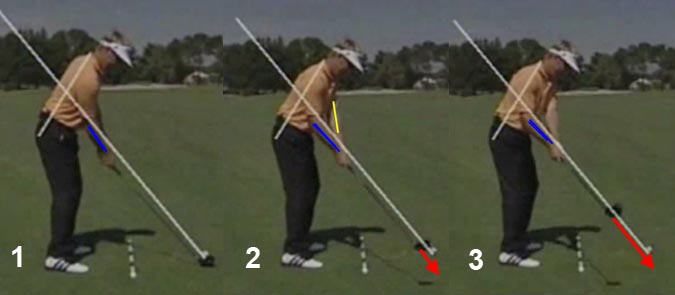
Regarding the initial takeaway movement - I favor Stuart Appleby's approach.
Note the movement of the right forearm (blue line) in space during the takeaway. It's three-dimensional movement occurs automatically/naturally due to three movements that are occurring simultaneously - i) external rotation of the right humerus without any abduction of the right humerus; ii) rotation of the shoulders around the spine and iii) a slight increase in the degree of right elbow bend.
I believe the "right forearm takeaway" motion should be natural - and follow the same path that a tennis player (or table tennis player) will move the right upper limb when taking the racquet back in preparation to perform a forearm strike. Yoda demonstrates this natural motion in his Alignment Golf video - using a racquet.
I like your co-ordinated movement of Right Shoulder back, Fanning and Elbow Bending. Perhaps Id list Fanning and Bending ahead of the Right Shoulder in a hierarchical sense as we dont put our minds in our right shoulder except for training purposes. Fanning and bending can be directed via conscious pressure point awareness. Swing the Hands.
Stuart has one nice and simple Startup that sets up his even more impressive Startdown. His on plane right shoulder and clubshaft move right down the turned shoulder plane in Startdown.
There must be a desired destination when we start back. This is the "Top" of the three Stations , Address, Top and Finish. It is a precision alignment. We dont just start going back Willie Nillie. Its must be precise. As the right shoulder goes in so does the right arm attached to it. As the right elbow bends the plane flattens etc. Like in Apps swing, the right shoulder has a destination it must get to especially for those using the Turned Shoulder Plane and employing an On Plane Right Shoulder Move in startdown.
The PP #3 traces the straight plane line. Hands to Pivot is key. Look back at the position of your Bent Right Hand at Top and then train your right forearm to take it there. The degree of elbow bend or the angle of the shoulder plane etc should be trained and then occasionally checked for alignment compliance but not used as a conscious swing thought in the ideal, when playing as opposed to practicing anways. Put your mind in your hands pressure points and take them where they should go. The rest will just happen. Use your pressure points to actually play the game.


 Well said.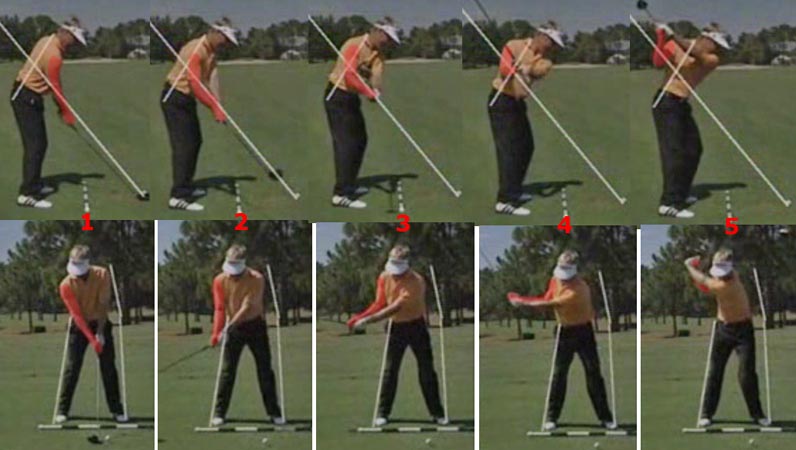


 Linear Mode


