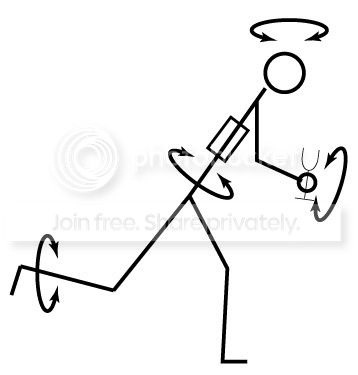
I like the basis of your observation Whip. The core of it, to my mind anyways, being that the Pivot and the Hands do not travel in the same direction but in fact travel their own unique paths which net out ideally with an on plane motion. One that is best directed by the brain through its sensory outpost in the Hands the pressure points. The antithesis of this being Pivot to Hands, the Hands being pulled in the direction the Pivot is traveling. Always under Plane in Startup. The Shoulder Turn Takeaway.
So the Pivot turns BACK and the Hands are lifted UP by the right elbow. Two vectors under consideration here. While largely unrecognized it is not a new concept by any means. Here are some references for further consideration or study. I bet Lynn or Drewit could add quite a few more too.
- The Golfing Machine, Homer Kelley:
Quote:
2-N-1 FORCE VECTORS. Actually, the orbit of the Clubhead (7-23) is a resultant force (2-C-1). That is the product of two divergent forces-one outward and one downward.
There is more to read there so check it out and note that the "outward" and "downward" mentioned by Mr Kelley represent two of the three dimensions of Three Dimensional Impact. The Down which you are addressing being the common missing Dimension in the average golfer. The Vertical Plane of motion of the Left Wrist Cock and Uncock. Vertical Hand Motion but on an Inclined Plane when striking a golf ball.
The lifting and lowering of the Left Arm Flying Wedge being done by the Right Elbow. Magic of the Right Forearm. Why? Try lifting with just your left arm on the club and see how much effort is required compared to the RF PIckup. Leave the left arm inert. Im rambling, sorry.
-Robert G. MacDonald, "Golf" , 1927. One of the accompanying illustrations depicts a man axing the base of tree on an inclined plane. The "MacDonald exercises" which Lynn discusses in detail on this website, dove tail quite nicely with several TGM concepts and clearly separate the direction and motion of the Pivot and the Hands.
-Peter Cowan, a friend to this site, with his take on golf and wood chopping.
-The great man himself, Mr Lynn Blake from the teaser to his smash hit "Alignment Golf" displaying his "hammer drill".
1. Go to a TSP Top, then zero out your pivot by returning the shoulders to their Impact position while leaving your arms at Top. You'll notice your left arm is across your chest and the hands are approximately over your right leg.
2. Do the same but from a Turning Shoulder position at Top or End. You will now notice your Hands are much more centered in your stance.
The difference I think being a result of changes in the mixture of Fan and Bend in the RFT. 1. has more Fanning 2. is almost pure Bending or pure Right Arm Pickup. Lynn in a lesson recommended that I begin the pickup immediately in Startup albeit for me with some accompanying Fanning as I prefer the TSP as the Turning Shoulder Plane requiring a Plane Shift back to the TSP prior to Start down.
Mr Kelley referred to the Turning Shoulder Plane as having an "off plane loading" procedure and described it as the motion used by those who take the club "straight back from the ball" another off plane procedure. Straight Back, Steering, being an outside the plane move.
So although it is named a Turning Shoulder Plane is it really a true Plane? I dunno. If its "Straight Back" you cant Trace, you'd have to Cover the Base Line with the clubhead. Ive been working really hard to get rid of things like this. Bad habits from my junior years in the 70's. Plaid pants, long hair, high hands and a sore back.
Is the Turning Shoulder Plane still the most popular plane out there? It was in Homer's day but is it still? Im inclined to say no.




 Hybrid Mode

