By moving the head off the ball during the Backstroke, it may remain there.
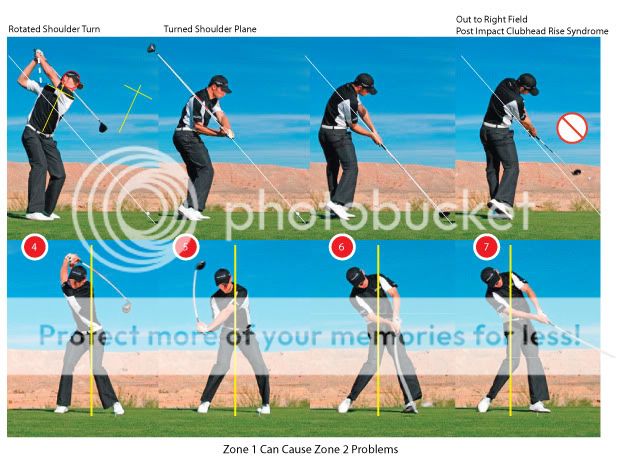
In the sequence below, #7, the Hips are out of alignment both Forward and front to back resulting in severe Axis Tilt and a Clubhead that rises above the Plane at Impact and Follow-through.
This Faulty Axis Tilt prevents his Left Hip from Turning as much as it needs. This Blocks his right hip from moving forward and forces it out toward the Plane Line too early. This prevents his right shoulder from continuing Down-Plane and Forward.
He may need to do this to get all of the distance he possibly can but imagine what it does to accuracy.
This Faulty Pivot really screws with Low Point, the Right Elbow, Impact Hand Location, Right Shoulder Location and Path, etc, etc.
Quote:
As I said, I was hitting the ball from my knees almost as far (and certainly as solidly) as I did while standing, and, in my prime, I consistently finished in the top 10 percent in driving distance while on tour. Don't forget, I was using a persimmon-headed, steel-shafted driver and a wound balata ball, let alone with no feet or legs!
The point here is, that, instead of driving my swing bottom forward and thus creating lag with my feet and legs, I relied on establishing a clear, forward-aiming point well out in front of my ball, and an aggressive forward shoulder and torso hip-turning motion to create the lag in my swing. Think of it this way: Because a club swung from the knees travels on a far more horizontal, or level-to-the-ground, arc than does one swung while standing up, the bottom, or low point, of such a swing also extends considerably more forward of the ball. Because this makes it easy to swing the club downward through and past the golf ball after impact, such a swing facilitates very solid contact as well. Certainly, it takes some time to get used to the initially awkward posture and geometry of hitting balls from the knees, but once done, you can really pound a golf ball that way.
Needless to say, the feet and legs add extra speed to the golf swing; but they become useless if they don't carry the hips and shoulders forward, to sustain the lag through the impact zone. I credit my efficient lag, created from the hips and shoulders, for driving the ball 250 yards, straight down the fairway. That means the feet and legs only had an additional 15 to 20 yards to give…….
The Impact Zone , Bobbie Clampett, Page 93
Bobby shows some of the same Pivot issues.
Having your head that far back keeps your shoulders that far back too. I bet his head doesn't move when he hits from his knees.
I noticed that on Bobby Clampett's actual drive his head swayed back even more. Not an unusual thing for a good player by any means but not necessary to my mind. I wondered if it was a compensation which moved his Left Shoulder back and gave him more time to Release. If thats what it is then you have to wonder if he could accomplish much the same thing without the Sway by just teeing the ball more forward in his stance. Dont get me wrong Id love to have Bobby's swing.
Those long drive guys have 4' long drivers or whatever and tend to Sway back too, I think to give them more time to Release their super long lever. You'll notice how Sadlowski's Sway increases during his Release, frames 5 to 6. There are ballistic, launch angle considerations too for sure, like he is creating an artificial up hill shot.
He's Canadian though and those guys are all kinda nutso, eh?
A Zone 1 compensation for a Snap Release related problem .......Bucket is going to be all over this one, I bet.
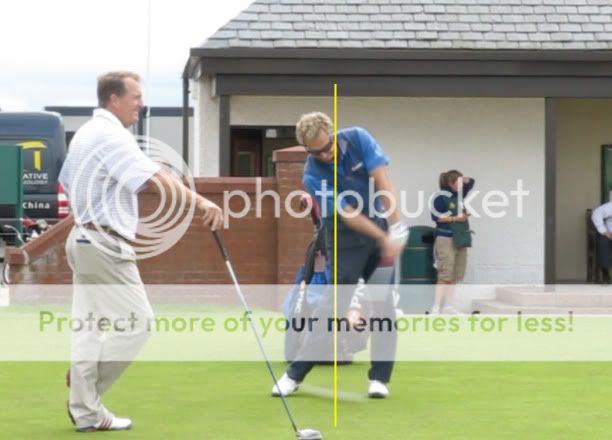
On the other hand, the head doesnt necessarily need to be positioned dead center between the feet does it? Isnt it dependent on the shot at hand? If you are in a fairway bunker or chipping or pitching or hitting out of the rough wouldnt you have your head more over your left side? Ive always noticed how Homer positioned his Head a little back of centre in this photo of him at Fix. From this position he wouldnt need to Sway back dynamically during the swing, its pre set, Fixed in a manner in accordance with the shot at hand.
I noticed that on Bobby Clampett's actual drive his head swayed back even more. Not an unusual thing for a good player by any means but not necessary to my mind. I wondered if it was a compensation which moved his Left Shoulder back and gave him more time to Release. If thats what it is then you have to wonder if he could accomplish much the same thing without the Sway by just teeing the ball more forward in his stance. Dont get me wrong Id love to have Bobby's swing.
Those long drive guys have 4' long drivers or whatever and tend to Sway back too, I think to give them more time to Release their super long lever. You'll notice how Sadlowski's Sway increases during his Release, frames 5 to 6. There are ballistic, launch angle considerations too for sure, like he is creating an artificial up hill shot.
He's Canadian though and those guys are all kinda nutso, eh?
A Zone 1 compensation for a Snap Release related problem .......Bucket is going to be all over this one, I bet.
On the other hand, the head doesnt necessarily need to be positioned dead center between the feet does it? Isnt it dependent on the shot at hand? If you are in a fairway bunker or chipping or pitching or hitting out of the rough wouldnt you have your head more over your left side? Ive always noticed how Homer positioned his Head a little back of centre in this photo of him at Fix. From this position he wouldnt need to Sway back dynamically during the swing, its pre set, Fixed in a manner in accordance with the shot at hand.
Sadlowski uses a 6.5 degree driver. He creates extra axis tilt so he can hit up on the driver - low spin high launch = long drives. No other way to do it but lean right and it up. JS can carry the ball 365 yds plus I have witnessed it in person.
Sadlowski uses a 6.5 degree driver. He creates extra axis tilt so he can hit up on the driver - low spin high launch = long drives. No other way to do it but lean right and it up. JS can carry the ball 365 yds plus I have witnessed it in person.
Yup, know what you mean, honestly , but it's a different game that one.
In TGM terms what you call "extra" Axis Tilt is a Head Sway. Not what you'd want for precision, Mechanically. You wouldnt design a machine that had an axis wobble, it would be imprecise and prone to wear and tear.
Having said that, I do lean back on occasion and let er fly. Its a type of shot.
This is a problem. It's not "so much" that your hips are controlling the shoulder turn but the way you turn your hips. There's no doubt that you have the right shoulder going way too far back and flat if you allow "turning hips" to direct them because that motion takes you off-plane. This is a sure way to make the clubhead go out to right field and rise above plane at and after impact.
Going out to right field is the "out" feel of the Downstroke. It is not intended for your shaft and clubhead to literally go to right field (Rise above the plane) at impact and follow-through. You must stay on-plane for a three dimensional impact. Use a Laser. I have a "Smart Stick Laser" that I use and I can "Rip" it through the Impact interval and I'm perfectly On-Plane but if I Turn too deep on the backstroke, like you, then the Laser goes to Right Field. That's not good and Impact is not a good time to use compensations.
If you rotate your hips around to turn them, then your right shoulder will go very deep and too flat and throw everything off plane. Please refer to exercise #5 and 6. March in-place while you swing your arms and you will learn the KEY to swinging on the TSP and how the Pivot can be aligned to automatically move the right shoulder On-Plane/Down-Plane every time without any effort. Keep the balls of your feet on the ground and lift your heels as you march. Experiment by exaggerating the "march" for you to feel that the Hips and Shoulders move differently but are synchronized. Don't pull the arms down, let the pivot do that. Notice that your Hips move in an alternating pattern from front to back and back to front while your shoulders move kind of up and down.
Please notice that your hips turn, but you aren't rotating them. The bending and straightening knees allow the turn.
HK said that if you can't get the right shoulder back to the plane during the backstroke, then use a steeper plane. In other words, use a TSP. Normal people don't have a problem getting the shoulder back to the Turned Shoulder Plane because it isn't very Far Back. In fact, from the deep shoulder turn you've become accustomed too, it will feel barely back at all.
...please keep a couple of things in mind. 1) I am greatful for the time you and the other people here spend explaining these great TGM insights. This is an amazing collection of golfers and golf insight. 2) I have had 11 hip operations and two total hip replacements since 1972. When I sleep at night, my left foot sticks straight up by itself. (KEEP YOUR MIND OUT OF THE GUTTER!!! ) The doctors at St. Mary's in Winona MN, broke my leg below my knee and rotated it so when I walk, my feet go forward and I do not drag my foot to the side. They were concerned about my social standing with members of the opposite sex not my ability to swing a golf club!
( I AM REALLY TEMPTED HERE TO ABUSE PEOPLE FROM A SMALL NORthEASTERN STATE BUT I AM RESTRAINING MYSELF. )
(THANK GOD JOHN WAYNE WAS POPULAR WHEN WE WERE YOUNGER. WHEN GIRLS INQUIRED ABOUT MY ANGULAR GAIT, I ASKED THEM HOW THEY FELT ABOUT JOHN WAYNE. I TOLD THEM I WAS A COWBOY WITH ALL THE ACCESSORIES..WHO KNEW THE BOY SCOUT KNOTS WOULD BE SO USEFUL?...BUT I DIGRESS! )
When I do those /these exercises my sense of balance is very different from yours or anyone else! I am very, very confused by the "synchronization" of my hips , shoulders and knees because I have not had a "normal" sense of coordination in 38 years. I do not wear a 1.5" lift in my left shoe because such lifts are illegal in USGA competition which is my ultimate goal, though that is the shortness in my front or left leg.
When I do exercises 2 and 4, it feels like I am walking up and down a flight of stairs, for example.
When you or another experienced TGM person explains something to me, I practice the insight for weeks. One of my regular foursome shot an "80" last week with every lucky bounce and he has an "18" hcp. Today, he shot a 93.
Because of TGM, I have shot a 42, 44, 42, 44, and 43 on the last 45 holes. I know I can shoot par or better, on purpose, on a regular basis if I can "translate" the TGM into my kinetic language and I know if I can apprehend those insights, I can teach them to others, regardless of their physical, social, emotional or intellectual perspectives.
SO BEAR WITH ME DARYL, I'M PADDLING AS FAST AS I CAN!
What I think you are saying Daryl, and again, thankyou for making the effort, (I mean it !) is:
1) The proper pivot is an organic motion that starts from the "use of the ground" going up. "The leg bone is indeed connected to the hip bone..."
2) The plane is the thing, first, last and in the middle.
3) Turning my back hip as a startup key is a disaster since the back shoulder is thrown far off plane.
4) The TSP is no joke. The left hand is kept on plane and the back or right shoulder is correctly aligned as a result.
5) The TSP prevents OTT when controlled from the ground up. Per exercises, 5 and 6, the shoulders must be held in front while marching, as much as possible. (That's the benefit of RFT and tracing the BLP as they keep the power package in front?) (Is this why Lynn emphasizes the "clapping motion" so much since the shoulders hardly move while doing that motion?)
6) For regular folks, marching while keeping the spine on the ball, thus the shoulders as forward as possible will force a coordination between knees and arms always on plane (front knee moves to the BLP, the arms move up-plane and vice-versa.). THOSE SWINGING ON PLANE ARMS ALLOW A PERSON TO HIT THE HECK OUT OF THE BALL!
Am I getting warmer?
Patrick
__________________
HP, grant me the serenity to accept what I cannot change, the courage to change what I can, and the wisdom to know the difference. Progress and not perfection is the goal every day!
Last edited by innercityteacher : 07-25-2010 at 01:04 PM.
Walking up and down stairs? Hmm? Ya, it's kind of like a "Stair Climber or Stair Stepper machine at the gym. So,, your feeling isn't far off.
The McDonald Drills are very, very good drills.
I'm not pushing or rushing you to improve. Hell, I don't expect you to shoot par for another month or two. Take your time. If you need an afternoon off from full stroke training; well ok. But, use this time to practice putting or bunker shots.
Walking up and down stairs? Hmm? Ya, it's kind of like a "Stair Climber or Stair Stepper machine at the gym. So,, your feeling isn't far off.
The McDonald Drills are very, very good drills.
I'm not pushing or rushing you to improve. Hell, I don't expect you to shoot par for another month or two. Take your time. If you need an afternoon off from full stroke training; well ok. But, use this time to practice putting or bunker shots.
Very thin bottoms of the bunkers. I open my 58 degr. wedge, play it back in the stance, lean forward (ball position reacts to depth of the bunker), and pick it. We putt out or hybrid out, a lot, too. EA keeps it and everything else on track, everything. The ball checks and releases quite often. But I have given up thread jacking for Lent so I will pursue this, later.
Thanks again, Daryl, everyone.
Patrick
__________________
HP, grant me the serenity to accept what I cannot change, the courage to change what I can, and the wisdom to know the difference. Progress and not perfection is the goal every day!
been trying to print the exercises but they are tiny, any idea how to print them?
__________________ The student senses his teacher’s steadfast belief and quiet resolve: “This is doable. It is doable by you. The pathway is there. All you need is determination and time.” And together, they make it happen.




 (KEEP YOUR MIND OUT OF THE GUTTER!!! ) The doctors at St. Mary's in Winona MN, broke my leg below my knee and rotated it so when I walk, my feet go forward and I do not drag my foot to the side. They were concerned about my social standing with members of the opposite sex not my ability to swing a golf club!
 )
) by the "synchronization" of my hips , shoulders and knees because I have not had a "normal" sense of coordination in 38 years. I do not wear a 1.5" lift in my left shoe because such lifts are illegal in USGA competition which is my ultimate goal, though that is the shortness in my front or left leg.


 Linear Mode


