Could someone tell me if there is a, 4 barrel swing pattern and a 4 barrel hit pattern? If there is two different patterns what are the differences. If there is only one pattern how would it be described, a hit or a swing or switting?
Please explain.
Could someone tell me if there is a, 4 barrel swing pattern and a 4 barrel hit pattern? If there is two different patterns what are the differences. If there is only one pattern how would it be described, a hit or a swing or switting?
Please explain.
1) YES
2) The difference is that one pulls and the other pushes
3) The sameness is that they both are using all four accumulators
4) Players choice - you could use a 4 barrel swinging pattern for putting if you wanted to
__________________
Life Goal- Developing a new theory of movement based on Brain Science
Interests - Dabbling with insanity
Hobbies- Creating Quality
I don't understand how it is possible to have a four barrel swinging action. I thought that the maximum was triple barrel (4:2:3) and that adding PA#1 would be switting.
I can imagine PA#1 release contributing to drag loading the clubshaft if the actively straightening right arm contributed to the release of either PA#4 or #2 in a coordinated/complementary manner. However, how would that be possible? How can active PA#1 release at a certain point in the downswing produce a better left arm movement than the standard method of releasing PA#4 in a pivot-driven swing? Also, how can contributory active PA#1 release improve on the centrifugal release action of PA#2?
I not only cannot understand how a four barrel swing action can be better than a triple barrel swing action (4:2:3) -I also cannot understand how it can be even be equal (because active release of PA#1 can cause considerable interference/harm in a swinger's action).
How can active PA#1 release at a certain point in the downswing produce a better left arm movement than the standard method of releasing PA#4 in a pivot-driven swing? Also, how can contributory active PA#1 release improve on the centrifugal release action of PA#2?
Jeff.
I'll take sound Three Barrel (4-2-3) over a Four Barrel any day, regardless of how wide the fairway is. Plus, you get better gas mileage .
Hmm just wondering. Tiger's driver is great on the range but not so on the course......could it be the addition of #1 to his 3 barrel swinging motion when he steps through the ropes?
Could someone tell me if there is a, 4 barrel swing pattern and a 4 barrel hit pattern? If there is two different patterns what are the differences. If there is only one pattern how would it be described, a hit or a swing or switting?
Please explain.
There is a 4-Barrel Swinging pattern in the 3rd Edition. Tomasello Chapter video series contains a 4 barrel swinging pattern.
I have viewed the TT swing videos (including his "Letter to Lee Dietrick" videos) many times, and I have attempted to use the "right arm" in a variety of ways to supply a "hitting action" while swinging. I still cannot understand why it will not adversely interact with a centrifugal-induced PA#2 release phenomenon (passive release of PA#2). Can you explain in words how one can usefully supply a "right arm hit force" when using a swinger's 4:2:3 release action (that is critically dependent on the passive release of PA#2)?
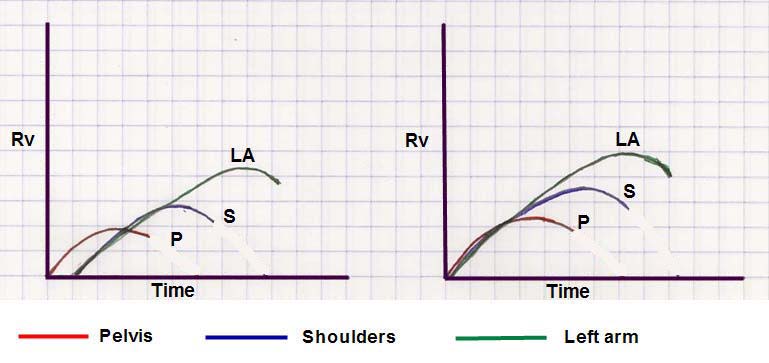
Here is a hand-drawn graph showing the kinetic sequence in a good golfer who uses a swinger's action.
Diagram 1 represents an optimal kinetic sequence where the pelvis rotates before the shoulders ala Hogan (creating increased torso-pelvic separation in the early downswing) while diagram 2 shows a golfer who rotates the pelvis/shoulders equally fast at the start of the downswing (ala Hardy OPS). Either way, both golfers can optimally release PA#4 in such manner that left arm speed is maximal in the mid-downswing.
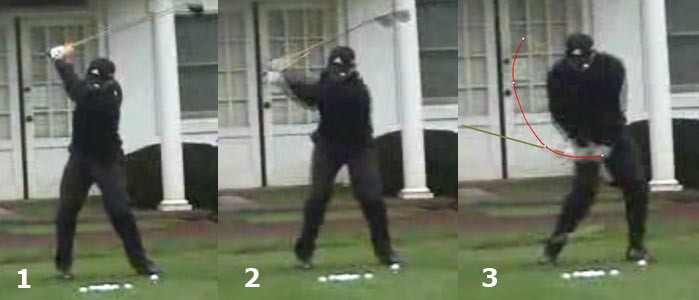
Now look at Sergio's downswing hand arc.
His U-shaped hand arc has its tightest turn (smallest radius) at the exact moment when his left arm, and therefore left hand/wrist, is traveling at its maximum speed (because his kinetic sequence is similar to diagram 1 above). That means that the force inducing a centrifugal release of PA#2 is maximal at that late release time point. He simply has to allow PA#2 to release passively (according to the laws of physics) to acquire maximal clubhead speed into impact.
How could a "right arm hit action" at some time-point in his downswing improve on his swinger's action?
There is a 4-Barrel Swinging pattern in the 3rd Edition. Tomasello Chapter video series contains a 4 barrel swinging pattern.
DG
Homer's words:
It theoretically meets maximum Power demands.
It is the most complicated "orthodox" uncompensated procedure.
It also has the greatest margin of error in execution.
It requires the most practice, fortitude and dedication.
It is for the gifted competitor.
Except for the driver, why not just switch to a longer club and avoid the risk?


 .
.


 Linear Mode


