You wrote-: "NOT Yoda . . . but most of that spine is left . . . Looks like the upper and lower are pretty much lined up".
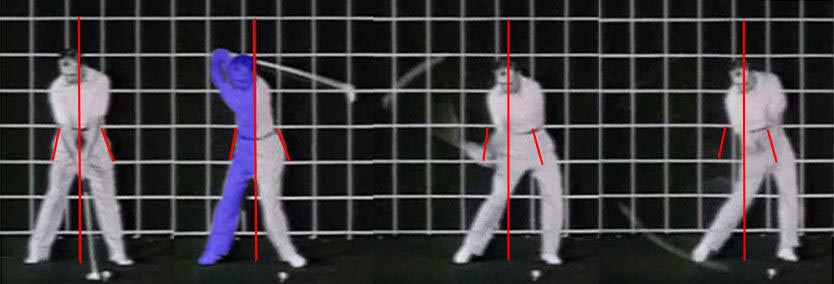
We see reality very differently. I see the classic Hogan reverse K position with a lot of rightwards torso/spinal tilt. The upper torso/spine is only left-of-center because his entire pivoting body is left-of-center. That body-left-of-center pivot is classically seen in the S&T swing (where the body is loaded over the left leg and not the right leg at the end-backswing position) - but S&T golfers don't have a rightwards spinal tilt like Hogan.
You wrote-: "NOT Yoda . . . but most of that spine is left . . . Looks like the upper and lower are pretty much lined up".
We see reality very differently. I see the classic Hogan reverse K position with a lot of rightwards torso/spinal tilt. The upper torso/spine is only left-of-center because his entire pivoting body is left-of-center. That body-left-of-center pivot is classically seen in the S&T swing (where the body is loaded over the left leg and not the right leg at the end-backswing position) - but S&T golfers don't have a rightwards spinal tilt like Hogan.
Could it be that Hogan had a big giant azz and barkley hips that is distorting some of this?
Jeff is there a frame between the address and the top? I think he pushes his hips right and then they go left early back to his original address waste bend giving the impression that he baked a lil' pie at the top. When his backfield has really reversed field.
Again . . . I think people can find a Hogan motion to support several pivot theories . . . He could manipulate everything . . . . true genius.
__________________
Aloha Mr. Hand
Behold my hands; reach hither thy hand
Last edited by 12 piece bucket : 12-08-2008 at 08:57 PM.
You wrote-: "Jeff is there a frame between the address and the top? I think he pushes his hips right and then they go left early back to his original address waste bend giving the impression that he baked a lil' pie at the top. When his backfield has really reversed field."
There are many missing frames. Hogan definitely moves his pelvis left-laterally during the late backswing (when his club is still moving backwards).
I am not sure why Yoda wanted to discuss Hogan's move. He may have a particular point that he wants to make.
Jeff.
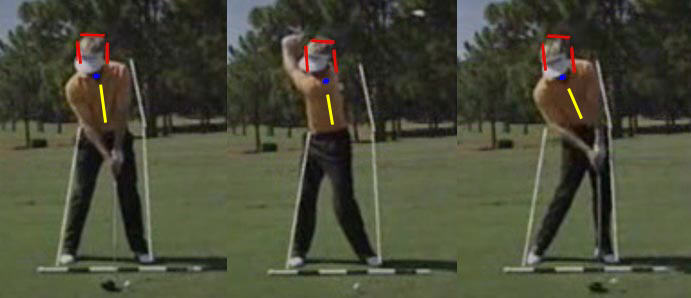
p.s. As a side-issue, Yoda states in his Alignment Golf DVD that one should center the head between the feet at address, and then acquire rightwards spinal tilt by shifting the pelvis left-laterally. Hogan doesn't do that - you can see that his head is behind the center of his stance at address. He also moves his head ahead of that center line during the downswing.
Last edited by Jeff : 12-08-2008 at 11:20 PM.
Reason: add more comments
I am not sure why Yoda wanted to discuss Hogan's move. He may have a particular point that he wants to make.
No particular bias or point to make, Jeff. Just wanted to establish that the line you drew in your Post #4 above (from Hogan's waist to his head) did not represent his spine.
As a side-issue, Yoda states in his Alignment Golf DVD that one should center the head between the feet at address, and then acquire rightwards spinal tilt by shifting the pelvis left-laterally. Hogan doesn't do that - you can see that his head is behind the center of his stance at address. He also moves his head ahead of that center line during the downswing.
Jeff,
What I advise is that golfers work diligently to acquire a stable Pivot Center, either the Head (2-0) or Point-Between-the-Shoulders (Glossary). Homer Kelley recommended the Head Center but did not mandate it (2-H). The Head 'Centered between the Feet' is a good idea, especially with the proviso -- per 1-L #2 -- that the Chin be permitted to Swivel right and left. [As Johnny Miller has observed, "The chin has a 'swing' of its own."] In any event, Geometric Golf demands a Centered Arc (1-L #1 and #2). At least as Centered as we humans are able to accomplish.
Now, assuming that stable Center is in place, any Hip Shift (right or left) will result in a Spine Tilt. As with the pendulum of a grandfather clock swinging from its hinge pin, that tilt will be either away from the target or towards it.
Clearly, through Impact, Hogan has both a Centered Head and a decided Hip Shift. Are you saying that he does not acquire a "rightwards spinal tilt by shifting the pelvis left"?
You wrote-: "Jeff is there a frame between the address and the top? I think he pushes his hips right and then they go left early back to his original address waste bend giving the impression that he baked a lil' pie at the top. When his backfield has really reversed field."
There are many missing frames. Hogan definitely moves his pelvis left-laterally during the late backswing (when his club is still moving backwards).
I am not sure why Yoda wanted to discuss Hogan's move. He may have a particular point that he wants to make.
Jeff.
p.s. As a side-issue, Yoda states in his Alignment Golf DVD that one should center the head between the feet at address, and then acquire rightwards spinal tilt by shifting the pelvis left-laterally. Hogan doesn't do that - you can see that his head is behind the center of his stance at address. He also moves his head ahead of that center line during the downswing.
Side issue . . . again . . . . that is one swing . . . and a driver in particular. You can watch the Hogan vs. Snead Shell deal. Hogan makes a different looking swing with the driver than with the irons. I pretty much sets up "on top of it" with the irons and stays there. I watched the "grid" swing too. The head does move some . . . but not a whole lot. Homer said steady head, not motionless.
I watched the "grid" swing too. The head does move some . . . but not a whole lot.
In this "Hell bent for leather" stroke, with maximum Pivot Participation and Arm Swing, the back of Ben Hogan's head never leaves the vertical grid line. It correctly swivels (per 1-L #2), and it Bobs a smidgeon, but it nonetheless remains anchored to the grid.
Put up a handicap golfer -- or even a TOUR player or three (past and present) -- and let's see how they do on the 'grid' test.
Now, the surveyor gets out his transit, measures off against his control points, and says "Ben set his head 1.1263 inches to the right of center at address and then moved it to .34 inches ahead of center at impact." I say, fine. Does that mean I should teach my students to set their heads 1.1263 inches to the right of center at address and move it .34 inches ahead at impact?
Please.
Students need to learn the correct Pivot -- the correct circular motion of the Body -- and the correct Action of its Components (Feet, Knees, Hips and Shoulders) . . . not how to move the Head back and forth one inch.
Learn to Pivot, guys. And learn to keep your Head still while you're doing it. Picture the spinning skater and Center your arc. Make it the subconscious lynch pin of your Stroke, and introduce a new consistency to your game.
Yoda - I agree with everything you say in post #27.
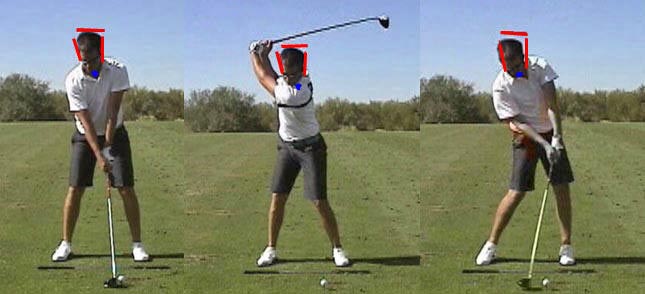
I personally like your idea of keeping the head centralised between the stance at address, and then shifting the pelvis slightly leftwards to get slight right spinal tilt. However, I have noticed that many PGA tour players prefer to have their head slightly behind the center of their stance at address.
I agree that they generally all have very stationary heads, except for slight head swivelling.






 Linear Mode


