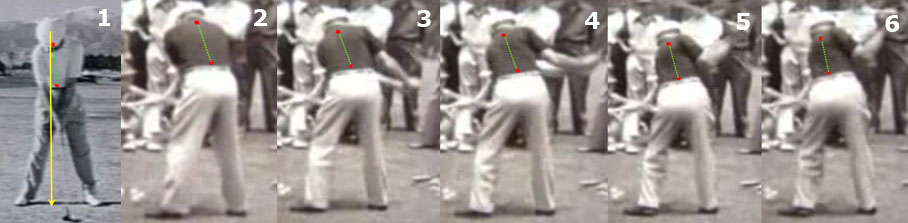
Yoda - here is another series of images that you may enjoy.
The two red dots were placed approximately over L5 and C7, and the green dotted line is simply a straight line joining those two points.
It may look like the spine is tilting left. However, that is only because one is looking at a three-dimensional motion (viewed from an angle) as a 2-dimensional image representation. Conceptually, I have no reason to believe that the spine angle tilt changes during the backswing action - even though the spine is spiraling in space.
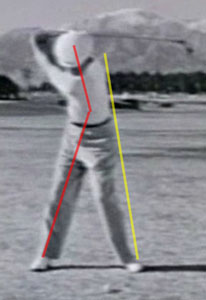
Thanks for these instructive views. I find Photos 4-6 particularly compelling. The point I've been making for almost four years now is that almost all great players swing about a reasonably Centered and Stationary Head (or, alternataively, the "Point between the Shoulders"). As a result, the spine remains vertical or, in some players, e.g., Colin Montgomery or Sergio Garcia, may even tilt a smidgeon toward the target.
The reason I've hammered on this is that many teachers take the opposite approach; namely, that the Head should Sway to the right on the Backstroke and that the player's back should assume a significant lean away from the target. They presume that this so-called "slice of pie" -- the 'wedge' created when the back leans away from the vertical -- is characteristic of the ideal pivot and a source of additional power. Nothing could be further from the truth. In fact, it is nothing more than an old-fashioned Sway that only disrupts the ideal Centered Arc and makes any real consistency diffficult, if not impossible.
I recommend golfers adopt the Pivot shown here: http://www.putfile.com/pic/5075264. [Golf, Bob MacDonald, 1927] Note the vertical spine and the relative degrees of circular Hip and Shoulder Turns. To my mind, this is one of the most important illustrations in the history of written golf instruction.
I believe that a golfer should adopt a certain degree of rightwards spinal tilt at address. One can acquire that small degree of rightwards spinal tilt by keeping the head in the center of the stance (or minimally right-of-center) and then shifting the pelvis left-laterally.
Then during the backswing, one rotates the torso around that small degree of rightwards spinal tilt in a neutral manner - with no swaying or tilting or movement of the head. That results in no change of the degree of rightwards spinal tilt at the end-backswing position (compared to the address position). I personally believe that Ben Hogan and Tiger Woods do that.
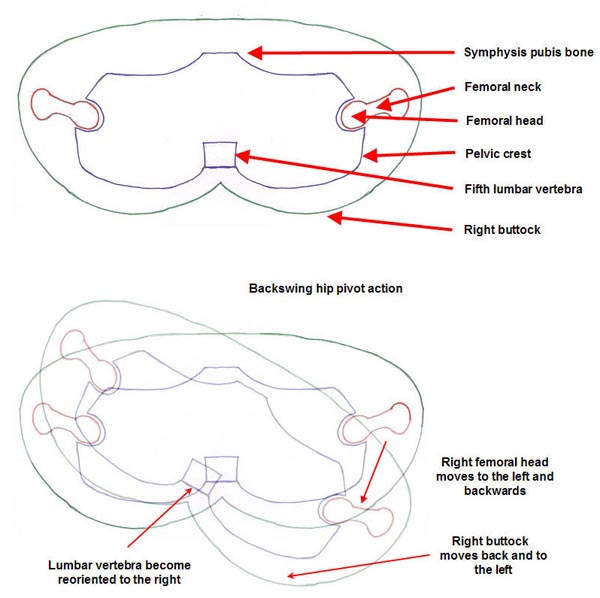
However, the issue is complex because of the spiraling of the spine. When the pelvis rotates 45 degrees, that shifts the lumbar spine to the left and reorients the front of the lumbar vertebrae to the right (by about 45 degrees) as shown in this next diagram.
The reorientation of the lumbar vertebrae affects the thoracic spine (because the lumbar vertebrae are incapable of much rotary movement due to the anatomical structure of their pedicles) and this causes the upper torso to rotate around a thoracic spine whose vertebrae are also reoriented (face) to the right, and this thoracic vertebral reorientation allows the upper torso to rotate freely around the rightwards tilted/spiraled spine. When the lumbar vertebra are moved left-laterally (due to the 45 degree pelvic rotation) and the head remains stationary, then theoretically the degree of rightwards spinal tilt should increase. However, the rotation of the upper torso is greater than the lower torso and it torques the spine in a clockwise manner. That torquing action has a verticalising effect on the spiraling thoracic spine and gives the mid-upper spine a more vertical appearance - although the overall spinal tilt is rightwards. The overall rightwards spinal tilt causes the right upper torso to slant rightwards - and that rightwards torso tilt is not due to swaying.
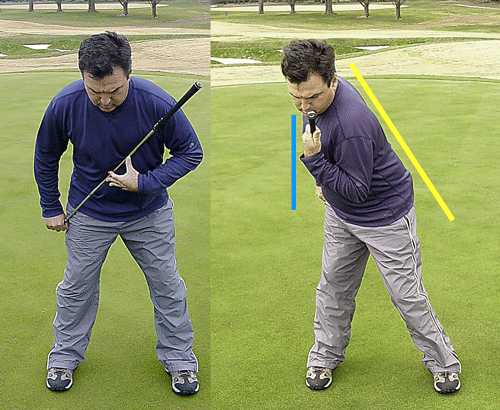
Here is Brian Manzella demonstrating his Guardsman drill.
That significant degree of rightwards torso tilt (away from the target) is not a sway - it is secondary to rotating the pelvis 45 back while allowing his head to freely move with his tilting upper torso into a reverse K posture. If he kept his head rigidly stationary while performing this pelvic maneuver, then he would "feel" a tightening in the mid-upper thoracic spine area as the spine becomes verticalised. When one keeps the head stationary it forces the mid-upper thoracic spine to become more vertical and prevents such an exaggerated degree of rightwards torso tilt. However, there will still be a small degree of rightwards torso tilt away fom the target, and that can be seen in Hogan's end-backswing reverse K posture (despite a verticalised mid-upper thoracic spine).
That MacDonald exercise 4 is a distortion because she is standing erect. If the she performed that same pivot maneuver while bending over 40 degrees, she would develop a reverse K posture - because the degree of rightwards torso tilt increases slightly more with each degree of forward bending.
Jeff.
Last edited by Jeff : 12-10-2008 at 04:21 PM.
Reason: add another paragraph at the end
Thanks for these instructive views. I find Photos 4-6 particularly compelling. The point I've been making for almost four years now is that almost all great players swing about a reasonably Centered and Stationary Head (or, alternataively, the "Point between the Shoulders"). As a result, the spine remains vertical or, in some players, e.g., Colin Montgomery or Sergio Garcia, may even tilt a smidgeon toward the target.
The reason I've hammered on this is that many teachers take the opposite approach; namely, that the Head should Sway to the right on the Backstroke and that the player's back should assume a significant lean away from the target. They presume that this so-called "slice of pie" -- the 'wedge' created when the back leans away from the vertical -- is characteristic of the ideal pivot and a source of additional power. Nothing could be further from the truth. In fact, it is nothing more than an old-fashioned Sway that only disrupts the ideal Centered Arc and makes any real consistency diffficult, if not impossible.
I recommend golfers adopt the Pivot shown here: http://www.putfile.com/pic/5075264. [Golf, Bob MacDonald, 1927] Note the vertical spine and the relative degrees of circular Hip and Shoulder Turns. To my mind, this is one of the most important illustrations in the history of written golf instruction.
YES SIR!!!
One of the main deals too is if you move your head back there . . . and then LEAVE IT back there or worse move it more back on the down stroke . . . . it's like a that bulldawg that chases Tom from Tom & Jerry . .. eventually the chain don't let you go no more . . . . hello my lil' friend Mr. Checkrein . . . . the dawg wants to keep going but can't . . . well in our case the dawg is the club . . . that hang back garbage leads to compromised flails . . . and at best a clubface that SLINGS shut REALLY REALLY fast. Fleeting clubface alignments = ball go everywhere if timing no good. You want a pivot that allows you to
1. Control Low Point
2. Control Selected Plane Angle
3. Have the ability to have a predictable Clubface motion
I believe that a golfer should adopt a certain degree of rightwards spinal tilt at address. One can acquire that small degree of rightwards spinal tilt by keeping the head in the center of the stance (or minimally right-of-center) and then shifting the pelvis left-laterally.
Then during the backswing, one rotates the torso around that small degree of rightwards spinal tilt in a neutral manner - with no swaying or tilting or movement of the head. That results in no change of the degree of rightwards spinal tilt at the end-backswing position (compared to the address position). I personally believe that Ben Hogan and Tiger Woods do that.
However, the issue is complex because of the spiraling of the spine. When the pelvis rotates 45 degrees, that shifts the lumbar spine to the left and reorients the front of the lumbar vertebrae to the right (by about 45 degrees) as shown in this next diagram.
The reorientation of the lumbar vertebrae affects the thoracic spine (because the lumbar vertebrae are incapable of much rotary movement due to the anatomical structure of their pedicles) and this causes the upper torso to rotate around a thoracic spine whose vertebrae are also reoriented (face) to the right, and this thoracic vertebral reorientation allows the upper torso to rotate freely around the rightwards tilted/spiraled spine. When the lumbar vertebra are moved left-laterally (due to the 45 degree pelvic rotation) and the head remains stationary, then theoretically the degree of rightwards spinal tilt should increase. However, the rotation of the upper torso is greater than the lower torso and it torques the spine in a clockwise manner. That torquing action has a verticalising effect on the spiraling thoracic spine and gives the mid-upper spine a more vertical appearance - although the overall spinal tilt is rightwards. The overall rightwards spinal tilt causes the right upper torso to slant rightwards - and that rightwards torso tilt is not due to swaying.
Here is Brian Manzella demonstrating his Guardsman drill.
That significant degree of rightwards torso tilt (away from the target) is not a sway - it is secondary to rotating the pelvis 45 back while allowing his head to freely move with his tilting upper torso into a reverse K posture. If he kept his head rigidly stationary while performing this pelvic maneuver, then he would "feel" a tightening in the mid-upper thoracic spine area as the spine becomes verticalised. When one keeps the head stationary it forces the mid-upper thoracic spine to become more vertical and prevents such an exaggerated degree of rightwards torso tilt. However, there will still be a small degree of rightwards torso tilt away fom the target, and that can be seen in Hogan's end-backswing reverse K posture (despite a verticalised mid-upper thoracic spine).
That MacDonald exercise 4 is a distortion because she is standing erect. If the she performed that same pivot maneuver while bending over 40 degrees, she would develop a reverse K posture - because the degree of rightwards torso tilt increases slightly more with each degree of forward bending.
Jeff.
So you are saying we are to move off the ball a foot or so . . . . Hogan isn't pivoting that way . . . plus it's a driver . . . . most of the pros stay right on top of it with irons.
You guys can try to figure out the most biomechanically efficient pivot for creating speed if you want . . . I chose to pivot in a way that you get sufficient speed with out compromising precision.
Thanks for these instructive views. I find Photos 4-6 particularly compelling. The point I've been making for almost four years now is that almost all great players swing about a reasonably Centered and Stationary Head (or, alternataively, the "Point between the Shoulders"). As a result, the spine remains vertical or, in some players, e.g., Colin Montgomery or Sergio Garcia, may even tilt a smidgeon toward the target.
The reason I've hammered on this is that many teachers take the opposite approach; namely, that the Head should Sway to the right on the Backstroke and that the player's back should assume a significant lean away from the target. They presume that this so-called "slice of pie" -- the 'wedge' created when the back leans away from the vertical -- is characteristic of the ideal pivot and a source of additional power. Nothing could be further from the truth. In fact, it is nothing more than an old-fashioned Sway that only disrupts the ideal Centered Arc and makes any real consistency diffficult, if not impossible.
I recommend golfers adopt the Pivot shown here: http://www.putfile.com/pic/5075264. [Golf, Bob MacDonald, 1927] Note the vertical spine and the relative degrees of circular Hip and Shoulder Turns. To my mind, this is one of the most important illustrations in the history of written golf instruction.
So there is a value of knowing "6 degrees of freedom" ......
__________________
Golf is an impossible game with impossible tools - Winston Churchill
I would have to agree with the Japanese chicken flinger, head over right foot equals smoke hook or some other horrible result
__________________ Hitting the Ball is the easiest part of the game-hitting it effectively is the most difficult. Why trust instinct when there is a science."1-G.
I never stated that one should allow the head to move 12" in response to the pelvic rotation. I merely stated that the head would move by that amount if the golfer didn't deliberately restrain that natural movement by keeping the head stationary. Keeping the head stationary forces the mid-upper thoracic spine to become verticalised, which is a necessary biomechanical phenomenon if one wants to keep the upper swinger center stationary during the swing (which is very desirable).
I never stated that one should allow the head to move 12" in response to the pelvic rotation. I merely stated that the head would move by that amount if the golfer didn't deliberately restrain that natural movement by keeping the head stationary. Keeping the head stationary forces the mid-upper thoracic spine to become verticalised, which is a necessary biomechanical phenomenon if one wants to keep the upper swinger center stationary during the swing (which is very desirable).
Jeff.
Jeff . . . Why should we pivot like that?
What does "natural" movement mean and in what context? Is there anything "natural" about swinging a golf club? I understand the deal with biomechanics . . . . but biomechanics to WHAT PURPOSE? Do biomechanic types know how golf clubs work?
Golf instructors have created a whole world of slicers with this concept that you have to "get behind the ball."






 B. J. Hathaway, G.S.E.B., M.C.I.


 Linear Mode


