I should qualify that.... I believe the final UP thing is that "pumping" the pendulum thing (parameteric acceleration). http://sciencelinks.jp/j-east/articl...06A1001780.php By the time they're going up and back they've already done everything possible to delay release and speed up the clubhead (shorten the radius)
So its done prior to low point or impact maybe? Is that you mean? I need some string.
Is there a dynamic / physics advantage in doing this:
Which outweighs any variation in alignments which may be out of synch by not swinging from a fix head position?
I don't think there is an advantage for golfers who keep score. Espescially those that have work schedules.
I think there is a form of loading the legs and pushing off the ground that would allow for a stable center, much like, and including, staying centered with hula hula.
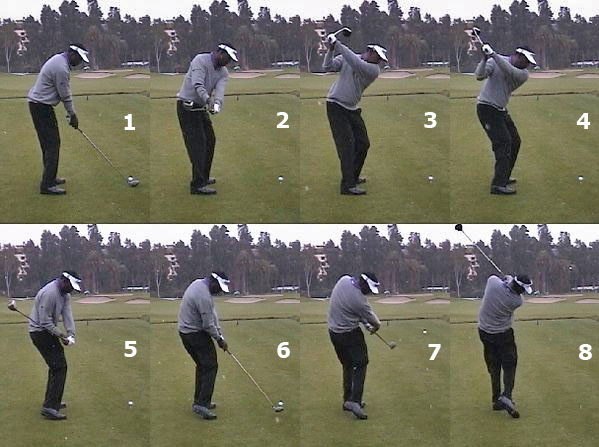
I agree that he is flexing his knees during the backswing. Biomechanically, he is still performing the same motion - bracing the knees by flexing the knees so that they are ready to withstand the downward arm swing thrust action movement without losing any body angles or balance. Theoretically, that knee flexing action could presumably occur in the early downswing - just before, and in anticipation of, the downward arm thrust action movement.
Here are images of VJ Singh where it appears that his knee flexing action occurs in the early downswing and not the backswing.
Not all PGA tour golfers seem to need that knee-flex action.
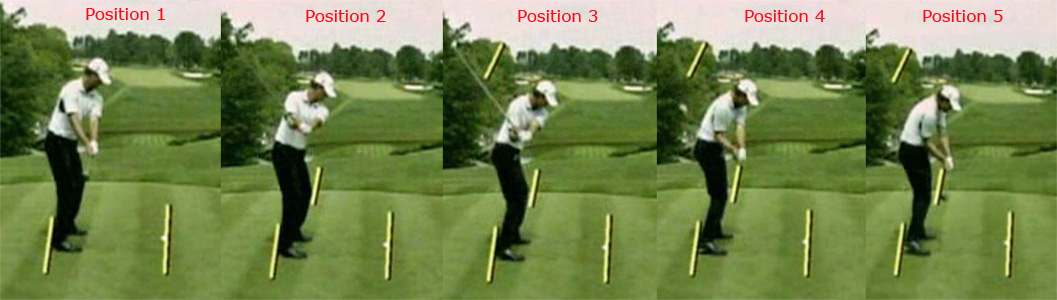
Here are a series of images of Adam Scott. His knee flex angle doesn't seem to change much during his backswing/downswing.
Position 1 and 2 = backswing, positions 3 and 4 and 5 = downswing.
Jeff.
Biomechanically, can one jump higher from a static bent knee posture or down and up motion?
I imagine that one could jump higher with a dynamic bend rather than a static knee bend.
However, what's the relevance of the jumping-up part?
My mental image of this knee-flexing action is that it is designed to stablise the golfer in his downward thrust action - a form of bracing equivalent to the bracing action of a "firm left leg" that is needed to brace a golfer against the forward momentum generated by the rotating arms/clubshaft.
David Lee, in his book "Gravity Golf" described a counterfall action directed 70 degrees left of the target - that he felt was required to stablise the torso during the down-and-out thrust action of the arms during the early-mid downswing.
I think that all these stabilising movements allow a golfer to swing faster and still remain in balance, but I don't think these movements are prime sources of added power.
I have become more conservative since I discovered TGM's system of power accumulator loading/release. I am skeptical of any "new" idea of generating more swing power - if the "new" idea cannot be explained in TGM terms/concepts. Consider the idea of a second hip/shoulder firing. How could it increase swing power? I think that any proponent of that "new" idea would have to demonstrate how it increases power via the PA system - which is essentially an arm power system. They would have to demonstrate how body power translates into increased arm power at a time point in the downswing when added arm power is useful, rather than harmful.
I imagine that one could jump higher with a dynamic bend rather than a static knee bend.
However, what's the relevance of the jumping-up part?
My mental image of this knee-flexing action is that it is designed to stablise the golfer in his downward thrust action - a form of bracing equivalent to the bracing action of a "firm left leg" that is needed to brace a golfer against the forward momentum generated by the rotating arms/clubshaft.
David Lee, in his book "Gravity Golf" described a counterfall action directed 70 degrees left of the target - that he felt was required to stablise the torso during the down-and-out thrust action of the arms during the early-mid downswing.
I think that all these stabilising movements allow a golfer to swing faster and still remain in balance, but I don't think these movements are prime sources of added power.
I have become more conservative since I discovered TGM's system of power accumulator loading/release. I am skeptical of any "new" idea of generating more swing power - if the "new" idea cannot be explained in TGM terms/concepts. Consider the idea of a second hip/shoulder firing. How could it increase swing power? I think that any proponent of that "new" idea would have to demonstrate how it increases power via the PA system - which is essentially an arm power system. They would have to demonstrate how body power translates into increased arm power at a time point in the downswing when added arm power is useful, rather than harmful.
Jeff.
Jeff,
I'm skeptical too. The more I figure out, the more Homer rings true. In fact, the more I think about moving my power package fast, the father the ball goes. But, I do notice that the guys that hit it really far in the air tend to go from bent legs to straight legs.
I'm skeptical too. The more I figure out, the more Homer rings true. In fact, the more I think about moving my power package fast, the father the ball goes. But, I do notice that the guys that hit it really far in the air tend to go from bent legs to straight legs.
So this bent to straight leg thing, aint in the book? Is that right?
Thats ok , though right. Homer did say "because of question of all kinds....
HB - I think that going from a bent knee position in the downswing to a straight left leg position at impact is nothing more than the O factor principle - as described by Robert Baker in his swing video lesson. It simply depends on how much of a positive O factor one wants to acquire at impact. Some golfers like Tiger Woods have a very straight left leg at impact (which is partially responsible for his left knee damage) while other golfers keep their left knee slightly flexed at impact.
I agree with Robert Baker that it is a good idea to have a positive O factor at impact, but greater amounts of O factor do not necessarily correlate with increased clubhead speed. One only needs enough O factor to get secondary axis tilt that allows the right shoulder to move downplane, which allows for the correct in-to-square-to-in clubhead swingpath when PA#4 releases the left arm into impact.
Ive got to find my Bertrand book to crack this "level left" thing that I keep hearing about. We can leave it for another day if it is off topic.
Love the left leg extension its helping me out nicely, but still have money on Yoda saying its a hip action of some sort. I could be wrong.
Homer ascribed the movement of the left shoulder to the action of the right shoulder if memory serves me well. I can see how the right shoulder driving on plane would send the left shoulder up, way up. Is this congruent to your thinking, though opposite shoulder minded?
Best be careful with the Georgia Bull Dog cracks around here , you know those guys like a fight and are very tight, them being all related and all.......
Cheers
O.B.
It's not JUST leg extension . . . EVERYTHING stretches out . . . spine and arms too . . . but without disrupting the centered pivot ideally. Not saying that that compression deal Hogan and Tiger do is wrong . . . just maybe not necessary for mortal golfers. You can have some of that flex extend deal without having your head moving like that . . .they don't hit it fat .. . don't mean we won't have disruption though.
HB - I think that going from a bent knee position in the downswing to a straight left leg position at impact is nothing more than the O factor principle - as described by Robert Baker in his swing video lesson. It simply depends on how much of a positive O factor one wants to acquire at impact. Some golfers like Tiger Woods have a very straight left leg at impact (which is partially responsible for his left knee damage) while other golfers keep their left knee slightly flexed at impact.
I agree with Robert Baker that it is a good idea to have a positive O factor at impact, but greater amounts of O factor do not necessarily correlate with increased clubhead speed. One only needs enough O factor to get secondary axis tilt that allows the right shoulder to move downplane, which allows for the correct in-to-square-to-in clubhead swingpath when PA#4 releases the left arm into impact.
Jeff.
Interesting stuff in regards to extension and flex.




 Linear Mode


