No. I am not plowing new ground. I am simply using words, and pictorial examples, to explain relevant Newtoniain laws that pertain to this issue of "centripetal acceleration" (as I understand those laws).
Although, nmgolfer labels me "clueless", I believe that all my posts are fully compatible with the Newtonian laws expressed in all those links.
That's why I am very comfortable with the idea of having him dissect my opinions as thoroughly as possible. It is interesting that nmgolfer is full of bluster about my "cluelessness", but doesn't offer a detailed argument explaining why my many posted explanations are inaccurate and incompatible with Newtonian laws.
I am not plowing new ground. I am simply using words, and pictorial examples, to explain relevant Newtoniain laws that pertain to this issue of "centripetal acceleration" (as I understand those laws).
Great, Jeff. I thought that was your intent. Thanks!
Instead of calling me clueless, why don't you use your superior knowledge to point out the errors in my understanding of the term "centripetal force". There are many other forum members who could benefit if you share your knowledge in a constructive fashion - by demonstrating my faulty reasoning.
Consider my understanding of the term "centripetal force".
In a previous post (#264) I wrote the following-: "Imagine that there a million points on that hypothetical circle's circumference, and imagine that an orbiting object (traveling at a constant finite speed) has to move from from one point on the circumference to the next point on the circumference to the next point on the circumference -- and that it has to complete this process one million times to complete one orbit. In each of those movements (from one point to the next point), the orbiting object needs a tangential force to move it at its constant "finite" speed and a centripetal force to keep it moving on the circular path."
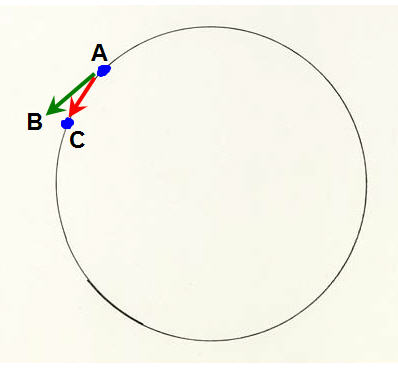
Now, consider the following diagram.
I mentioned that one could mentally picture that there a million time-points that the orbiting object will pass through on its circular orbit around one circumference of the circle in one second.
Now, imagine that the orbiting object is at point A. Then, one millionth of a second later the object is at point C.
What forces are in play to move the orbiting object from point A to point C, and do those forces involve the use of energy?
I believe that two forces are in play. The first force is a tangential force that moves the object in a straight line direction with enough energy to keep the object traveling at the same speed. In one millionth of a second, if that tangential force was operant, and no centripetal force was present, then the object should end up at point B (having traveled in a straight line at a 90 degree angle to the circumference of the circle).
If the orbiting object ends up at point C, then we can reasonably conclude that a centripetal force is present. What did that centripetal force actually do? I think that the centripetal force applied centripetal acceleration that moved the orbiting object more inwards (towards the center of the circle) so that it ends up at point C instead of point B. The centripetal force, in theory, should direct the orbiting object to the center of the circle. However, the amount of energy that the centripetal force has is only sufficient to bend the path of straight line movement of the orbiting object enough to get it to point C in one millionth of a second - in other words, the centripetal force has enough energy to keep the orbiting object traveling on a constant circular path. The centripetal force when operant is manifesting its force (energy) and it is therefore doing work to get the orbiting object to end up at point C instead of point B.
Please explain the errors in my reasoning?
Thanks,
Jeff.
p.s. I did read all those links.
Jeff
i am no physics buff but what about if its the other way around..i.e if there is no tangential force it would end up at point B..nice drawing btw
I mentioned that one could mentally picture that there a million time-points that the orbiting object will pass through on its circular orbit around one circumference of the circle in one second.
Now, imagine that the orbiting object is at point A. Then, one millionth of a second later the object is at point C.
What forces are in play to move the orbiting object from point A to point C, and do those forces involve the use of energy?
Jeff,
You've already drawn two vectors in your figure, so let's just start by saying that a vector is a directed size. In our case it will either be a directed force or a directed velocity.
If the object is already moving in a circle you don't need the B force vector to move it from A to C. You only need a centripetal force from A to Origo to do that. So your diagram need an invard pointing vector to be complete. Origo is the center of the circle, btw.
The centripetal force simply adjust the direction a little all the time, so the object is forced to move in a circle instead of going straight ahead. It can be a string attached to a pole or it could be a physical path that forces the object to circulate. As long as there's no friction loss, air drag or other resistance that consumes energy, the object will spin forever.
The centripetal force doesn't do any work in a Newtonian sense. It doesn't increase the speed. It doesn't overcome any resistive loss if any of such is present. It only changes the direction of the mass movement.
If you apply a B force vector to the system the speed of the moving object will be increased. But only to the the extent that the force vector points in the same direction as the object is moving. It's the B forces that produces the swing speed.
Work is Force X Distance (has units of energy)
Power is Work / time."
Your formula is wrong when you state that work = force X distance.
One also needs to consider the work force needed to stay in balance when moving in a circular manner. Centripetal force is constantly operating to keep an object in its circular track while traveling at a constant speed - and if the centripetal force is operant, then it is contributing to work (energy) output by preventing the object from flying off its circular path.
Jeff,
The formula is 100% correct. Without exception. This is very basic physics.
The efforts to stay in balance, preventing the object from flying off its circular path etc does not produce work in a Newtonian sense. And they do not produce swing speed either. Even though they are required to perform a golf stroke.
Bernt - you wrote-: "If the object is already moving in a circle you don't need the B force vector to move it from A to C. You only need a centripetal force from A to Origo to do that. So your diagram need an invard pointing vector to be complete. Origo is the center of the circle, btw."
You don't understand my position. I have simply divided the model into the two forces that are operant when an orbiting object travels in a circular path - a tangential force (operating always in a straight line direction) that supplies energy to allow the oribiting object to travel at a constant speed; and a centripetal force that causes the orbiting object to centripetally accelerate so that it travels along a circular path instead of a straight line path.
In that diagram - the tangential force vector is directed towards B because a tangential force always operates in a straight line direction. The centripetal force (which is directed towards the center of the circle) deflects the orbiting object so that it ends up at point C instead of point B.
You also wrote-: "The centripetal force doesn't do any work in a Newtonian sense. It doesn't increase the speed. It doesn't overcome any resistive loss if any of such is present. It only changes the direction of the mass movement."
I agree that a centripetal force doesn't increase the speed of the orbiting object and that it only changes the direction of the movement of the mass. However, it requires a Newtonian force to change the direction of a moving object, and when that force is operant it is using energy and therefore doing work.
To make it even easier for anyone to falsify my understanding/explanation of "centripetal force action", I am producing this simple example of forces in action.
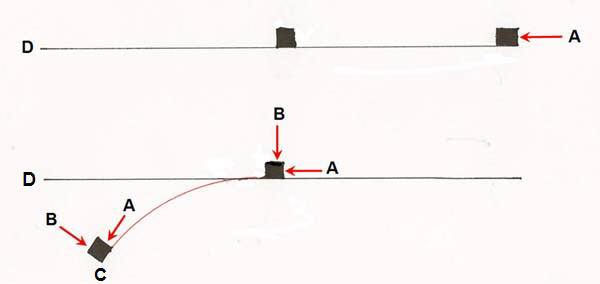
This diagram represents a birds eye view of person A pushing a lightweight 10'x10'X10' square box across an ice rink. His plan is to push the square box in a straight line direction towards destination D. He works out that it would take him 20 minutes to accomplish that goal - considering the friction drag of the ice against the undersurface of the box. He pushes in a straight line direction towards destination point D. Because of the 10' height of the box he cannot see where he is going, but imagine that person A has an uncanny ability to always apply his constant push force perpendicular to the surface of the box and that he is always pushing in a straight line thrust action.
After 10 minutes, person A stops for a rest and he notes that he has completed 50% of the distance to destination point D (top diagram) - because he is applying a constant straight line push-force against the box.
Now imagine that person A starts pushing again with the same level of straight line push-force. However, he doesn't realise that person B has arrived and person B is also pushing in a straight line thrust against the surface of the box - at a right angle to person A's straight line thrust action. Person B is less strong than person A and applies less push-force than person B.
What happens after 10 minutes? The box ends up at point C rather than destination point D (bottom diagram). The reason is that there is another force present that deflects the moving mass from its straight line path. In other words, that other force changes the direction of the movement of the moving mass, so that it follows a circular path instead of a straight line path. Note that the other force pushes at right angles to the circumference of the circular path - and that it is therefore directing its force towards the center of a hypothetical circle.
It doesn't take much common sense to interpret what I have described.
Person A is supplying a push-force that moves the mass at a constant speed in a straight line direction - and that represents the tangential force.
Person B is also supplying a push-force that is directed at right angles to the tangential force - and that represents the centripetal force.
It should also be apparent that the centripetal force is a Newtonian-type force that is capable of changing the direction of movement of a mass (that is being moved at a constant speed by a constantly present tangential force), and that it is manifesting energy and performing work.
Since there is friction here, A is doing work even though the speed becomes constant after a while.
If B's contribution is only to turn a linear movement into a circular movement, B is not doing any work. The object is always moving perpendicular to the direction B is pushing. The angle between the object movement and B's pull force need to be different from 90* before any work is done. Changing direction is not the same as doing work - even though it makes a significant difference.
You wrote-: "If B's contribution is only to turn a linear movement into a circular movement, B is not doing any work. The object is always moving perpendicular to the direction B is pushing. The angle between the object movement and B's pull force need to be different from 90* before any work is done."
I think that you are wrong. The fact that the object is changing direction means that there is a force present that is causing that change of direction. If a force is present and causing a change in the direction of the object's path, then it is doing work by moving the object in another direction. Person A represents the tangential force that causes the object to overcome friction and move forward at a finite speed. Person B is providing another force that pushes the object in a constantly changing direction at every instantaneous moment in time, and causes the object to follow a circular path. Conceptually, person B is providing a push-force that constantly deflects the object in its straight line path, so that the object is forced to follow a circular path. In a Newtonian sense, that push-force must have energy and it must be working - if it has the capacity to constantly deflect the mass of the object to an ever-changing directional path (a circular path).
I think that your idea that person B cannot be doing push-work because he is standing at 90 degrees to the circular path is incorrect. He is only standing at 90 degrees to the circular path - as result of his successful work effort of constantly deflecting the object from person's A desired straight line push-action. If person B wasn't doing any work, the path would no longer be circular and it would become a straight line path again.
You wrote-: "The object is always moving perpendicular to the direction B is pushing." That is correct, but it is a reflection of person B's effective work effort. In fact, if person B increases his push-force by working even harder, he will still always be perpendicular to the circular path, but now the circular path will have a tighter (smaller) radius. If that doesn't represent the result of increased work effort, then I do not understand simple Newtonian physics.
"An object moving in circular motion is at all times moving tangent to the circle; the velocity vector for the object is directed tangentially. To make the circular motion, there must be a net or unbalanced force directed towards the center of the circle in order to deviate the object from its otherwise tangential path. This path is an inward force - a centripetal force."
That section states that at every instantaneous moment in time an object in circular motion is moving at a tangent to a circle and the velocity vector is directed tangentially. Tangentially means that it is directed at right angles to the radius of the circle at the point on the circumference where the object is presently located. That means that if there was no centripetal force operant, the vector force would cause the object to travel in a straight line direction - towards point B. What causes the orbiting object to remain on the circular path, and move to point C, is the presence of an unbalanced force directed towards the center of the circle - a centripetal force.
You asked for credible evidence that the clubhead arc is more rounded than the hand arc.
I posted a strobe photograph of Bobby Jones which demonstrated that the hand arc is less circular than the clubhead arc.
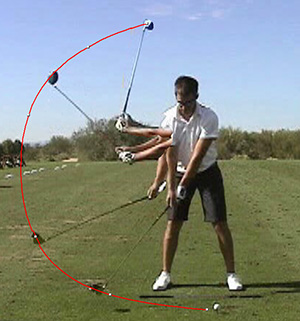
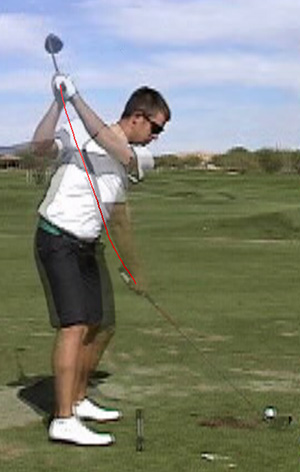
I also posted this composite photograph that shows the clubhead arc (in red) and also shows the hand position at different time points. An imaginary line joining the hand position points would be less circular and more U-shaped.
Of course, there is the problem of camera perspective distortion due to the fact that the camera is face-on, while the clubhead/hand arcs are on an inclined plane.
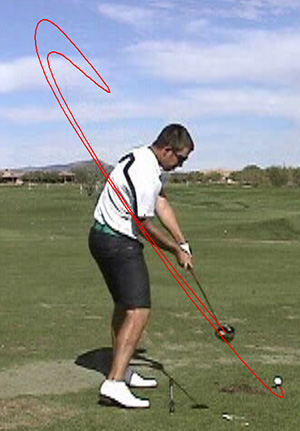
I therefore produced the following down-the-line views of the clubhead arc and hand arc.
Clubhead arc
Hand arc
Note that the hand arc is more vertical than the clubhead arc. Therefore there will be there less camera perspective distortion with respect to the hand arc, and there is every reason to believe that the hand arc is U-shaped rather than circular.
Do you have any problem with the quality of the "evidence" that I am presenting?





 Linear Mode


