Thank you, BerntR. You know a whole lot more physics than I do, and I appreciate your contributions. My efforts here hang on my Georgia Tech education (101/2/3 - 201/2/3 long since forgotten ) plus whatever Homer Kelley and his book taught me as it relates to the Golf Stroke.
Jeff,
Forgive the interrupt, but . . .
Could we please take a moment and revisit this idea -- which, either in this thread or another (can't remember) -- started this whole magnificent interchange . . .
In the Golf Stroke, does the Left Arm and Clubshaft function as the "string" (Centripetal Force) keeping the Sweetspot in orbit around its Left Shoulder Center?
Thank you, BerntR. You know a whole lot more physics than I do, and I appreciate your contributions.
Thank you Yoda,
In my opinion TGM is the only truly systematic framework for understanding the golf stroke. But the book itself is at least as hard a read as an advanced textbook in digital signal processing. And while your countless explanations have opened the door and then some, I believe there is more between the lines of the yellow book than we currently are aware of. And with all due respect to the legacy of Homer Kelley - there is (probably) always room for improvement. And kudos to Jeff for asking questions that triggers this kind of discussions (even though he is a hardheaded bloke).
Yoda - I strongly suspect that you are not going to like this answer.
I think that the concept of the left arm-clubshaft combination being equivalent to a taut string connecting the sweetspot to the left shoulder socket only applies to a very small part of the clubhead arc - when the left arm becomes straight-in-line with the clubshaft post-impact. In the early downswing when the clubhead is lagging well behind the hands (>90 degrees) - prior to the release of PA#4 - there is essentially no independent rotation of the left arm around the left shoulder socket joint, and the left hand is essentially traveling along the straightish part of its U-shaped arc - so there can be no centripetal force involved. During the release phase of the downswing - after release of PA#4 - it is only the left hand that is rotating in a circle around the left shoulder socket (which acts as the fulcrum point), and a centripetal force only applies to the relationship between the left hand and the shoulder socket, and not between the clubhead sweetspot and the left shoulder socket. In fact, during the release phase the clubhead sweetspot is actually in a state of centrifugal release, which by definition means that it is essentially free of any centripetal influence. When the clubhead catches up to the hands and the left arm becomes in line with the clubshaft, then the clubhead sweetspot moves at roughly the same rpm as the left hand, and under those conditions a centripetal force applies to the relationship between the clubhead sweetspot and the left shoulder socket, with the left arm and clubshaft structural unit acting as a taut string connecting the sweetspot to the left shoulder.
If you are seriously interested in a detailed explanation of my personal opinions, then I may consider preparing a detailed post.
Yoda - I strongly suspect that you are not going to like this answer.
I think that the concept of the left arm-clubshaft combination being equivalent to a taut string connecting the sweetspot to the left shoulder socket only applies to a very small part of the clubhead arc - when the left arm becomes straight-in-line with the clubshaft post-impact. In the early downswing when the clubhead is lagging well behind the hands (>90 degrees) - prior to the release of PA#4 - there is essentially no independent rotation of the left arm around the left shoulder socket joint, and the left hand is essentially traveling along the straightish part of its U-shaped arc - so there can be no centripetal force involved. During the release phase of the downswing - after release of PA#4 - it is only the left hand that is rotating in a circle around the left shoulder socket (which acts as the fulcrum point), and a centripetal force only applies to the relationship between the left hand and the shoulder socket, and not between the clubhead sweetspot and the left shoulder socket. In fact, during the release phase the clubhead sweetspot is actually in a state of centrifugal release, which by definition means that it is essentially free of any centripetal influence. When the clubhead catches up to the hands and the left arm becomes in line with the clubshaft, then the clubhead sweetspot moves at roughly the same rpm as the left hand, and under those conditions a centripetal force applies to the relationship between the clubhead sweetspot and the left shoulder socket, with the left arm and clubshaft structural unit acting as a taut string connecting the sweetspot to the left shoulder.
If you are seriously interested in a detailed explanation of my personal opinions, then I may consider preparing a detailed post.
Jeff.
You got give some credit guys...its a surgical answer with precision
Bernt
The fact that the object is changing direction means that there is a force present that is causing that change of direction. If a force is present and causing a change in the direction of the object's path, then it is doing work by moving the object in another direction.
Jeff,
d Work/dt (work per time unit, power) = A * B * cos(ab),
A = centripetal force,
B = distance per time unit (speed),
ab = angle between force and speed = 90*
cos(ab) = Zero.
Work per time unit is zero at all times as far as the centripetal force is conserned. Therefore total work is zero.
You asked for credible evidence that the clubhead arc is more rounded than the hand arc.
I posted a strobe photograph of Bobby Jones which demonstrated that the hand arc is less circular than the clubhead arc.
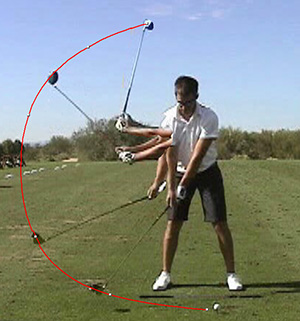
I also posted this composite photograph that shows the clubhead arc (in red) and also shows the hand position at different time points. An imaginary line joining the hand position points would be less circular and more U-shaped.
Of course, there is the problem of camera perspective distortion due to the fact that the camera is face-on, while the clubhead/hand arcs are on an inclined plane.
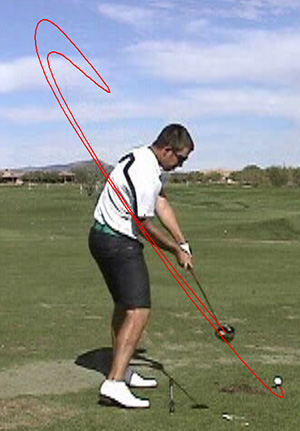
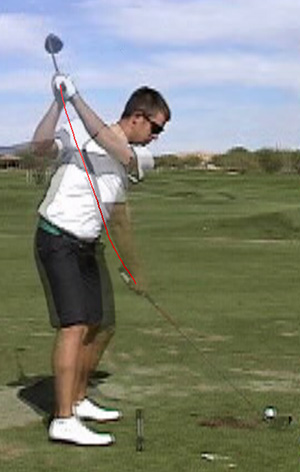
I therefore produced the following down-the-line views of the clubhead arc and hand arc.
Clubhead arc
Hand arc
Note that the hand arc is more vertical than the clubhead arc. Therefore there will be there less camera perspective distortion with respect to the hand arc, and there is every reason to believe that the hand arc is U-shaped rather than circular.
Do you have any problem with the quality of the "evidence" that I am presenting?
Jeff.
My only problem would be calling the path of this clubhead "more circular" that the path of the hands (#3 pressure point).
If the hand arc is really as circular as your drew it, and as circular as the clubhead arc, how does HK's endless belt analogy work? According to the analogy, the machine has a straight line belt section with a pulley at the end. The release phenomenon occurs when the hands pass around the small pulley. If the hand arc is circular, then the idea of the endless belt system (as described by HK) becomes inapplicable. So, how does a random/late release phenomenon occur in a golfer who has a perfectly circular hand arc path?
In your formula, the work output is zero because of the way the formula is structured. That's why I sometimes distrust the input of physicists (like nmgolfer) who are capable of deep mathematical expositions based on mathematical formulas. The "real" issue is not the accuracy of the formula, the "real" issue is it's relevance. The most important question is what's the best perspective to look at a problem, and then one has to decide which formula to use in that situation.
In the situation of centripetal force, if the force doesn't provide the tangential force needed to move a mass at a certain speed a certain distance, then one shouldn't be using a formula that 'a priori' uses those requirements (speed and distance) to calculate work output. Secondly, the idea of a centripetal force always being at 90 degrees to the mass is only a mental concept, and it obviously results in zero work output according to that formula.
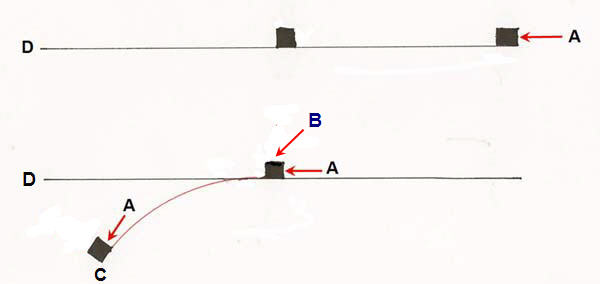
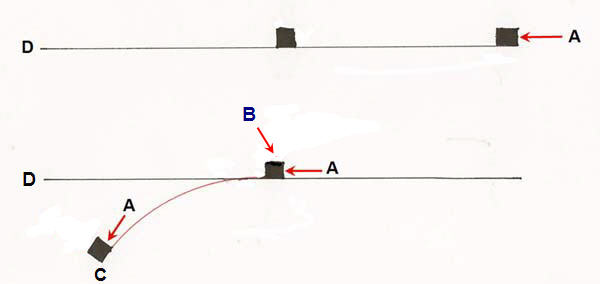
Consider the example I gave of person B applying a force to deflect the mass (that was being pushed in a straight line direction by person A). Presume that he doesn't apply a force at right angles to the moving mass, but presume that he stands at an angle to the mass - as described in this next example - and pushes in the direction of the arrow.
If you look at the angle that he is pushing, one can imagine that the object will not travel in a straight line path and that it will be deflected slightly leftwards. The amount that it will be deflected leftwards depends on the magnitude of person B's push-force relative to the magnitude of person A's push-force. If person B's push-force far exceeds person A's push-force, then the degree of leftwards deflection will increase. Note that person B's push-force will make the object travel faster, because a component of the push-force is working in the same direction as person's A's push-force. In other words, from a conceptual perspective, one can describe person B's push-force as having two directional components - a vector component that works in the same direction as person A's push-force and helps increase the speed of movement of the mass in person A's straight line direction, and a vector component that works at 90 degrees to person's A's straight line path, and that causes the mass to be deflected slightly leftwards. Both vector components are doing work.
Now consider another example.
Note the direction of person B's push force. It is directed somewhat backwards. If one dissects person B's push-force into two directional components - one vector component will work in direct opposition (180 degree angle) to person A's push-force and that will slow the speed of movement of the mass. The other vector component will conceptually work at right angles to person's A direction of push-force and that will cause the object to be deflected leftwards. Both vector components are producing a work output. The amount that the object is deflected leftward depends on the magnitude of person B's push force relative to the magnitude of person A's push force.
Hopefully, you will understand what points I am trying to make.
1) The first point is that the force (exerted by person B) that deflects the object leftwards is a "real" force that requires energy, and one has to rationally conclude that the force is doing work by deflecting the object.
2) After the object has been deflected, one can look back at the circular path that was transcribed on the ice rink and one can 'a posteriori' theorize as to what "force" resulted in the path being circular rather than straight line (towards destination D). One can simply conceive/theorize that a deflection force was present that caused the path to become circular-shaped. One can conceive that the "force" has centripetally accelerated (deflected) the object - defined simply as a "force" that causes an object (that already has enough energy to move in a straight line direction) to follow a circular path rather than a straight line path. In one's mental conception, one can conceive that the "force" is directed towards the center of a hypothetical circle, which means that the "force" is operating at 90 degrees to the circular path transcribed on the ice rink. However, this "force" and its 90 degree directional angle relative to the final arced path transcribed on the ice rink is merely a mental construct. In reality, there was only one force exerted by person B and it was in the direction of the red arrow, and the red arrow is not perpendicular to the circular path's arc.
For a starter, a real force can exist without any energy spending. For instance, when you stand on the ground, you are subject to a gravity force. It is as real as any other force, but while you'r standing, it doesn't do any work.
Regarding your curve pattern. You could put up a fence that forces the object to turn. The forces from this fence will not use any energy and they will not work. Still they will do the same "work" as the centripetal components in your examples.
In the world of golf swings & Newton, work is related to energy pretty much in the same way as acceleration is related to speed. Whenever you do work you change the mass-speed of the club or any other moving mass. (or you generate kinetic energy somewhere). When you don't do work, the energy remains constant - or is reduced due to resistance.
If you learn to see the difference between forces that work and forces that doesn't, you will get a clearer image of what swing speed is made of.
If the hand arc is really as circular as your drew it, and as circular as the clubhead arc, how does HK's endless belt analogy work? According to the analogy, the machine has a straight line belt section with a pulley at the end. The release phenomenon occurs when the hands pass around the small pulley. If the hand arc is circular, then the idea of the endless belt system (as described by HK) becomes inapplicable. So, how does a random/late release phenomenon occur in a golfer who has a perfectly circular hand arc path?
Jeff.
They are not perfect circles, because there is movement in the center of the arc via shoulder turn and axis tilt.
How can the club path in the downswing be more circular when the left wrist is cocked for a large portion of the downswing (shrinking the radius from shoulder to clubhead) while the left arm remains straight (maintaining the radius from shoulder to hand)?
Notice that YodasLuke used #3 to mark the spline while you used the butt end of the club.
Last edited by Hennybogan : 12-28-2008 at 09:37 PM.


 ) plus whatever Homer Kelley and his book taught me as it relates to the Golf Stroke.





 Linear Mode


