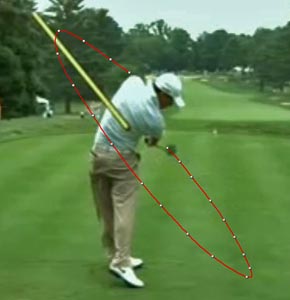
I always attempt to mimick his swing pattern - by attempting to be on the same inclined plane in the backswing and downswing (while slowly and progressively shifting planes between the elbow plane and turned shoulder plane in the backswing and vica versa in the downswing), and to always be on-plane even during the followthrough and early finish. I try to always get my clubshaft to be parallel to the ball-target line at the third and fourth parallels.
This is the clubhead path that I try to emulate.
When starting the backswing, I trace the SPL during the takeaway - and that means that the PP#3-sweetspot axis line points at the ball-target line. After the first parallel, it is the butt end of the club that points at the ball-target line and not any "hypothetical" axis of sweetspot rotation. For me, the most critical part of the swing in terms of being on-plane is between the first parallel and the third parallel. If I can keep on-plane during that time period and get to the third parallel perfectly on-plane, then I know that my clubshaft will be perfectly on-plane during the downswing time period between the third parallel and impact. In other words, I am mainly focused on ensuring that my clubshaft is on-plane when the club is above waist level, and during that time it is the butt end of the club, and therefore clubshaft, that points at the baseline of the inclined plane. In other words, all your theorising about options 1,2, and 3 have no relevance with respect to my above-waist biomechanical movements that are required to keep the clubshaft -on-plane.
I have tied a string between the sweetspot and PP#3 and it is no value, because the only time that I actually see the string is during the takeaway, at which time I can easily stay on-plane. The string has no value for the critical biomechanical movements that occur above waist level- in both the backswing and downswing. Seeing the string blur between the third parallel and impact has no potential value because if I am not on-plane during that time period, then it is far too late to alter events.
In fact, I have now trained my hands (specifically PP#3) to move correctly by "feeling" it trace the SPL and I never even think of the clubshaft and/or the sweetspot. My only awareness of the clubshaft is after I have completed the shot - when I replay the shot in my mind. I can then usually recall where the clubshaft was situated at the third and fourth parallel, and I know retrospectively that if the clubshaft wasn't parallel to the ball-target line at those two time points, then I obviously didn't succeed in my goal of being on-plane throughout the entire swing.
Jeff.
p.s. I am not a good golfer by Ben Hogan's standards, but I am a great golfer by my standards. I never dreamt that I would ever regularly break 80 (from the senior tees) considering my degree of physical inflexibility and lack of golf athleticism. I never play 7,200 yards courses because I am not a masochist. I only play 6,000-6,500 yards courses by always playing from the senior tees. My driving distance is 220-240 yards.
The string's not meant to help you with anything other than Basic Motion (2 feet back and through).
I have no problem with Kim. He has great Alignments. But, it seems like everything is Plane oriented. Do you ever work on the physics?
I am a masochist. I played last week with my best friend in Franklin, TN last week. We played from 7,190. It was 38 degrees and the wind was blowing, and it was soaking wet. I hit 3 wood into four par 4's and one par 3. I normally hit 3 wood 250 yards, but I wasn't planning on that distance in that weather. I shot 76 with two doubles, two bogeys, and two birdies. No one died, but we felt like it.
You wrote-: "I have no problem with Kim. He has great Alignments. But, it seems like everything is Plane oriented. Do you ever work on the physics?"
I don't understand your statement that everything is plane-oriented. Anthony Kim has an incredible ability to swing on-plane, but I don't think that doing so causes some other part of his swing action to be deficient. Do you?
What do you mean when you ask about working on the physics?
I am not consciously masochistic like you - I do not enjoy playing in wet 38 degrees weather with heavy winds blowing. I have played in Ireland or Scotland every year for the past 4 years, and the wind there causes me immense trouble. I recall one hole in Ireland that was only 320 yards in length, but the wind velocity was >40mph. I hit a perfectly executed drive which only traveled 150 yards. I then hit a really solid three wood and the ball went about 100 yards. I finally hit a perfect 8 iron that traveled 60 yards. I missed my par putt. I personally don't enjoy the experience of hitting the ball (as well as I can) and having to hit three well struck shots in order to reach a 320 yard hole.
You wrote-: "I have no problem with Kim. He has great Alignments. But, it seems like everything is Plane oriented. Do you ever work on the physics?"
I don't understand your statement that everything is plane-oriented. Anthony Kim has an incredible ability to swing on-plane, but I don't think that doing so causes some other part of his swing action to be deficient. Do you?
What do you mean when you ask about working on the physics?
I am not consciously masochistic like you - I do not enjoy playing in wet 38 degrees weather with heavy winds blowing. I have played in Ireland or Scotland every year for the past 4 years, and the wind there causes me immense trouble. I recall one hole in Ireland that was only 320 yards in length, but the wind velocity was >40mph. I hit a perfectly executed drive which only traveled 150 yards. I then hit a really solid three wood and the ball went about 100 yards. I finally hit a perfect 8 iron that traveled 60 yards. I missed my par putt. I personally don't enjoy the experience of hitting the ball (as well as I can) and having to hit three well struck shots in order to reach a 320 yard hole.
Jeff.
I'm sorry that I wasn't very clear. It seems like everything with regard to your swing versus Kim is Plane oriented. Do you ever compare the Face-On characteristics to check the physics? I've had students that have come to me with excellent geometry (On Plane) and they couldn't hit it out of their shadow.
As far as you not being a masochist, I think you just gave your secret away. Although, I do like the way you slipped the word consciously in there. You've played every year for 4 years! If you don't like the pain, why would you keep going back? The only other alternative is that you're an eternal optimist (crazy). You would have to believe that the weather there was going to be better next year. Good luck with that.
I am playing golf tomorrow. Reading this thread and thinking too much about it will likely cause me a few shanks tomorrow. But please don't quit the thread yet as there remain a few issues to be concluded. With Jeff's strive for truths, Yodasluke's golf skills, nmgolfer's physics, we can go a long way..... I now want to stir up some dust ......
I would like to differentiate between (a) the COG of mass of the whole club, (b) the COG of the mass of the clubhead which again is different from (c) the sweetspot on the clubface.
1. My current thinking now has shifted from keeping the clubshaft on the swing plane. I now believe that for an optimum swing from p3 to p4, we should keep pp#2 and (a) the COG of the club on plane.
2) So if we draw a straight line between pp#2 and (a), this straight line will sweep the swing plane and the centripetal and the centrifugal forces act along this line. Let me call this line the force line.
3) Under centrifugal acceleration, all the mass of the club will seek to be in line with the force line so the COG of the clubhead (b) will seek to line up with the force line.
4) The swivel rotation to close the club face is not around the hosel but should be around the line pp#2 to (a) which is now a balanced rotation.
I am playing golf tomorrow. Reading this thread and thinking too much about it will likely cause me a few shanks tomorrow. But please don't quit the thread yet as there remain a few issues to be concluded. With Jeff's strive for truths, Yodasluke's golf skills, nmgolfer's physics, we can go a long way..... I now want to stir up some dust ......
I would like to differentiate between (a) the COG of mass of the whole club, (b) the COG of the mass of the clubhead which again is different from (c) the sweetspot on the clubface.
1. My current thinking now has shifted from keeping the clubshaft on the swing plane. I now believe that for an optimum swing from p3 to p4, we should keep pp#2 and (a) the COG of the club on plane.
2) So if we draw a straight line between pp#2 and (a), this straight line will sweep the swing plane and the centripetal and the centrifugal forces act along this line. Let me call this line the force line.
3) Under centrifugal acceleration, all the mass of the club will seek to be in line with the force line so the COG of the clubhead (b) will seek to line up with the force line.
4) The swivel rotation to close the club face is not around the hosel but should be around the line pp#2 to (a) which is now a balanced rotation.
I tend to agree. However, a small but important implication is that in case of a center-shafted club the shaft plane = the sweetspot plane.
Therefore, we can go further and create a variable weighted toe/heel of such a club and see if e.g. with a heavy toe/light heel center shafted club (imitating the proportions of a standard club to a degree) the shaft plane still equals the sweetspot plane.
Cheers
Not sure I follow you 100%, but Id think that with a heavier toe the sweet spot would move and you'd be back to a non aligned shaft and sweet spot.
All of this begs the question: Why arent there face balanced , center shafted irons? There must be a very good reason. We must need the rotation perhaps? Or is there something else? Homer suggested the long nosed, low profile irons of the 1930's were a delight to hit.
I've sort of struggled with tracing conceptually as there seemed to be a parallax issue. I now realize that while I was swinging the sweet spot, I was trying to trace the shaft plane. Lukes point about tracing the sweet spot plane, the imaginary string from #3 to sweet spot is insightful. Like pointing your finger at a bird in flight, tracing. This way I am aiming that which I am swinging, the sweet spot!
Per 2-F PLANE OF MOTION. "Regardless of where the Clubshaft and Clubhead are attached it will always feel as if they are joined at the Sweet Spot---the longitudinal center of gravity, the line of pull of Centrifugal Force."
I would like to know your age. Age and athleticism are big factors in how far a person can hit. I know this because I often play will a group of older-timers which I wager to guess have been on the planet hitting golf balls long before you were even a twinkle in your mother's eye.
These guys sit around an remiss saying things to each other like: "when did you start losing it".... (They mean distance). Just because Jeff does not hit hit his 5 iron as far as you does not mean he has a "power leak". Besides... golf is about three games.... distance off the tee is only one of them, then there is the short game and putting. Winning means being reasonably good at all three.
I'm backing out of this thread now because.... Frankly none of what you wrote (in that last post) make a damn bit of sense to me (I don't know the book chapter and verse and never will). But I thought were were talking about the face opening on the backswing and closing on the downswing not release. I thought the issue was what causes shanking. Anyway. .... Here are a couple of parting thought on the dreaded "S" word...
1) Check your balance.. if you are going forward (on your toes) you will shank it
2) Try gripping down a bit. One-size fits all clubs don't work (men's adults for instance) but can be played by about anyone but only if you compensate for your individual anatomy. If, say your arms are longer than normal or your legs are shorter than normal or god forbid both, then you are going to have too much club shaft between your hands and ball. That will cause a shank... and it may even vary from day to day. Bobby Jones would adjust his hands up and down the grip on any given day and we should too.
Last edited by no_mind_golfer : 01-17-2009 at 12:58 PM.
"So there is a "Clubshaft" Plane and a "Sweet Spot", or "Swing", Plane. But herein unless otherwise noted, "Plane Angle" and "Plane Line" always refer to the Center of Gravity application,. Study 2-N. Except during Impact, the Clubshaft can travel on, or to and from , either Plane because Club Shaft rotation must be around the Sweet Spot-not vice versa. So Clubhead "Feel" is Clubhead Lag Pressure (6-C) and is a Golfing Imperative. (2-0), If Lag Pressure is lost the Hands tend to start the hosel (instead of the Sweet Spot) toward Impact---the mysterious "Shank"..............."
And we sense this lagging sweet spot with the pp #3. Both ends of Lukes string.
While common sense would seem to suggest a shank is caused by getting too close to the ball , which maybe the case sometimes, this is another very interesting cause. Perhaps there is a chicken and egg relationship too? The loss of swing radius as a possible effect rather than cause? Swinging the clubshaft causing us to encroach, shorten our radius and shank?
All of this begs the question: Why arent there face balanced , center shafted irons? There must be a very good reason. We must need the rotation perhaps? Or is there something else? Homer suggested the long nosed, low profile irons of the 1930's were a delight to hit.
OB
That's the point ! Hell knows why aren't there face balanced clubs, but IMO not because someone wanted to make golfer's life harder.
I would risk to say that because of tradition. Backing to the middleages when golfers played with wooden stick bent at one end (looking similarily to a walking stick for elderly people)...and it was much easier to manyfacture it instead manufacturing a center shafted club.
Sir Winston Ch. could be right - we are playing with tools that are wrongly designed to this goal...
OB Left - You wrote-: "All of this begs the question: Why arent there face balanced , center shafted irons? There must be a very good reason. We must need the rotation perhaps?"
Exactly. Golf is a sport where the golfer swings the arms and clubshaft around a rotating torso at an angle to the ground. We need the rotation because human anatomy dictates the need to rotate the flat left wrist/hand unit during the backswing to get the hands far enough back (near the right shoulder) and human anatomy dictates that the golfer must perform a similar reverse-rotation (as a mirror image movement) in the followthrough/finish phase. The clubface will only be square to the ball-target line at impact. During the downswing-followthrough motion, the clubface rotates from open to closed because it is moved in that manner by the flat left wrist/hand. At no time point does the clubshaft rotate about its longitudinal axis (like a spinning top). If it did, then the idea of an axis between PP#3 and the clubface sweetspot, and the idea of the hosel rotating about that axis, may have some definite relevance. So far, Yodas Luke has only inferred that the imaginary straight line between PP#3 and the sweetspot has relevance during the takeaway. That's only a small fraction of the clubshaft's total movement during the golf swing.
Regarding the issue of shanking, I think that a major causal factor is a failure of a golfer to understand that the clubface must rotate from open-to-close through the impact zone, and that the closing clubface phenomenon is due to the release swivel action where the flat left wrist/hand rotates 90 degrees in the late downswing. I think that the mental idea of the "clubhead rotating about the hosel" would actually help those golfers because they are essentially dragging the clubshaft towards impact as if the clubhead were center-shafted. I think that they need to realize conceptually that the toe of the club must rotate about the heel of the club during the pre-impact phase of the golf swing, and that it will happen automatically if they correctly rotate the back of their flat left wrist/hand.


 The only other alternative is that you're an eternal optimist (crazy). You would have to believe that the weather there was going to be better next year. Good luck with that.
 But please don't quit the thread yet as there remain a few issues to be concluded. With Jeff's strive for truths, Yodasluke's golf skills, nmgolfer's physics, we can go a long way..... I now want to stir up some dust ......


 Linear Mode


