I do not disagree that setting up as 10-6-B #1 is comfortable. However, I cannot perform the correct right elbow folding action in a comfortable biomechanical manner that allows me to get my right forearm flying wedge to its desired location relative to my right shoulder - when I start from that address position.
I am curious - why do you believe that zero plane shift on the turned shoulder plane is desirable?
Also, could you please supply me with a list of about five PGA tour players who follow your recommended zero plane shift TSP pattern?
I do not disagree that setting up as 10-6-B #1 is comfortable. However, I cannot perform the correct right elbow folding action in a comfortable biomechanical manner that allows me to get my right forearm flying wedge to its desired location relative to my right shoulder - when I start from that address position.
I am curious - why do you believe that zero plane shift on the turned shoulder plane is desirable?
Also, could you please supply me with a list of about five PGA tour players who follow your recommended zero plane shift TSP pattern?
Thanks,
Jeff.
Mr. Kelley suggested the less plane shifts the better. IF you built a machine (The Iron Byron, Ping Man) would you have it shift planes?
I do not know of a single player on the PGA tour that does not plane shift. Where did I recommend it?
When I wrote that you recommended a zero plane shift, I inferred it from your previous statement that 12-1-0 and 12-2-0 is desirable, and I presumed that if it is desirable then it must be recommendable.
I personally can understand why a zero plane shift could be perceived to be desirable from a mechanical/geometrical perspective, but I believe that it is very undesirable from a biomechanical perspective, which is presumbaly the reason PGA tour players do not use it. Most PGA tour players use a double plane shift swing - hand plane (or elbow plane) to the turned shoulder plane in the backswing, and turned shoulder plane to the elbow plane in the downswing. I think that the major reason for this choice is biomechanical - it is biomechanically natural and therefore it is easier to develop a repeatable swing.
The other point that I cannot understand about 12-1/2-0 is the choice of TSP for the downswing plane. Why would it be desirable to come down on the turned shoulder plane? Virtually all PGA tour players are on, or near, the elbow plane at impact.
When I wrote that you recommended a zero plane shift, I inferred it from your previous statement that 12-1-0 and 12-2-0 is desirable, and I presumed that if it is desirable then it must be recommendable.
I personally can understand why a zero plane shift could be perceived to be desirable from a mechanical/geometrical perspective, but I believe that it is very undesirable from a biomechanical perspective, which is presumbaly the reason PGA tour players do not use it. Most PGA tour players use a double plane shift swing - hand plane (or elbow plane) to the turned shoulder plane in the backswing, and turned shoulder plane to the elbow plane in the downswing. I think that the major reason for this choice is biomechanical - it is biomechanically natural and therefore it is easier to develop a repeatable swing.
The other point that I cannot understand about 12-1/2-0 is the choice of TSP for the downswing plane. Why would it be desirable to come down on the turned shoulder plane? Virtually all PGA tour players are on, or near, the elbow plane at impact.
Jeff.
12-1-0 and 12-2-0 the discussion was the Turned Shoulder Plane not plane shifts.
"Virtually all PGA tour players are on, or near, the elbow plane at impact".
I suggest you study the Mr. Kelley's plane further 10-6-a,b,c. It is not a question of where the elbow is at impact but rather the plane the club was swung down from the top into impact.
You wrote-: "It is not a question of where the elbow is at impact but rather the plane the club was swung down from the top into impact."
Who was talking about the position of the elbow at impact? I stated that most PGA tour golfers have their clubshaft on the elbow plane at impact. They get it there by having their clubshaft shift planes from the turned shoulder plane to the elbow plane during the downswing.
12-1-0 and 12-2-0 recommends a zero plane shift swing where the golfer remains on the turned shoulder plane. I cannot understand why having the clubshaft on the turned shoulder plane in the late downswing and at impact is deemed to be desirable.
Thanks, Jeff. With regards to Plane Angle Variation (Component #7) -- and making a mental adjustment for camera placement, especially in Tiger's case -- what conclusion(s) do you draw from these photos?


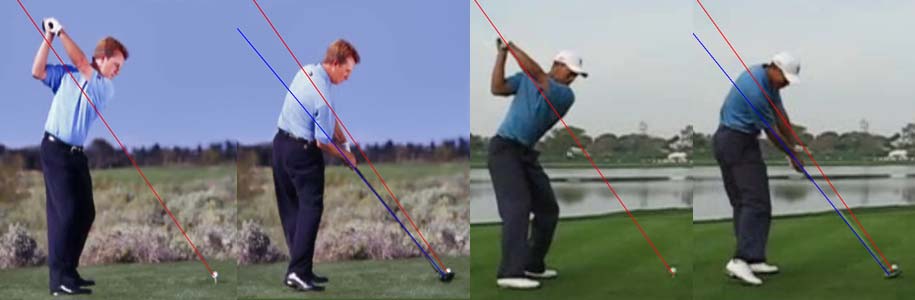


 Linear Mode


