The AJ Bonar methodology is a recipe for disaster - a recipe for an inconsistent ball flight direction because it is so dependent on exquisite timing. I am not surprised that professional golfers use a release swivel action followed by a hinging action - and that they do not use any "active" hand manipulations through the impact zone.
You wrote-: ". I don' think you quite understand what you think you do re: the finer points of TGM."
That is very likely true. That's why I like to read other forum members' opinions. I always hope to continually improve my knowledge re: the finer points of TGM.
Hopefully, Yoda will make an insightful post regarding the Sergio Garcia and Tiger Woods swing sequence that he requested that I produce.
I think there was an earlier post which asked that you take a club and hold it between your finger and thumb (top of the grip)and let it hang .Then rotate the grip back and forth.The shaft does not hang vertically.The clubshaft rotates around the sweetspot(as does the toe of the club),do you think this FACT will not occur when free swinging a club -with no clubface manipulation(ie horizontal hingeing)?
It is true that the hosel rotates around the sweetspot when one rolls the club on a tabletop. However, that happens because the clubshaft is rotating around its longitudinal axis with no lateral movement of the entire clubshaft in space. That phenomenon doesn't happen in the golf swing.
Jeff,
You are wrong.
Your argument ignores the fact that the Horizontal Hinge Action is DUAL (10-10-D). That is, the Horizontal Motion of the Clubface (Closing Only) through Impact (Ideal applciation / 2-C-1) is executed on an Inclined Plane. In TGM, the orbiting Sweetspot defines the Inclined Plane, and for this reason, the Clubshaft cannot possibly remain on its own Address and Impact Plane. Hence, it mustrotate to and from the Plane of the Sweetspot.
Of course, the Hackers of the world agree with you and do their dead-level best to avoid this required rotation. Homer Kelley understood this applied misconception and aptly labeled it Steering . . .
You state that I am wrong. That may certainly be true. However, I would better appreciate that fact if you provided a detailed explanation.
In 10-10-D, Homer states that the angled hinge keeps the clubshaft on the inclined plane while the horizontal hinge keeps the clubface turning. That's exactly what I was demonstrating in this short video.
I placed the clubshaft on the inclined plane. I could then theoretically vary the degree of roll-over of the clubface while the clubshaft travels on the inclined plane - by varying the instantaneous degree of rotation of the clubshaft during its travel on the inclined plane.
Where is my error in the interpretation of 10-10-D?
You also wrote with respect to the clubshaft-: "it must rotate to and from the Plane of the Sweetspot." How does the clubshaft rotate to/from the plane of the sweetspot when Homer stated in 10-10-D that the clubshaft is maintained on the inclined plane?
Neil - let me ask you a simple question. If you can imagine the clubshaft twirling on its axis so that the hosel rotates around the sweetspot, can you please provide photographic evidence of exactly where in the golf swing this phenomenon is happening? Thanks.
You state that I am wrong. That may certainly be true. However, I would better appreciate that fact if you provided a detailed explanation.
I already did. Incubate my reply -- posts don't have to be 1,000 words long to be precise -- for more than a nanosecond and get back to me. In retrospect, in addition to 10-10-D and 2-C-1, also study 2-F, 2-G, 7-10, 6-B-3-0, and The Glossary (specifically Flat And Vertical Left Wrist; Hinge Action; and Rhythm).
Originally Posted by Jeff
In 10-10-D, Homer states that the angled hinge keeps the clubshaft on the inclined plane while the horizontal hinge keeps the clubface turning. That's exactly what I was demonstrating in this short video.
. . .
Where is my error in the interpretation of 10-10-D?
For starters, you did not demonstrate 10-10-D (Horizontal Hinging on an Angled Plane). Instead, you demonstrated 10-10-C (simple Angled Hinging). But, even Angled Hinge Action demands Clubshaft Rotation. Only with Vertical Hinge Action (10-10-B/E and 2-C-2/3) and its Zero #3 Accumulator Action would your argument have any validity.
Originally Posted by Jeff
You also wrote with respect to the clubshaft-: "it must rotate to and from the Plane of the Sweetspot." How does the clubshaft rotate to/from the plane of the sweetspot when Homer stated in 10-10-D that the clubshaft is maintained on the inclined plane?
Read the caveat and detailed explanation in 2-F, and you will understand. On second thought, maybe not. In a pinch, re-read the third sentence of the second paragraph in my post #125 above.
Originally Posted by Jeff
Neil - let me ask you a simple question. If you can imagine the clubshaft twirling on its axis so that the hosel rotates around the sweetspot, can you please provide photographic evidence of exactly where in the golf swing this phenomenon is happening? Thanks.
Neil has given me his proxy, so allow me, please . . .
"What I said is a fact. And anyone who understands Sweetspot Plane versus Shaft Plane understands that fact. In person, I can demonstrate it in five seconds. Regarding photographic proof, it ain't my job to jump through your hoops."
Jeff,
You are advocating the center of mass (COM) of the clubhead to move in a non-planar like fashion. In a real full swing, we now need to identify a force - a significant one indeed - to change direction of the COM like you stated.
I like your fighter spirit - cornered but still fight hard.
I agree that I was demonstrating angled hinging. To demonstrate horizontal hinging, I would merely have had to increase the degree of instantaneous clubshaft rotation per unit time while the clubshaft remained on the inclined board.
You didn't comment on the fact that under 10-10-C/D, Homer stated that the clubshaft remains on the inclined plane.
I have read 2-F, and I have stated many times in this thread that I have no problem understanding the concept of PP#3 tracing the sweetspot's SPL - because it is the sweetspot that hits the ball and not the hosel. The hosel has to be inside the baseline of the sweetspot's inclined plane at impact. In that sense, one could argue that the hosel leaves the sweetspot's arc of rotation at the third parallel and returns to it at the fourth parallel. I can easily understand those points.
The actual difference in the arc of rotation of the hosel and sweetspot is very small.
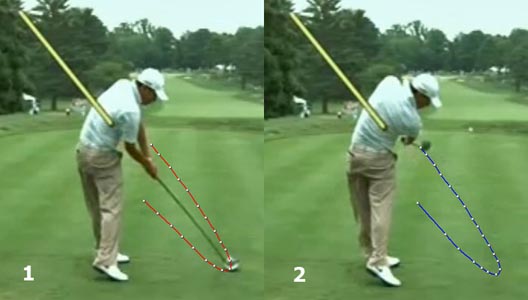
Here is a composite photo showing the arc of rotation of the hosel and sweetspot in Anthony Kim's swing.
See -
The red arc delineates the sweetspot arc. The blue arc delineates the hosel arc. They are very close together. The yellow line was drawn by the TV commentator and it represents the clubshaft angle in mid-downswing. Note how it goes through the clubshaft at impact. In other words, in a general sense, the clubshaft is still on-plane at impact - although it is obvious that the only "real" plane of relevance is the sweetspot plane because it is the only plane that is precisely located on the ball-target line. The base of the hosel's inclined plane must theoretically be slightly inside the ball-target line at impact.
I still think that the mental idea of the hosel rotating around the sweetspot has no real relevance because the clubshaft never rotates about its own longitudinal axis to a significant degree at any instantaneous moment in time. The clubshaft rotates very slowly in space throughout the downswing/followthrough and it therefore causes the hosel's arc of rotation to be different to the sweetspot's arc of rotation.
I like Homer's statement when he states-: "Except for Impact, the clubshaft is an acceptable Visual Equivalent for both planes, especially if the Clubface is Turned "On Plane"."




 Linear Mode


