I still think that the mental idea of the hosel rotating around the sweetspot has no real relevance . . .
Jeff.
It was already dark when I finished my last lesson tonight -- under the lights -- at the Marietta Golf Center. As I walked to my car, I saw a guy hitting ball after ball dead right and with a big left-to-right curve. It wasn't the first time I had witnessed these futile efforts, and I couldn't help myself . . .
I walked over and asked him if he had ever hit a draw. He said no. I told him I was about to change his life.
In twenty minutes, I adjusted his ball position and his address hands location. I unfroze his right hip and got his left foot and knee into action. All this allowed him to swing to top in a beautiful, classic alignment. This done, I taught him how to use his left hand through impact, i.e., how to rotate the shaft around the sweetspot.
Results?
Long, strong draw shots and tears in the eyes of a 52-year-old man who never thought he would or even could see such things.
So, Jeff, you talk to me of "relevance", and I talk to you of joy.
I like Homer's statement when he states-: "Except for Impact, the clubshaft is an acceptable Visual Equivalent for both planes, especially if the Clubface is Turned "On Plane"."
Jeff.
That's because the Clubshaft has rotated onto the Plane of the Sweetspot.
Yoda - Consider again my demonstration of the clubshaft lying on the plane board.
In my example, I stated that the clubshaft lies against the inclined plane board throughout the impact zone. In that practical example I let the clubface close gradually pre-impact and post-impact. However, I also stated that I could vary the degree of clubshaft rotation during the pre-impact phase (to simulate the release swivel phenomenon) and vary the degree of clubshaft rotation post-impact to simulate different hinging actions.
Here is a capture image showing the situation.
The yellow line represents the ball-target line and also the base of the sweetspot plane.
The red line represents the sweetspot plane line (drawn from PP#3 through the sweetspot ).
The green line represents the clubshaft plane - note that the base of the clubshaft plane is inside the ball-target line.
Do you believe that this practical example is actually happening in a golf swing? In other words, do you think that the clubshaft is traveling on its own clubshaft plane through the impact zone while the sweetspot is traveling on its sweetspot plane?
If your answer is yes - then consider your statement in your last post.
You stated-: "the clubshaft has rotated onto the plane of the sweetspot."
Do you imagine the hosel rotating around the sweetspot? If you imagine the hosel rotating around the sweetspot post-impact, then does the hosel have to leave the surface of the clubshaft plane to achieve that goal? If not, then how do you mentally envisage the hosel rotating around the sweetspot? If the hosel has to leave the clubshaft plane to rotate around the sweetspot, then how one can infer that the clubshaft is on its own inclined plane through the impact zone?
If you are tempted to answer that the hosel leaves the clubshaft plane in order to rotate around the sweetspot post-impact, then look at the following Martin Hall swing video.
Note that he is using a simulated golf club that has very long clubhead (>12" in length). If that club has the same club lie angle as a regular club, then doesn't Martin have to swing the club along the same clubshaft inclined plane (along the surface of that plane board) even though the sweetspot plane angle in this example is going to be very different to the clubshaft plane angle. Then, in what sense do you imagine the hosel rotating around the sweetspot of that clubhead post-impact? Also, in what sense do you imagine the clubshaft rotating onto the sweetspot plane of that club post-impact?
Jeff.
Last edited by Jeff : 01-23-2009 at 01:13 PM.
Reason: add another question
The yellow line represents the ball-target line and also the base of the sweetspot plane.
The red line represents the sweetspot plane line (drawn from PP#3 through the sweetspot ).
The green line represents the clubshaft plane - note that the base of the clubshaft plane is inside the ball-target line.
Do you believe that this practical example is actually happening in a golf swing? In other words, do you think that the clubshaft is traveling on its own clubshaft plane through the impact zone while the sweetspot is traveling on its sweetspot plane?
At Impact, yes.
Originally Posted by Jeff
If your answer is yes - then consider your statement in your last post.
You stated-: "the clubshaft has rotated onto the plane of the sweetspot."
Do you imagine the hosel rotating around the sweetspot?
Yes.
Originally Posted by Jeff
If you imagine the hosel rotating around the sweetspot post-impact, then does the hosel have to leave the surface of the clubshaft plane to achieve that goal?
Yes.
Originally Posted by Jeff
If not, then how do you mentally envisage the hosel rotating around the sweetspot?
Not applicable.
Originally Posted by Jeff
If the hosel has to leave the clubshaft plane to rotate around the sweetspot, then how one can infer that the clubshaft is on its own inclined plane through the impact zone?
Read the bolded portion of the sentence in question from your own post:
Originally Posted by Jeff
I like Homer's statement when he states-: "Except for Impact, the clubshaft is an acceptable Visual Equivalent for both planes, especially if the Clubface is Turned "On Plane"."
Jeff.
"Except for Impact" means exactly what it says. Those words imply -- and I infer -- that otherwise, the Clubshaft is in the process of rotating to or from the Sweetspot Plane.
Originally Posted by Jeff
If you are tempted to answer that the hosel leaves the clubshaft plane in order to rotate around the sweetspot post-impact, then look at the following Martin Hall swing video.
Can I call my lawyer?
Seriously, Jeff, I'm out of time for now. I'll see what I can do later.
In a previous post I think that OB Left stated that he felt the sweetspot through PP#3 during the downswing, and I presume that he tries to trace the base of the sweetspot plane via PP#3 throughout the entire dowswing (and not any clubshaft plane).
OK. Now consider this example.
See -
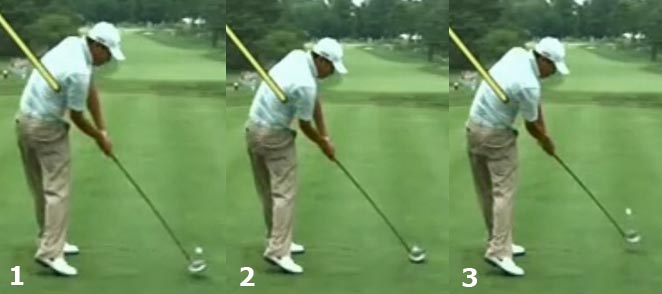
Anthony Kim is swinging on-plane during the early-mid downswing and that plane is represented by the yellow line drawn by the TV commentator.
Here is AK's clubshaft through impact.
Note that his clubshaft is in a straight line relationship with the yellow line when the clubshaft travels through impact. So, does AK have to trace the sweetspot plane's baseline to achieve that goal, or is he simply swinging on the same clubshaft plane that he was swinging on when his clubshaft was above the third parallel?
Consider this next example.
Imagine that AK was swinging a specially designed club that had a clubhead of 12" width and presume that the club lie angle was the same as his regular driver - represented by the blue lines. Then, he would have to position the ball further away (about 6" from the hosel) to hit the ball in the center of his clubface. The red line represents the sweetspot plane.
Do you imagine that AK could hit the ball well by tracing the baseline of that sweetspot plane? How would he get the bottom of his clubhead to be parallel to the ground if he didn't have the clubshaft tracing the same path (traveling along the same clubshaft plane) as occurs in his regular swing? To achieve that goal, he would have to trace the clubshaft's SPL and not the sweetspot's SPL because one couldn't trace both the clubshaft SPL and the sweetspot SPL at the same time.
If you imagine the hosel leaving the clubshaft plane post-impact to get to the sweetspot plane (so that the hosel can rotate around the sweetspot post-impact), then how would that be possible if he was obliged to keep the clubshaft on the same clubshaft plane throughout the post-impact time period until he reached the fourth parallel?
Jeff.
Last edited by Jeff : 01-23-2009 at 02:11 PM.
Reason: added a question
To be honest this thread has been eye opener for me too. I now have a better appreciation of the difference between the sweetspot plane and shaft plane. Thanks for that.
Close your eyes and swing. That feeling, that weight at the end of the shaft feeling is the sweetspot, the longitudinal center of gravity. Not the shaft or merely the clubhead. We thrust that COG knowingly or unknowingly at the target (aiming point).
Makes it sound like an easy game, eh? What could possibly go wrong?
If you are tempted to answer that the hosel leaves the clubshaft plane in order to rotate around the sweetspot post-impact, then look at the following Martin Hall swing video.
Note that he is using a simulated golf club that has very long clubhead (>12" in length). If that club has the same club lie angle as a regular club, then doesn't Martin have to swing the club along the same clubshaft inclined plane (along the surface of that plane board) even though the sweetspot plane angle in this example is going to be very different to the clubshaft plane angle. Then, in what sense do you imagine the hosel rotating around the sweetspot of that clubhead post-impact? Also, in what sense do you imagine the clubshaft rotating onto the sweetspot plane of that club post-impact?
No, Jeff, he does not "have to swing the club . . . (along the surface of that plane board)". In fact, he must not. That is the whole point of this discussion, and it is exactly the piece of the puzzle you are missing. The Sweetspot always orbits on the Sweetspot Plane whereas the Clubshaft moves to and from that Plane. In so doing, it moves from and to its own Clubshaft Impact Plane.
Look, this is not that hard. Because the Sweetspot is 'outside' the Clubshaft, and because they are aligned on essentially the same Plane throughout most of the Golf Stroke, then either the Clubshaft must have rotated to the Sweetspot Plane or the Sweetspot must have rotated to the Clubshaft Plane. There are no other alternatives.
When you demand -- in either Martin's demonstrations or your own -- that the Clubshaft adhere to the Plane Board (except during Impact), you also demand that the Sweetspot leave its Sweetspot Plane and go the Clubshaft Plane. In other words, you insist that the Sweetspot rotate off its own Plane and onto the Plane of the Clubshaft (as made visible by the Plane Board). And that wobbly motion, sir, just ain't the way it works.
The Plane Board is a useful and practical theoretical conception. But, the truth is that if the Shaft stays on it throughout the Stroke, you will necessarily disrupt the Sweetspot's orbit. And that particular malfunction has a name . . .
In my mental universe, Martin Hall has to swing his clubshaft along the plane board in order to keep the sole of his 12+" wide clubhead parallel to the ground at impact. You simply choose to ignore the need for the sole of his wide clubhead club to be parallel to the ground, and roughly on ground level, at impact.
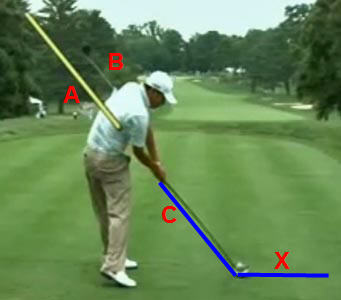
Consider this photo of Anthony Kim produced from the following swing video.
Swing video -
In this photo, A represents his clubshaft plane in the mid-downswing. B represents his clubshaft plane in the finish phase. Both A and B are on the same inclined plane as C ( C is his clubshaft plane at impact) because Anthony Kim has a perfectly symmetrical swing.
Now imagine Anthony Kim swinging a club that has a clubhead width of 18" and an identical club lie as his regular driver - represented by the blue lines. Point X is the sweetspot at impact and it is 9" from the hosel.
In my mental universe AK has to swing his club so that his clubshaft is exactly on plane C at impact - in order to get the sole of his 18' wide clubhead to be parallel to the ground at impact and just touching the surface of the ground at impact. In my mental universe, X rotates to B - in other words, the sweetspot rotates to the clubshaft plane at B (while the clubshaft simply remains on-plane between C and B).
I am really enjoying the dialogues between you and Yodas and learning.... So very sorry to interrupt. But in you hockey-stick golf swing in your mental exercise now without the support of the plane board. What are you swinging? The COM of the clubshaft? The COM of the whole club which should be near the straight-line segment joining point C and point X? Or the COM of the clubhead which is near point X?






 Linear Mode


