A spinning top has a single axis of rotation because it spins over a tip point that is in-line with the center of its structure and its COG is in line with the tip point.
Human beings have two legs and the pelvis cannot rotate around a single axis. The pelvis pivots over two separate femoral heads, and the backswing pivot action forces the spine to become angled when the pelvis rotates. That creates a reverse K posture of varying degrees of rightwards upper torso tilt.
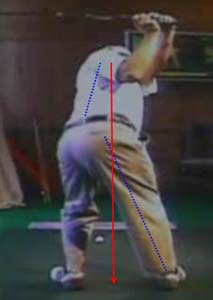
Here is a photo of VJ Trolio rotating during the his backswing - from his swing video at
The blue dotted lines depict his reverse K posture.
The red arrowed line shows that his head is centralised.
Now, if you think that VJ Trolio is rotating around a centralised pivot axis that is straight in-line with his head, and if that thought helps you to improve your golf swing, then I do not feel impelled to convince you otherwise.
I simply see reality differently. I simply see the end-result of a well-executed backswing pivot action - a reverse K posture where the body is generally left-centralised between his feet with his head in the center. His body is left-centralised because he favors shifting his pelvis leftwards in the late backswing in order to get his COG closer to his left foot.
I can see and understand exactly what he is doing - and I do not have to think of a hypothetical "pivot center" or hypothetical "pivot axis" to make sense of his biomechanical actions.
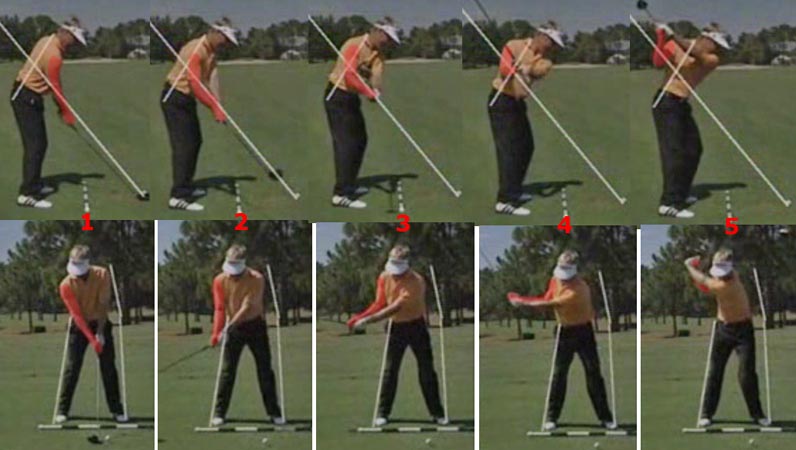
He has a rotary motion and not any lateral swaying motion. I think that a good backswing pivot action must have that type of rotary motion. However, I find it perfectly acceptable if a golfer has a rightwards-centralised body position because the COG of the body is closer to the center of the stance, rather than closer to the left foot, as in these images of Stuart Appleby.
Stuart Appleby's head is right-of-center, but his COG is more centralised - compared to VJ Trolio.
From my perspective, both backswing pivot actions occur according to the same rotary principles - with no lateral swaying. They simply differ in terms of their weight distribution at the end-backswing position.
A spinning top has a single axis of rotation because it spins over a tip point that is in-line with the center of its structure and its COG is in line with the tip point.
Human beings have two legs and the pelvis cannot rotate around a single axis. The pelvis pivots over two separate femoral heads, and the backswing pivot action forces the spine to become angled when the pelvis rotates. That creates a reverse K posture of varying degrees of rightwards upper torso tilt.
Here is a photo of VJ Trolio rotating during the his backswing - from his swing video at
The blue dotted lines depict his reverse K posture.
The red arrowed line shows that his head is centralised.
Now, if you think that VJ Trolio is rotating around a centralised pivot axis that is straight in-line with his head, and if that thought helps you to improve your golf swing, then I do not feel impelled to convince you otherwise.
I simply see reality differently. I simply see the end-result of a well-executed backswing pivot action - a reverse K posture where the body is generally left-centralised between his feet with his head in the center. His body is left-centralised because he favors shifting his pelvis leftwards in the late backswing in order to get his COG closer to his left foot.
I can see and understand exactly what he is doing - and I do not have to think of a hypothetical "pivot center" or hypothetical "pivot axis" to make sense of his biomechanical actions.
He has a rotary motion and not any lateral swaying motion. I think that a good backswing pivot action must have that type of rotary motion. However, I find it perfectly acceptable if a golfer has a rightwards-centralised body position because the COG of the body is closer to the center of the stance, rather than closer to the left foot, as in these images of Stuart Appleby.
Stuart Appleby's head is right-of-center, but his COG is more centralised - compared to VJ Trolio.
From my perspective, both backswing pivot actions occur according to the same rotary principles - with no lateral swaying. They simply differ in terms of their weight distribution at the end-backswing position.
Jeff.
Different model/pattern for Trolio . . . . typically more draw biased.
A spinning top has a single axis of rotation because it spins over a tip point that is in-line with the center of its structure and its COG is in line with the tip point.
Human beings have two legs and the pelvis cannot rotate around a single axis. The pelvis pivots over two separate femoral heads, and the backswing pivot action forces the spine to become angled when the pelvis rotates. That creates a reverse K posture of varying degrees of rightwards upper torso tilt.
Here is a photo of VJ Trolio rotating during the his backswing - from his swing video at
The blue dotted lines depict his reverse K posture.
The red arrowed line shows that his head is centralised.
Now, if you think that VJ Trolio is rotating around a centralised pivot axis that is straight in-line with his head, and if that thought helps you to improve your golf swing, then I do not feel impelled to convince you otherwise.
I simply see reality differently. I simply see the end-result of a well-executed backswing pivot action - a reverse K posture where the body is generally left-centralised between his feet with his head in the center. His body is left-centralised because he favors shifting his pelvis leftwards in the late backswing in order to get his COG closer to his left foot.
I can see and understand exactly what he is doing - and I do not have to think of a hypothetical "pivot center" or hypothetical "pivot axis" to make sense of his biomechanical actions.
He has a rotary motion and not any lateral swaying motion. I think that a good backswing pivot action must have that type of rotary motion. However, I find it perfectly acceptable if a golfer has a rightwards-centralised body position because the COG of the body is closer to the center of the stance, rather than closer to the left foot, as in these images of Stuart Appleby.
Stuart Appleby's head is right-of-center, but his COG is more centralised - compared to VJ Trolio.
From my perspective, both backswing pivot actions occur according to the same rotary principles - with no lateral swaying. They simply differ in terms of their weight distribution at the end-backswing position.
Jeff.
To me the axis of rotation as Vj defines it and TGM's pivot center are different concepts. For the perfectly spinning top they would be on the same centralized line but the human golfer with multiple centers, levers etc who is playing most of his shots with the weight left at impact will not have the two aligned.. We all need to get on our left side for most shots.
Now the spinning top analogy with the axis of rotation aligned with the COG and its implications to club head speed are relevant but should not be thought of as centralized between the feet for fuller shots for humans. The pivot center maybe is but not the COG or axis of rotation.
Its been a while since I read VJs book but isnt his whole "move" one of getting his COG (which he defines as a spot for him anyways which is underneath his belly button but mid body, close to spine) over the axis of rotation (which is around his left foot). So as to reduce the wobble about the axis of rotation and thereby speed the rotors (body's) blades (arms) to the fullest?
The Vj move and the main difference being his and Apps swings being that he gets it (COG and hips, axis tilt) there (left, over his axis of rotation) on his backswing rather than on his downswing. Apps will do this in the photos not included above, during his downswing. All pros get left dont they? Isnt that one of the things that sets them apart from us hackers?
Now all of this goes out the window if golf is a non rotational motion. So does CF I guess too.
This is almost a counter intuitive deal . . . . for the hands to stay on plane without a plane shift out . . . there HAS TO BE LATERAL MOVEMENT. Keep in mind the plane that a top spins on is a Horizontal Plane . . . . our basic plane is inclined . . . so for the hands to stay IN on the way down you have to tilt your axis . . . we're trying to move the hands in a circle . . . not necessarily the pivot. Lateral is a big deal interms of plane and circle.
Bucket, Im struggling with this one a little. The vertical vs inclined plane thing seems great, please elaborate.
Does this relate to CF throwing the hands to a position that is OUT irrespective of the inclined plane? Cool. Is this what you mean? The science behind the need for axis tilt, the on plane right shoulder and therefore the hands all from a lateral hip slide action?
You are correct that the TGM pivot axis (which is apparently a vertical line centralised between the feet while going through the base of the neck) is different to VJ's pivot axis. VJ has invented his own concept of a downswing pivot axis which is imprecisely defined. It starts at the left foot and goes up the left leg and then it is angled towards the center of the body. However, he states that the pivot axis changes constantly throughout the downswing and I don't think that he has precisely defined how it is angled at different time points during the downswing. He also states that the COG is near the navel. In his recommended backswing pivot action where the pelvis is shifted left-laterally in the late backswing, the pivot axis would then be very close to passing through his COG as it is situated at the end-backswing position. He believes that with the COG located near the pivot axis, that it allows a golfer to rotate more efficiently around his (idea of a) pivot axis without any need for a lateral pelvic shift in the early downswing. By contrast, Stuart Appleby would have to shift his pelvis left-laterally first in the early downswing (towards the left white line in those SA photos) before he could pivot in a rotational manner around this downswing pivot axis.
I personally have more sympathy for VJ's pivot axis idea (than the TGM vertical pivot axis idea) because i) at least he acknowledges that the downswing pivot axis is located somewhere near the left femoral neck, the pivot point for the pelvis rotation in the late downswing/followthrough - rather than being arbitrarily located centrally between the feet; and ii) because he thinks of the pivot axis as being angled from the left foot to the base of the neck (roughly related to the idea of secondary axis tilt) - rather than being vertical. I think that those two defining points make more sense from a biomechanical perspective, and I can relate to it better than TGM's vertical pivot axis centralised between the feet that goes vertically upwards to the base of the neck - creating a hypothetical tripod-shaped structure.
However, I cannot really relate to the idea of the torso being an unitary rotating cyllinder that rotates around that downswing pivot axis. I think of the "rightwards tilted spine and its angled relationship relative to the straight left leg" as being a braced skeletal structure (kept stationary by the stationary head) that provides structural support stability - so that the arms can swing efficiently and fluidly across the front of the rotating body after release of PA#4.
You are correct that the TGM pivot axis (which is apparently a vertical line centralised between the feet while going through the base of the neck) is different to VJ's pivot axis.
Jeff.
Hey Jeff
Actually what I said was vj's "axis of rotation", TGMs "pivot center".
TGM's "pivot center" as defined in the glossary is: "SOME POINT on the body kept stationary throughout the Stroke, to stabilize the motion". CAPS BY ME.
VJ's axis of rotation for full shots is around the left foot. I dont have my Vj book with me but the two seem not to be mutually exclusive. VJ , if memory serves me correctly advocates shifting the hips, axis tilt, to align COG with his "axis of rotation" all the while holding the "pivot center" in place to stabilize the motion.
I may be wrong but assuming the head is not the pivot center the heads weight will have to be counterbalanced to avoid a wobble about the axis of rotation. No?
OK, now for the incubator stuff: Is this counterbalancing sort of like a fly wheel? Is there is a mechanical advantage to the counterbalance? Like in Leonardo's Flywheel. Click on the link and watch it go with just a flick of the hand.
Jeff, perhaps your objection to the pivot center definition would change with MORE thought given to it not being the head but rather the base of the neck or somewhere there abouts? The head with all of its weight counter balancing the mass on the other side of the axis of rotation like in Leonardo's flywheel? Perhaps you could do a drawing? The head's weight is considerable and would take a substantial amount of body or hip to offset it. An optical illusion of sorts when trying to perceive a pivot center and axis of rotation.
Im obviously out on a incubatorial limb here. Heck, just grip it and rip it.
I hope that this "Golf by Jeff" forum will be a forum where any LBG forum member can test his radical (or less radical) ideas using i) "objective reality" and ii) "logical coherency" and iii) "degree of concordance with well known biomechanical/mechanical facts" rather than authority-based dictums as the "gold standard" for estimating success.
I have tried to foster that attitude by never censoring any forum member who put forward an alternative opinion that contradicted my personal opinion - as long as the expressed opinion is related to mechanical or biomechanical "issues" relating to the golf swing (and as long as the expressed opinion is not an overt ad hominem attack). As long as this forum continues to exist and as long as I have the power to be a moderator, then I plan to maintain those high standards. I will never claim that I am an "expert" and therefore automatically "right" or accept any ideology that proposes that any other self-appointed "expert" is automatically "right". I expect every LBG forum member, irrespective of his knowledge and experience, to defend his opinions via the mechanism of a logical counterargument and I do not expect him to have to kow-tow to any authority figure. This "Golf by Jeff" forum welcomes all enterprising LBG forum members who are willing to argue passionately on behalf of their opinions and who refuse to give "authority-based" opinions any special consideration.
My greatest admiration goes towards those forum members who disagree with my opinions, and who then take the trouble to pen a detailed counterargument. As long as that type of forum member continues to post in this "Golf by Jeff" forum, them my personal interest and participation will not wane. I hope to learn from them.
I do not recall VJ referring to the head as the pivot center. In one drawing, his pivot axis goes up the left leg and then through the cylinder to exit centrally at the top of the cylinder (equivalent to a torso with an exit point at the level of the base of the neck). On another page, he draws the pivot axis through the left side of the torso - well left of the spine and head.
I personally do not think that the head acts as a counterbalancing force, and/or that it will necessarily create wobble of the torso if slightly offset.
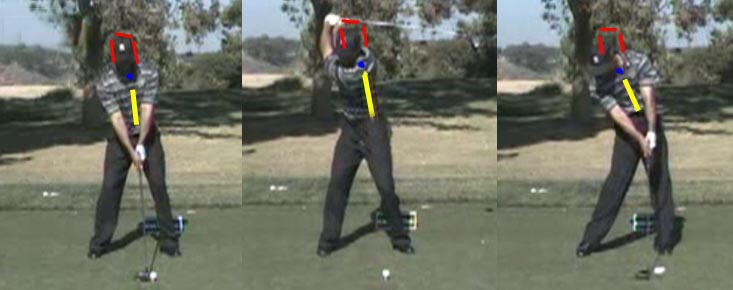
Here is a capture image from a Tiger Woods swing video - his head falls back-and-downwards during the downswing. However, I don't think that it affects his swing.
Whether one describes the base of the neck or the head as the pivot center, I can accept the implications of your posted HK-definition of a pivot center - "SOME POINT on the body kept stationary throughout the Stroke, to stabilize the motion."
However, I cannot understand the concept of a centralised pivot center (being centrally located in the body or centrally located in the stance) with a vertical pivot axis going through that pivot center point.






 Linear Mode


