To your previous post; I assume the addition was addressing this issue, that you highlighted in your response to Jeff:
Originally Posted by Yoda
"This lag pressure point Pressure (1-L #7) is driving the club."
And the Lag Pressure Point Pressure is Centrifugal Force being transmitted through Pressure Point #3.
In both versions -- original or edited with additional information -- my post stands.
I agree that the lag pressure point is driving the club. And by "driving" i mean adding energy to the club; In Newtons language - increasing 1/2 mv2.
BUT - I do not follow you when you say that the lag pressure is centrifugal force. (Actually I think centripetal force is the right term here, but it is beside the point I want to get through). The point is that centripetal force doesn't add energy to the golf swing. It only stores the energy that has been added throught the work of tangential forces:
A centripetal acceleration …
occurs whenever a moving object changes direction,
does not change the speed of an object,
acts at right angles to the velocity at any instant, and
is directed toward the center of a circle.
A centripetal force …
is the force that makes a moving object change direction,
is not a particular force, but the name given to the net force responsible for circular motion,
acts at right angles to the velocity at any instant, and
is directed toward the center of a circle.
Directions in circular motion:
Velocity is tangential (lies on a tangent to the path).
Centripetal acceleration and centripetal force are radial (point toward the center of a circle).
Centripetal acceleration and the object's velocity are always perpendicular.
Centripetal force and centripetal acceleration are always parallel.
______________
To put it in my own words:
It takes tangential force to create swing speed. Force with the same direction as the clubhead. The centripetal force that we have to produce to keep the club swinging is an effect of the velocity introduced by tangential forces. It is an effect of swing speed and not a cause.
For simplicity, assume a one-lever system (no lag pressure between hands and club).
To analyze what the pull from a left shoulder on a one-lever system does to the swing, the pull should be decomposed into two force vectors; One centripetal force component - pointing at the swing centre. And one tangential component that points in the same direction the swinging object is moving. The angle of the lever vs the angle of the centripetal force (the line from MOI to the swing center) provides all the info we need to estimate the tangential force.
The tangential component is the one that increases the swing speeed. It adds velocity energy to all the moving parts of the swing. The centripetal component changes the speed simply by changing the direction of the movement. The velocity energy of the system is not affected by this.
Applying only centripetal force is the same as hanging the lever assembly around your neck and just stand still. In a perfect, friction free and without earth gravity world , it will spin forever at a constant speed. Of course you will have to apply tangential force initialy to get the spin rate up.
We can do the same analyzis on a two-lever system from the hands and down; The hands pullling the club will induce a drag force* on the club. This drag force can be decomposed in a tangential component and a centripetal component. More clubhead lag (the further the golf shaft points away from the neck) will mean a larger ratio of longitudunal /centripetal force.
The actual golf stroke is an harmonic blend of tangential force that builds speed and centripetal force that purely helps us store the speed that's already there. You need to apply a centripetal force of increasing size to account for the ever increasing energy that is accumulated by tangential force.
I think it is important to undestand that tangential force is the only kind that builds swing speed. Even though the force we feel the strongest just before impact is likely to be the centripetal force, it's the tangential forces that do the work. And those who hit the ball long applies more of it than most others.
There is a lot of complicated things going on in the golf swing. The hand radius changes, the clubface radius changes etc etc. Looking for energy accumulation and release in the swing simplifies IMO some of the most basic mechanical understanding of what's going on. What it all boils down to then is that tangential forces are the only ones who add energy. We can use centripetal acceleration to store the energy in a circular move and we can use a few "tricks" to redistribute some of the energy towards the clubhead just prior to impact etc. But all the energy that eventually is transmitted to the ball comes from tangential forces.
I believe there's a lot of confusion between cause and effects here, also among experienced instructors. The major part of the strong pull that we feel from "pulling the rope" through impact is actually a simple reaction to the energy that's already accumulated in the swing. And the other part - a much smaller one - does in fact produce tangential force. But only as long as we're pulling from a point that is offsett the swing center.
____
* When the right hand PP's work on the club below the left hand / club hinge - there will in addition be imposed a Newtonian moment on the club ref my first post in this thread - a momoment that will energize the spring effect of the shaft & clubhead. This energy will be stored and released later when the moment is reduced.
1) "I agree that the lag pressure point is driving the club. And by "driving" i mean adding energy to the club."
How does PP#3 add energy to the club considering that PP#3 is simply the right index finger against the back of the club?
2) "The point is that centripetal force doesn't add energy to the golf swing. It only stores the energy that has been added through the work of tangential forces."
How does a centripetal force store energy? Stored where? To what purpose? Is that energy eventually released? When, and how?
3) "The centripetal force that we have to produce to keep the club swinging is an effect of the velocity introduced by tangential forces."
Why is a centripetal force needed to keep the club swinging? You then immediately state that centripetal force is an "effect" and the "cause" of that effect is the "velocity produced by tangential forces". From where is this tangential force derived? When those tangential forces act to increase velocity - velocity of what? How does velocity of "what" produce a centripetal force?
4) "The tangential component is the one that increases the swing speed. It adds velocity energy to all the moving parts of the swing. The centripetal component changes the speed simply by changing the direction of the movement". How does a change in direction increase swing speed? Speed of "what"?
5) "More clubhead lag (the further the golf shaft points away from the neck) will mean a larger ratio of longitudunal /centripetal force."
Why? If the club lag is 90 degrees, why is there a higher ratio of longitudinal/centripetal force compared to a situation where the clubhead lag is 75 degrees?
6) "The actual golf stroke is an harmonic blend of tangential force that builds speed and centripetal force that purely helps us store the speed that's already there. You need to apply a centripetal force of increasing size to account for the ever increasing energy that is accumulated by tangential force."
Where does the centripetal force store the speed? If one uses a tangential force to move "what" why is energy accumulated? If the swinging "what" travels at a faster speed, why must centripetal force increase?
Somehow for some unknown reason I knew Bernt was gonna cop this ...love the note on the end in brackets.What Jeff really meant was ..since he is a physics expert himself ..is that you have just wrote a whole lot of bs..entertaining stuff
To understand a person's viewpoint, I need very simple explanations where every sentence is well-defined in terms of definitions and concepts, and where all the sentences are carefully connected so as to finally produce a coherent storyline.
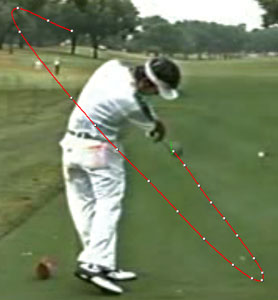
Here is a photo of a golfer's clubhead swingarc.
One can see that the clubshaft/clubhead moves down-and-out-and forwards along a circular arc in the downswing. Therefore, the forces needed to move the clubhead need to achieve two goals from an energy perspective - i) move the clubshead at a finite speed in space and ii) move the clubhead in a circular arc (which is equivalent to supplying the clubhead with centripetal acceleration while it is traveling at its finite speed).
I would like to see Bernt use that simple model to describe the forces needed, and their mechanism of energy storage and release.
Thanks for your post, BerntR. Once again, I want to respond to this very important point.
1. The Clubshaft has inertia. Tipped-stiff or senior flexible, it has inertia.
2. At the same time, Centrifugal Force has a Line of Pull. That invisible line is from the #3 Pressure Point (first joint of the right forefinger) to the Sweetspot. This Lag Pressure Point Pressure (1-L #7) is what is driving the Club, not the Clubshaft.
3. The inertia of the clubshaft cannot keep up with the Centrifugal Line of Pull. Hence, it lags behind. This 'reverse' parabola (reverse in that the forward bend is counter-intuitive) made a dramatic appearance in Ben Hogan's first book, Power Golf. With the exception of Elbow Postion (Pitch versus Punch), the photo on page 97 of that book (hardcover version) is virtually identical with Image #2 (below) in your post.
If somebody could put that up, I'd appreciate it. Thanks!
Boy Howdy.... That's some massive toe down deflection.. was he playing hickory?
NM - you agree with Jorgensen re. shaft flex behaviour in downswing?
He concludes (from examining the shaft behaviour of one golfer) that the "flexing of the shaft forward as the clubhead comes in to hit the ball is a general characteristic of the golf swing. Photographs made with the use of a focal plane shutter must be ignored in this context. There are few photgraphs in the golf literature made with stroboscopic light sources, but of those I have examined, all of them show clubs flexed in this manner"
So exclude focal plane shutters and some video cameras ...before theorising too much about shaft flex photos .
1) "I agree that the lag pressure point is driving the club. And by "driving" i mean adding energy to the club."
How does PP#3 add energy to the club considering that PP#3 is simply the right index finger against the back of the club?
When you apply a force to an object - and the object moves (partly) same direction, you energize the object. Same thing here. This is very basic mechanics.
Quote:
2) "The point is that centripetal force doesn't add energy to the golf swing. It only stores the energy that has been added through the work of tangential forces."
How does a centripetal force store energy? Stored where? To what purpose? Is that energy eventually released? When, and how?
It lets the swing keep it's speed. The precise formula is 1/2 mv2. For each molecule that is moving. So you need to do some integral calculus to get the exact result.
The energy is released as the club stops to move.
Quote:
3) "The centripetal force that we have to produce to keep the club swinging is an effect of the velocity introduced by tangential forces."
Why is a centripetal force needed to keep the club swinging?
Just spend some time googling "centripetal force". And you can start with the link I put up.
Quote:
You then immediately state that centripetal force is an "effect" and the "cause" of that effect is the "velocity produced by tangential forces".
From where is this tangential force derived?
From the left shoulder pull, from PP 1,3, 4 and their combination.
Quote:
When those tangential forces act to increase velocity - velocity of what? How does velocity of "what" produce a centripetal force?
You really have no idea of what I'm talking about do you?
Let me see - what is moved during the swing? Clubhead, clubshaft, hands, arms partly upper body.
Anything that moves in circle is subjected to a centripetal force. But you need to understand what a centripetal force really is to have any progress in this regard.
Quote:
4) "The tangential component is the one that increases the swing speed. It adds velocity energy to all the moving parts of the swing. The centripetal component changes the speed simply by changing the direction of the movement".
How does a change in direction increase swing speed? Speed of "what"?
Good question. the answer: It doesn't increase swing speed. But the change of direction is the only reason that the accelleration caused by centripetal force is called accelleration. Not that there is anything wrong with that. But it is grossly misleading to golfers.
Quote:
5) "More clubhead lag (the further the golf shaft points away from the neck) will mean a larger ratio of longitudunal /centripetal force."
Why? If the club lag is 90 degrees, why is there a higher ratio of longitudinal/centripetal force compared to a situation where the clubhead lag is 75 degrees?
Quote:
Because the alternative will have less clubhead lag. If you think "rope handling" technique, it should be clear that the total forces on the club has the same direction as the rope.
6) "The actual golf stroke is an harmonic blend of tangential force that builds speed and centripetal force that purely helps us store the speed that's already there. You need to apply a centripetal force of increasing size to account for the ever increasing energy that is accumulated by tangential force."
Where does the centripetal force store the speed?
In the moving club. And having it go in a circle is a very attractive alternative to the ... alternative, don't you think?
Quote:
If one uses a tangential force to move "what" why is energy accumulated?
Because the the tangential force adds speed to what's already in the swing. The swing speed builds up gradually. If it didn't there wouldnt be any point in having a full back swing.
Quote:
If the swinging "what" travels at a faster speed, why must centripetal force increase?
Jeff.
If the swinging MASS travels at a faster speed a larger centripetal force is required to maintain the swing radius. Of course to a certain extent the swing radius does increase so the CF probably doesn't increase as much as the swing speed.
I would like to see Bernt use that simple model to describe the forces needed, and their mechanism of energy storage and release.
Jeff.
First you need tangential forces to make the club move at all. Then you need more of the same to get proper swing speed.
At the same time you need centripetal force to make the club move in a circle instead of flying down the driving range.
You should also be aware that the centripetal force is not a force per se in the golf swing. Because there isn't anything in there that is pulling from the swing center. The centripetal force is merely result of decomposing the total force on the club in a centripetal component and a tangential component - and possibly other components too - that will will reduce the quality of the stroke.
That (what you said) don't make a whole lotta sense to me.
You start out good re... the centripetal acceleration stuff, but then you lose me when you say: centripetal stores energy (no) and things in the golf swing are harmonic (sinusoidal as in sin and cosine) (no) and golfers are a drag.
Whoa nelly.... Lets take a step back here.
Everyone knows that there some guys who can hit pretty darn far with club head tied to string. Who was that instructor? famous guy who's name escapes me... anyway it don't matter.
Lets forget for a moment any torque (pun not intended) the golfer might impart via push/pull between that hands and consider the "pure swinger" case (club head on string)
If at any time during the downswing we drew a free body diagram of the club head it would show only one force acting on it (for the time being forget about gravity too ok... trust me its a minor contribution). We would call that one force acting on the club head (drum roll please..... no not centrifugal.... no not centripetal.... no not tangential no not radial...) we would call that force TENSION. Furthermore if we consider the "local coordinates" of the club head (see 2/3 down the page here: http://en.wikipedia.org/wiki/Centripetal_force ) we would find TENSION has both a tangential and radial (aka centripetal) components (again...is in local coordinates Tension has both tangential and radial (orthogonal) components). The force is tension... and it has two components: tangential and radial or centripetal.
{{{ Its worth mentioning that only w^2/r of the radial component is "centripetal" ... and excess us just radial }}}}
NOW the radial or centripetal component (being, by definition, directed at the instantaneous center of rotation (not left shoulder... not hands ... but at the instantaneous center of rotation as defined solely by the path of the club head itself) is what's know as a "central force" ( http://en.wikipedia.org/wiki/Central_force ) .... (and here is where we (mostly) agree Berntr... central forces (ie radial ones) generally do not increase the angular velocity of a rotating obect and the centripetal central force NEVER does.
Said another way, the centripetal component of the tension in the rope tied to the club head (usually) does not increase the speed of the club head. Its that tangential component which increases the speed of the club head.
This is why when Jeff swings his ball on a string, the central pivot must trace a curvilinear path.... in order to generate a tangential component which is solely responsible for making the ball rotate, the tension force in the string must not point at center of rotation.
Anyway in the ball on a string case, we must do that because the ball has AERODYNAMIC DRAG which acts in a tangential direction which must be overcome. Were the ball already spinning in the vacuum of space , then tension need only point to the center of rotation. The club head is subject to AERODYNAMIC "DRAG" too.
Just a thought...
Last edited by no_mind_golfer : 12-22-2008 at 06:28 PM.




 Linear Mode


