There is a difference between actively driving the hands in a circle and merely let the hands respond to a centripetal force. The first one accumulates energy, the second only preserves it.
I don't think I have said that centripetal force is required to store energy. (At least not in this thread But for those of us who prefere the traditional swing-like golf stroke I'm afraid it is unavoidable.) My main point about the centripetal force is that it doesn't power the golf swing. It is a deliberate drive of your hands in a circular manner that powers the swing in your video.
The release sequeence (in your demo) also has a side that deals with redistribution of energy that I haven't addressed. As you know a good golf swing is typically dominated by body rotation in the early down swing. Then the body slows down as the arms take over. Then the arms slow down as the club take over. This overtaking action redristributes some of the velocity energy from the body to the arms and further to the club. And this plays a part in generating clubhead speed. But if you look at the club in isolation, you still need the tangential forces to make this transfer of energy happen.
Some of the tangential forces will come from mass that already moves in a circular manner (hands, arms, body). This mass-velocity will resist slowdown.
The release action is also similar to a gear shift in a car. It enables you to apply a significant tangential force - and build incredible swing speed while working at close to optimum body speeds.
I have produced a 2 minute swing video lesson on "what powers a swinger's golf swing". If you understand this simple double pendulum swing model demonstration, then you will understand what powers the golf swing in a swinger's action.
Consider what I have demonstrated. One powers the golf swing by moving the left arm (central arm) in a circular manner. That "cause" produces an "effect". The "effect" is the circular motion of the left wrist/hand (peripheral hinge joint) in space. That "effect" becomes a "causal agent" with respect to releasing the club ("effect"). The circular movement of the left wrist/hand in space causes the release of the club.
If you understand what I have stated, there are only two possible causative agents in this sequence.
1) The left arm moves in a circular manner (due to the release of PA#4).
It produces an effect - the circular motion of the left wrist/hand in space.
2) The left wrist/hand unit moves in a circular manner in space.
It produces an effect - the release of the club.
The club release phenomenon is an "effect" and not a cause. I therefore think that it is nonsensical to state that an "effect" drives the golf club (via the lag pressure point at PP#3).
Note that I don't need to use the word centripetal or centrifugal in my description of "how the golf swing is powered" in a swinger's action.
I certainly think that it is nonsensical to believe that a centripetal force is necessary to "conserve speed and store energy".
Jeff.
Jeff,
What if I want NOT to release the club so soon with circular hand path?
__________________
If you cannot take the shoulder down the clubshaft plane, you must take along some other path and add compensations - now, instead of one motion to remember, you wind up with at least two!
THERE IS A HUGE DISTINCTION AND MISUNDERSTANDING ABOUT TWO CONCEPTS HERE . . .
1. Circle Path - this relates to HAND PATH
2. Sweep Release - this releates to CLUBHEAD PATH
You CAN have a Circle Path and NOT HAVE A SWEEP RELEASE.
I mean throw out action in relation to straight line delievery path...as Jeff don't believe 10-23-A
__________________
If you cannot take the shoulder down the clubshaft plane, you must take along some other path and add compensations - now, instead of one motion to remember, you wind up with at least two!
The hand arc is not as circular as the clubhead path.
The only time that the hand arc can be circular is a swing where the left shoulder socket remains stationary in space - as demonstrated with that double pendulum swing model where the fulcrum remains stationary (and as seen in an Iron Byron machine).
A poor golfer may have a near-circular hand arc if he accelerates the hands from the top of the swing and starts the kinetic sequence incorrectly with a hand pull down motion.
Good golfers start the downswing with a lower body shift movement that causes secondary axis tilt => they then rotate the right shoulder downplane => that allows the left arm to be pulled down to the ball (via the release of PA#4) along an inside track. That produces an U-shaped hand arc - as demonstrated in this next photo of Tiger Woods hand arc.
The upper portion of the hand arc is very "straightish" and that doesn't induce a release phenomenon. The release phenomenon doesn't only depend on the radius of the hand arc curve; it also depends on the hand speed as it moves through that portion of the hand arc curve. Tiger's hands aren't moving very fast during the "straightish" portion of the U-shaped hand arc because he hasn't yet released PA#4. The speed of hand movement in the early downswing is determined by the speed of the pivot rotation - because the left arm is still kept across the chest wall (PA#4 remains loaded) and the power package is kept intact.
Tiger's hand speed becomes maximum when PA#4 is released and that happens when his hands are going around the bottom of the U-shaped hand arc. That means that his hand speed is maximum when the radius of the hand arc curve is smallest (tightest rounded curve) and that causes the passive release of the club. Although we commonly refer to this release as a centrifugal-induced release, a better explanation is nm golfer's mathematical explanation. Either way, the release is passive, and the "force" inducing the release is the circular motion of the fast-moving hands.
KOC - I do believe in 10-23-A - see above photo of Tiger Woods. I simply use the term 'straightish" because the hand arc can never be perfectly straight. However, it can be close to straight if the kinetic sequencing is correct. To prevent a circular hand arc path that promotes a sweep release, a golfer needs to induce a more U-shaped hand arc (like Tiger Woods) by making sure that the thrust-direction of the hands is in a straight line direction towards a desired aiming point (eg. ball or point ahead of the ball on the ball-target line) and the kinetic sequence is optimised.
The hand arc is not as circular as the clubhead path.
The only time that the hand arc can be circular is a swing where the left shoulder socket remains stationary in space - as demonstrated with that double pendulum swing model where the fulcrum remains stationary (and as seen in an Iron Byron machine).
A poor golfer may have a near-circular hand arc if he accelerates the hands from the top of the swing and starts the kinetic sequence incorrectly with a hand pull down motion.
Good golfers start the downswing with a lower body shift movement that causes secondary axis tilt => they then rotate the right shoulder downplane => that allows the left arm to be pulled down to the ball (via the release of PA#4) along an inside track. That produces an U-shaped hand arc - as demonstrated in this next photo of Tiger Woods hand arc.
The upper portion of the hand arc is very "straightish" and that doesn't induce a release phenomenon. The release phenomenon doesn't only depend on the radius of the hand arc curve; it also depends on the hand speed as it moves through that portion of the hand arc curve. Tiger's hands aren't moving very fast during the "straightish" portion of the U-shaped hand arc because he hasn't yet released PA#4. The speed of hand movement in the early downswing is determined by the speed of the pivot rotation - because the left arm is still kept across the chest wall (PA#4 remains loaded) and the power package is kept intact.
Tiger's hand speed becomes maximum when PA#4 is released and that happens when his hands are going around the bottom of the U-shaped hand arc. That means that his hand speed is maximum when the radius of the hand arc curve is smallest (tightest rounded curve) and that causes the passive release of the club. Although we commonly refer to this release as a centrifugal-induced release, a better explanation is nm golfer's mathematical explanation. Either way, the release is passive, and the "force" inducing the release is the circular motion of the fast-moving hands.
KOC - I do believe in 10-23-A - see above photo of Tiger Woods. I simply use the term 'straightish" because the hand arc can never be perfectly straight. However, it can be close to straight if the kinetic sequencing is correct. To prevent a circular hand arc path that promotes a sweep release, a golfer needs to induce a more U-shaped hand arc (like Tiger Woods) by making sure that the thrust-direction of the hands is in a straight line direction towards a desired aiming point (eg. ball or point ahead of the ball on the ball-target line) and the kinetic sequence is optimised.
Jeff.
I appreciate your efforts in making your points with pictures. But, perspective is so important. Pictures of planes are not valid, unless the camera is 'looking' on plane. Pictures of circles are not valid, unless the camera is 'looking' squarely at the face of the plane.
Measuring a radius of a circle from an oblique camera angle can give you an invalid reading. Any measurement of the hand of a clock should be taken when facing the clock. It should not be measured in a 2-D picture taken from the side.
You wrote-: "Measuring a radius of a circle from an oblique camera angle can give you an invalid reading. Any measurement of the hand of a clock should be taken when facing the clock."
That's perfectly correct. I am presuming that all readers understand that all my photographs are only representative - that they are 2-D images of 3-D motions, and that there will be perspective distortion due to an imperfect camera angle relative to the relevant clubshaft/hand plane. However, I do not believe that the fundamental principles that I am attempting to demonstrate are incorrect - because of these camera angle problems. For example, the clubhead arc of Tiger Woods driver swing (from the Nike commercial) is obviously distorted because the camera angle is face-on - while the clubead arc motion is on the inclined plane. However, it remains a "fact" that the radius of the clubhead arc (relative to the swing center) is very different at different time points during the downswing and followthrough, and that the swing center cannot be conceived to be the dead-center of a circle of the clubhead arc's rotational arc motion in space. The same "fact" applies to Tiger's hand arc photo - it is only representative because the camera angle is not perpendicular to the hand arc's circular arc of motion in space.
What do you think of his centripetal arrow pointing towards the swing center in his diagram?
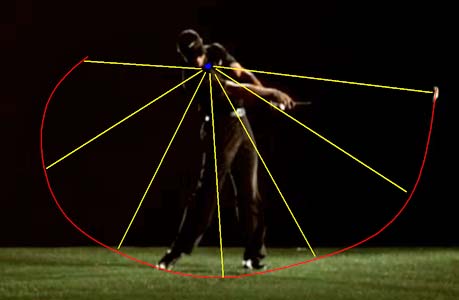
The presumption is that the swing center is the center of the clubhead's arc of travel. However, it is nowhere near the center of a circle transcribed by the clubhead arc.
Here is Tiger Woods clubhead arc - only roughly outlined in red. Blue is the swing center. Yellow is the radial distance to different points on the clubhead arc.
What do you think of Bernt's statement "that centripetal force conserves speed and stores energy"?
Surely centripetal force is only relevant to the clubhead's circular motion at each instantaneous moment in time - as it constantly changes direction in a circular manner, and moves from one point on the clubhead arc (point X) to another point (point Y), and the centripetal force is the force needed to centripetally accelerate the clubhead from point X to point Y. The direction of the centripetal force is surely drawn towards the center of the instantaneous circle of rotation, which changes from moment-to-moment because the clubhead arc is not perfectly circular.
Jeff.
Jeff...
I do not understand those yellow lines. The center of curvature depend on the path (kinematics) not the golfers body or somebody's perceived swing center.
Consider for instance the simple circle, which is just a special case of an ellipse. For a circle the instantaneous center of curvature is always the center of the circle and it doesn't ever deviate from that position. The radius of curvature is just the radius of the circle and it never deviates. Now consider an ordinary ellipse where that has different major and minor axis. (see image)
I the case of the ellipse the radius of curvature rarely points to the center of the ellipse and both the location of the center of curvature and the magnitude of the radius of curvature are constantly changing. This constant change scenario is the case for the vast majority of curves be they hyperbola, parabollas ellipses, spirals or general 3d space curves (which is what the golfer's hand path and club head path are)
I think this from the centripetal force wiki is good stuff
Quote:
Centripetal force should not be confused with centrifugal force. Centripetal force is a kinematic force requirement deduced from an observed trajectory, not a kinetic force like gravity or electrical forces. Centripetal force requirements may be deduced from a trajectory in any frame of reference (although the trajectory of an object and the deduced centripetal force will vary from one frame to another). Because centripetal force is a kinematic force requirement inferred from an established trajectory, it is not used to deduce a trajectory from a physical situation, and centripetal force is not included in the inventory of forces that are used in applying Newton's laws F != m a to calculate a trajectory.
The centripetal force always points in the direction normal (perpendicular) to the path at any instant towards the instantaneous center of curvature. That location would rarely if ever be a golfer's body part (left shoulder... spine etc....) Its a location in space determined solely by the path of the object.
Also... as the words "centripetal force requirement" imply, its something that is required to keep an object rotating but not something that does work (force through distance = work) or stores energy.
Energy comes in the forms of Kinetic or Potential... Its not "stored per se" in the golf swing anywhere in my mind.
PS .... This is really good stuff from that same wiki... we don't use rotating reference frames in golf... therefore CF should be purged from the lexicon.
Quote:
Centrifugal force, on the other hand, is treated in a rotating frame as a kinetic force, that is, as part of the inventory of forces used in Newton's laws to predict motion. Centrifugal force is a fictitious force, however, that arises only when motion is described or experienced in a rotating reference frame, and it does not exist in an inertial frame of reference.[4]
Last edited by no_mind_golfer : 12-23-2008 at 06:38 PM.
Reason: fix image
But - what's the point of a back swing at all if there's no energy storage related to the golf stroke? Why not just move the club forward from address?
(Rethorical quesion: Of course energy is stored through the down swing. You increase the mv2 all the way to the ball.)


 But for those of us who prefere the traditional swing-like golf stroke I'm afraid it is unavoidable.) My main point about the centripetal force is that it doesn't power the golf swing. It is a deliberate drive of your hands in a circular manner that powers the swing in your video.




 Linear Mode


