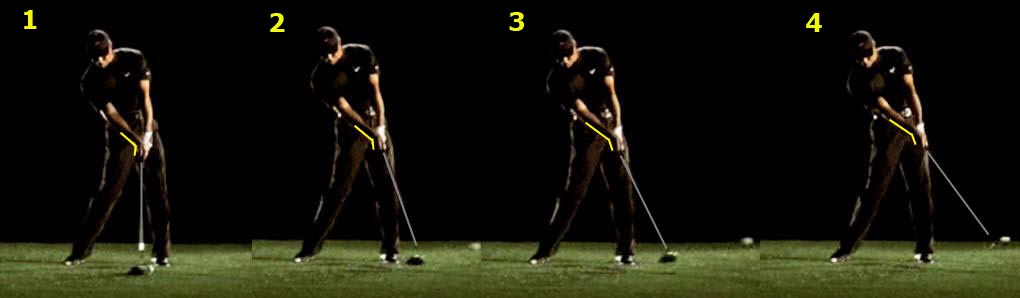
Bray - if you read this thread, we extensively debated the "issue" of whether the backward lean of his peripheral cubshaft is "real" or secondary to a camera artifact. This "issue" was never resolved in a rationally/scientifically conclusive manner - from my perspective. I still do not know whether it is "real" or whether it is a camera artifact.
OB Left - you are presuming that the low point must always be opposite the left shoulder. That may apply most of the time, but not necessarily all of the time. I don't think that it applies to Jamie's driver swing. It is possible to get the hands ahead of the left shoulder at impact with forward shaft lean - which means that the clubhead is on a descending path and not an ascending path. In Jamie's photo, the central end of the clubshaft near the hands has forward shaft lean at impact - even though the hands are ahead of the left shoulder. Note the bend in his left elbow at impact - which makes this possible.
Jeff.
So to itemize you:
- dont think this photo is showing the real facts, that the shaft bend isnt real. A video artifact. But the handle end bend is real and revealing some true shaft lean. This is not an artifact. Interesting please explain.
- dont think that low point is necessarily opposite the left shoulder. That it can be manipulated.
-dont think this fellow pictured here is hitting up.
These are your opinions and you are entitled to them. But I disagree.
I tend to see things differently. But unlike you I can be swayed as these are only opinions or perceptions of mine and I am open to anything that improves my understanding of the games methods. Why? Because I want to improve my game. That is why I am here. Why are you here? To what end?
I currently believe that:
-that the high speed photos are accurate in their depiction of shaft bend.
-that while it is possible to manipulate your swing so that you bottom out outside the left shoulder, low point is ALWAYS opposite your left shoulder. That is to say that a straight left arm and club, vertical to the ground and opposite its attachment to the body is as low as that sucker is ABLE to get. Like the six o'clock position on a clock, it is as low as is POSSIBLE. Sure you could come in with a shortened radius and then bottom out later but why? You would never get all of the "down" that is possible as in "down, out and forward". Three dimensional impact. Or is that less important?
-i think that given his success he must be hitting up like most of those guys. That is how they reduce the spin and increase the launch angle.
You have a curios web of beliefs and non beliefs that seems constructed as a defense of your previously proposed and still hotly defended hypothesis. All of it making for a huge construct of what? Your opinion. Which you are entitled to. But:
You wrote-"These are your opinions and you are entitled to them. But I disagree. I tend to see things differently. But unlike you I can be swayed as these are only opinions or perceptions of mine and I am open to anything that improves my understanding of the games methods. Why? Because I want to improve my game. That is why I am here. Why are you here? To what end?"
Arrogance!
You are implying that you are capable of changing your mind, but imply that I am incapable of changing my mind - that I cannot be swayed. Yet the "reality" is that I did change my mind when GBD presented "evidence" of potential camera artifact distortion problems due to focal plane shutters. That's why I changed my mind regarding this "issue" and why I adopted a more equivocal position of ambivalence.
You are free to hold your strong opinion that the clubshaft is really bent forward (while I equivocate about this "issue").
You are also free to ignore, or reinterpret, the fact that the hands are pointing downwards and slightly backwards at impact. You are even free to believe that this appearance is due to camera distortion. However, from my personal perspective, I believe that i) the hands are "really" pointing slightly backwards and ii) that "fact" is biomechnaically incompatible with hitting up-at-the-ball.
I believe that his hands and central clubshaft are facing backwards (and that it is not due to a camera artifact) for two reasons - i) the hands are traveling much slower than the clubhead and therefore they are less susceptible to the problem of camera artifact due to focal plane shutters and because of ii) evidence from other swings.
In this swing, one can clearly see that his hands are ahead of the club as he nears impact, and that the clubshaft is vertical immediately post-impact. That indicates that he is not hitting up-at-the-ball. By the way - the ball is teed behind the white line, which is just ahead of the red colored script.
Also, if the low point is at the point where the clubshaft is vertical, then the low point must be ahead of his left shoulder. The low point is where his left arm is in a straight line with the clubshaft and where it is as straight as he can practically get it - considering the fact that he has a small degree of left elbow bend that causes his straight left forearm/clubshaft to be behind his left elbow but ahead of his left shoulder socket.
Jeff.
Last edited by Jeff : 01-01-2009 at 12:12 AM.
Reason: add another comment, and revise a statement
You are also free to ignore, or reinterpret, the fact that the hands are pointing downwards and slightly backwards at impact. You are even free to believe that this appearance is due to camera distortion. However, from my personal perspective, I believe that i) the hands are "really" pointing slightly backwards and ii) that "fact" is biomechnaically incompatible with hitting up-at-the-ball.
Jeff,
In the quote above you say it's "biomechanically incompatible" for the hands to point slightly backwards and hit up through the ball.
However it is possible.
The Flying Wedges can be maintained whether they are traveling up or down, and in fact they are maintained......most player's set their right wrist bend in the backswing so the clubshaft is leaning slighly backwards as the club is traveling up back and in to the top or end of the backswing.
The player then maintains that right wrist bend and flat left left wrist down out and forward through impact.
Unless they have axis tilt......then it can be up out and forward through impact.
Axis Tilt is a function of the movement of hips (amount of slide versus turn) and the upper body's reaction to that movement.
Depending on the amount of Axis Tilt a player can hit up with a backward leaning shaft.
Take a look at 6-b-3-O The flying Wedges
and the Hula-Hula Motion
As well as Knee Action and Hip Action
(hope I qouted these right I don't have my book in front of me)
And sorry if I did not read all 33 pages of this thread before posting I am just replying to your last post.
Sorting Through the Instructor's Textbook.
B-Ray
__________________
I have the best job in the world, I get to teach golf for a living!!!
Catch ya on the lesson tee.
You are correct to state that the right wrist remains bent post-impact and that it would be theoretically possible to hit up on the ball with a bent right wrist. However, that would only be possible if the ball was teed up well ahead of the left foot on a high tee. Also, the hands (despite a bent right wrist) would be angled forwards at that time point and not be angled backwards.
Look at these photos of Tiger Woods. He maintains a bent right wrist throughout the followthrough phase of the swing - and he could theoretically hit upwards with his driver if he teed the ball more forwards - see image 2.
In image 2, it would be possible to hit up on a teed ball if the ball was placed on a long tee at that point - where the clubhead is located. However, his hands would not be angled backwards or be vertical (despite the bent right wrist) at impact. The hands would be angled forwards.
Arrogance? Cool. Because I sometimes disagree with...... YOU?
Then what about you? If I am arrogant then you must be something that supersedes arrogance. Have you ever thought about the number of brilliant golf minds that dont post very often in your caveat emptor forum. This is what motivated my previous post. Your inflexible, debate oriented style has driven them away. People who have devoted their professional lives to acquiring the knowledge you debate and often dismiss. This is an arrogance of a higher order.
I love the evidence you presented of your ability to change your opinion. From disbelief to "adopting a more equivocal position of ambivalence". Wow. Thats some flexibility you got there.
You are correct to state that the right wrist remains bent post-impact and that it would be theoretically possible to hit up on the ball with a bent right wrist. However, that would only be possible if the ball was teed up well ahead of the left foot on a high tee. Also, the hands (despite a bent right wrist) would be angled forwards at that time point and not be angled backwards.
Jeff.
"Only" is a very exclusive word. Highlighted (by me) in red is a small point but an important one. The location of the fulcrum (the Left Shoulder) is much more important than the location of the foot, when considering the possibility of an upward strike. For example, I could position the ball inside my foot and outside my Left Shoulder (very wide stance and/or too much axis tilt at Address), and I'd have the ability to strike the ball with an ascending blow. In contrast, I could have the ball outside of my left foot and still catch the ball with a descending blow. It would require a forward leaning spine and/or a very narrow stance. Either scenario could place my left shoulder forward of the ball.
The following pictures are from the same frame (7 frames post Impact). The 2nd picture is zooming in on my hands, just to echo the ability of the Right Wrist to remain bent post Impact.
However, I presume that we both agree that it would not be a good idea to have a forward-leaning spine tilt at impact when hitting a driver.
Also, I generally agree with you when you state-: "I could position the ball inside my foot and outside my Left Shoulder (very wide stance and/or too much axis tilt at Address), and I'd have the ability to strike the ball with an ascending blow." However, I think that Jamie Sadlowski has the ability to hit a descending blow under those same conditions - because his left upper arm is well ahead of his left shoulder socket at impact, and he also has a large degree of left elbow bend at impact which moves his left forearm behind (inside) his left upper arm and it also angles his left forearm backwards away from the target.
OB left
You wrote-: "Arrogance? Cool. Because I sometimes disagree with...... YOU?"
Not at all. I welcome disagreements and I would never label someone arrogant for disagreeing with me. I actually like disagreements because it forces me to rethink my position. I only used the term "arrogant" because your statement implied that you are intellectually capable of changing your mind, while simultaneously implying that I am too rigid a thinker and therefore "a priori" incapable of intellectually changing my mind in the face of a good counterargument.
I have changed my mind about many points regarding the golf swing - particularly since I started studying TGM in earnest (starting in April 2008 ). In particular, it has significantly changed my personal approach to my own golf swing. I never realized to what degree I was switter (because I unconsciously used "right arm power" in my downswing) until I more clearly understood the differences in power accumulator use in swinging versus hitting. I have now radically revamped my personal golf swing by becoming a much more "pure" swinger rather than a switter. I also recently changed my mind regarding head position in the golf swing. I used to keep my pelvis centralized at address, and I then tilted my upper torso rightwards to acquire some rightwards spinal tilt at address. That caused my stationary head to be positioned well right-of-center. I now much prefer Yoda's suggestion that one should keep the head centralized at adddress, and then shift the pelvis left-laterally at address to acquire a rightwards tilted spine. It works much better for me. The third major TGM-induced change of mind came when I more clearly understood the importance of extensor action - I only recently realized that extensor action is critically important in preventing chicken-winging of the left arm at impact, and that's another very useful insight. Hopefully, I will gain more TGM insights in the months/years ahead.
Jeff.
Last edited by Jeff : 01-02-2009 at 12:50 AM.
Reason: added another paragraph




 Linear Mode


