Tomasello Australia "Chapter Series" videos - 4 Barrel Swing per 10-20-D and 7-3, 6-B-2-0 (both forearms start down)
Tomasello Myrtle Beach studio "Letter Series" videos - Right Arm Swing per 10-20-B and 7-3.
Tomasello July 1991 Golf Illustrated interview - Right Arm Swing per 10-20-B and 7-3.
Both swinging procedures utilize a throw from the top with the Right Forearm utilizing longitudinal acceleration (Lengthwise) per 10-19-C and 7-1.
When I studied with Tommy in October of 1993 at his Deer Track Resort studio and out on the driving range, he taught me a Right Arm Swing. Then Tommy handed me the Australia video series tape as I left his studio at the completion of my three-day school. The sequence of events now makes sense!!!
Learn the letter series video first, then move onto the chapter series. I hope you make the connection.
DG
Last edited by Delaware Golf : 06-06-2008 at 06:52 AM.
Could you please expand on the Tomasello right arm 4-B swing?
I can understand a swinger using a three barrel swing, but I cannot clearly understand how the Tomasello 4-B right arm swing works. Where exactly is the right arm and right forearm active in a right arm 4-B downswing, and is that activity isometric and/or isotonic?
Tom doesn't explain the biomechanics of the right arm throw action or formulate a causal relationship between the right forearm throw and the downswing pivot action.
How does a right forearm throw work in terms of which muscle is active, and whether it is isometetrically or isotonically active, and when exactly it's active?
I also cannot understand an automatic causal connection between a right arm throw and lower body activity.
However, both Peter Croker and Tom Tomasello are both presuming that the lower body will respond appropriately. However, "appropriate" with respect to the downswing pivot action could be considered to be a learned behaviour and not necessarily an automatic action.
Finally, how does a right arm throw improve on the alternative of starting a downswing pivot action with a right shoulder throw (as per 10-20-C)?
Tom doesn't explain the biomechanics of the right arm throw action or formulate a causal relationship between the right forearm throw and the downswing pivot action.
How does a right forearm throw work in terms of which muscle is active, and whether it is isometetrically or isotonically active, and when exactly it's active?
I also cannot understand an automatic causal connection between a right arm throw and lower body activity.
However, both Peter Croker and Tom Tomasello are both presuming that the lower body will respond appropriately. However, "appropriate" with respect to the downswing pivot action could be considered to be a learned behaviour and not necessarily an automatic action.
Finally, how does a right arm throw improve on the alternative of starting a downswing pivot action with a right shoulder throw (as per 10-20-C)?
Jeff.
Jeff,
Where does Homer write about Bio-mechanics in TGM? The pivot does respond to the right forearm.....Tommy talks about the response of the pivot to the right forearm in both video series. The trigger types are options... one needs to experiment with all of them to decide what works best for you...not sure what the correct sampling process you would need to determine what trigger type is the most effective (get all 5000 LBG members using a different trigger type....then you have to deal skill level, body type, practice time, etc....LOL). Homer has laid out the components according to their difficulty in execution. I guess the relationship between the components could be thought of in a risk/reward relationship. I tend not to be risk adverse. I enjoy the thrill/risk of cracking a 300 yard drive with hitting the ball a little off-line and I do mean a little!!!
DG
Last edited by Delaware Golf : 06-06-2008 at 11:20 AM.
Tom doesn't explain the biomechanics of the right arm throw action or formulate a causal relationship between the right forearm throw and the downswing pivot action.
How does a right forearm throw work in terms of which muscle is active, and whether it is isometetrically or isotonically active, and when exactly it's active?
I also cannot understand an automatic causal connection between a right arm throw and lower body activity.
However, both Peter Croker and Tom Tomasello are both presuming that the lower body will respond appropriately. However, "appropriate" with respect to the downswing pivot action could be considered to be a learned behaviour and not necessarily an automatic action.
Finally, how does a right arm throw improve on the alternative of starting a downswing pivot action with a right shoulder throw (as per 10-20-C)?
Jeff.
Check out these excerpts from Erie Els book "How to Build a Classic Golf Swing". Erie appears to be one PGA golfer who swings the golf club like the way Tom Tomasello taught the golf swing.
Page 126
I start with my feet firmly planted and as I draw my arm back (per TGM Right Forearm Takeaway and cocking the right elbow per The Magic of the Right Forearm 7-3), my weight transfers back over on to my right side in harmony with the movement of my arm. Then as I bring my arm forward to release the ball, my weight simultaneously shifts over on to my front foot. If I didn't do that, the ball wouldn't go far. Yet this happens naturally on to my front foot without me even having to think about it.
....If you're copying me now you'll realise that in all of these actions, you don't really have to think about the role of your body. It behaves quite instinctively as your arm moves back and forth (Magic of the Right Forearm again). The golf swing isn't such an instinctive, natural movement, but the theories are exactly the same. You can't generate power unless your weight is in harmony with the swining movement of your arms and the club. That's what is meant by good weight transfer.
No wonder so many golfers are befiddled by the smooth swing of Erie....he doesn't swing the club by starting with the lower body...
Last edited by Delaware Golf : 06-06-2008 at 11:37 AM.
Let's see if we can agree on certain fundamentals.
I believe that one needs to keep the power package assembly intact in the early downswing, which means that one must maintain the right flying wedge intact, while the lower body undergoes a pelvis shift rotation movement - irrespective of the downswing trigger.
Do you agree?
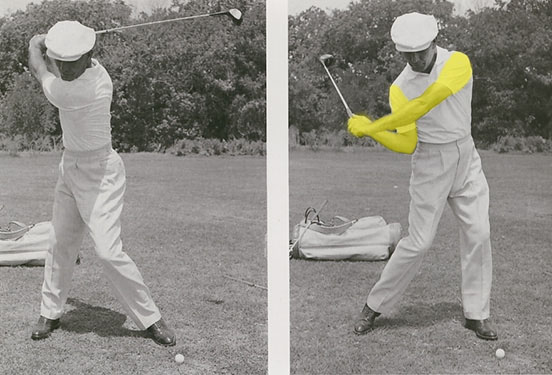
Here is posed photo of Hogan's swing demonstrating what I mean.
The yellow colored area represents the power package assembly and I think that it should be intact at this point in the downswing - intact despite the fact that the hips have rotated about 45 degrees to a hip squaring position, and despite the fact that the entire pelvis has shifted a little left-laterally as one puts weight on the left foot.
Now, has does a golfer get to this position? Ben Hogan states that he thinks of starting the downswing with a lower body move - a pelvis shift-rotation move (hip squaring action) that pulls the power package assembly downwards . I used to start my downswing this way, but it was problematic for me because I tended to suffer from one-or more of these problems - i) too much left-lateral hip slide; ii) a tendency to move my hips too fast and out-of-synch with my upper torso, iii) a tendency to spin my pelvis and roundhouse my upper body. I now initiate my downswing with a right shoulder throw action downplane - and this works better for me because the right shoulder throw downplane causes my pelvis to move the correct amount as a result of a transmitted force going down the spine (right shoulder moves downplane => causes the spine to develop secondary axis tilt and simultaneously produces a transmitted force that passes down the rightwards tilted spine to the pelvis => pelvis shift-rotates to a hip squaring orientation). In other words, I still end up looking like Hogan at this point in the downswing - with a squared pelvis and the power package intact and the right elbow approximated to the right hip. My power package remains intact because during the right shoulder throw action, I also isometrically contract my right arm/forearm muscles in order to maintain the right arm flying wedge angles intact.
Now, if a golfer states that he trigger-starts the downswing with a right forearm throw, I can imagine that golfer end-up looking like Hogan if the right forearm throw is i) a throw of the entire power package assembly (as an intact unit) down towards the right hip area and ii) the right forearm is in a state of isometric contraction (and not isotonic contraction, which would straighten the right elbow and prematurely release power accumulator #1). Is my description of the right forearm throw action (that initiates the downswing) representative of Tom Tomasello's approach, or is it totally different?
Let's see if we can agree on certain fundamentals.
I believe that one needs to keep the power package assembly intact in the early downswing, which means that one must maintain the right flying wedge intact, while the lower body undergoes a pelvis shift rotation movement - irrespective of the downswing trigger.
Do you agree?
Here is posed photo of Hogan's swing demonstrating what I mean.
The yellow colored area represents the power package assembly and I think that it should be intact at this point in the downswing - intact despite the fact that the hips have rotated about 45 degrees to a hip squaring position, and despite the fact that the entire pelvis has shifted a little left-laterally as one puts weight on the left foot.
Now, has does a golfer get to this position? Ben Hogan states that he thinks of starting the downswing with a lower body move - a pelvis shift-rotation move (hip squaring action) that pulls the power package assembly downwards . I used to start my downswing this way, but it was problematic for me because I tended to suffer from one-or more of these problems - i) too much left-lateral hip slide; ii) a tendency to move my hips too fast and out-of-synch with my upper torso, iii) a tendency to spin my pelvis and roundhouse my upper body. I now initiate my downswing with a right shoulder throw action downplane - and this works better for me because the right shoulder throw downplane causes my pelvis to move the correct amount as a result of a transmitted force going down the spine (right shoulder moves downplane => causes the spine to develop secondary axis tilt and simultaneously produces a transmitted force that passes down the rightwards tilted spine to the pelvis => pelvis shift-rotates to a hip squaring orientation). In other words, I still end up looking like Hogan at this point in the downswing - with a squared pelvis and the power package intact and the right elbow approximated to the right hip. My power package remains intact because during the right shoulder throw action, I also isometrically contract my right arm/forearm muscles in order to maintain the right arm flying wedge angles intact.
Now, if a golfer states that he trigger-starts the downswing with a right forearm throw, I can imagine that golfer end-up looking like Hogan if the right forearm throw is i) a throw of the entire power package assembly (as an intact unit) down towards the right hip area and ii) the right forearm is in a state of isometric contraction (and not isotonic contraction, which would straighten the right elbow and prematurely release power accumulator #1). Is my description of the right forearm throw action (that initiates the downswing) representative of Tom Tomasello's approach, or is it totally different?
Jeff.
Jeff . . . not to be nitpicky (which I reckon means I'm gonna be nitpicky) . . . but the shoulders are PART OF THE POWER PACKAGE . . . Your pattern is valid BUT you are not benefiting from the entire radius via Swinging from the Feet if you aren't starting the swing from the ground up. The radius ends at the first nonlagging component closest to the ground.
Let's see if we can agree on certain fundamentals.
I believe that one needs to keep the power package assembly intact in the early downswing . . .
Do you agree?
Now, if a golfer states that he trigger-starts the downswing with a right forearm throw, I can imagine that golfer end-up looking like Hogan if the right forearm throw is i) a throw of the entire power package assembly (as an intact unit) down towards the right hip area and ii) the right forearm is in a state of isometric contraction (and not isotonic contraction, which would straighten the right elbow and prematurely release power accumulator #1). Is my description of the right forearm throw action (that initiates the downswing) representative of Tom Tomasello's approach, or is it totally different?
Jeff . . . not to be nitpicky (which I reckon means I'm gonna be nitpicky) . . . but the shoulders are PART OF THE POWER PACKAGE . . . Your pattern is valid BUT you are not benefiting from the entire radius via Swinging from the Feet if you aren't starting the swing from the ground up. The radius ends at the first nonlagging component closest to the ground.
Jeff,
My recommendation is to not only watch the Tomasello videos but you MUST watch them multiple times (so many don not do this). From your comments, I know you haven't done that...first checkout, Tommy's number 2 Letter series video. If you would have studied that video you would not have put up the pictures of Hogan!!! and made the comments regarding keeping the flying wedges intact. For some reason, golfers make the mis-interpretation that if you throw the right forearm from top that you lose the flying wedges....not so. Watch the video (again). Reference the comment around the 14 to 15 minute mark about high speed cameras.
It's a shame you want to disprove what Tommy taught.
Jeff....btw, Tommy taught both Jodie Mudd and Sally Little the 10-20-C trigger. I'm glad you're experiencing success with that component. It sounds like you have found your swing. However, I have teaching professionals contacting me who say they're having success starting the club down with both forearms per 10-20-D. And they have tried the other trigger types.
The beauty of the Golfing Machine it's an individual Journey!!! With Lynn's site, it can finally be a group Journey!!! For so many years, it was an individual Journey, it's a shame we don't have Homer and Tommy here to share in the group journey.
DG
Last edited by Delaware Golf : 06-06-2008 at 09:27 PM.
Jeff . . . not to be nitpicky (which I reckon means I'm gonna be nitpicky) . . . but the shoulders are PART OF THE POWER PACKAGE . . . Your pattern is valid BUT you are not benefiting from the entire radius via Swinging from the Feet if you aren't starting the swing from the ground up. The radius ends at the first nonlagging component closest to the ground.
Jeff,
Watch video 5 from the Chapter series on Power....I no problem in generating superior distance with throwing the right forearm from the top. I'm surprise by how much the pivot contributes in a Right Forearm generated swing.
Send me your regular email address and I will send you a copy of Tommy's 1991 GI interview. Where Tommy talks about the right arm and pivot.
DG
Last edited by Delaware Golf : 06-06-2008 at 02:38 PM.




 Linear Mode


