You've made good points, bray, but regarding the above, I must disagree.
You can "Paint it with the right side" (as NBC analyst Johnny Miller recently desribed a TOUR player's Stroke) and still be Swinging. In fact, you must feel this.
Despite his Passive Right Elbow Accumulator (#1), the Swinger delivers -- via his Pivot and Left Wrist Throw -- a stiff-wristed Right Forearm Slap (Pitch Major Basic Stroke / 10-3-B). The Right Forearm's Basic Stroke (7-3) and the first joint of the Right Forefinger (6-C-1 #3), Loaded with its Lag Pressure (The Secret per 6-C-2-0/E), Traces the Straight Plane Line (2-O / B - #3) and accurately Delivers the Clubhead to the Ball (1-L #1 through #10). All while Extensor Action (6-B-3-0-1), Right Triceps Pressure via the heel of the Right Hand against the Left Hand Thumb, creates maximum Power Package Structure.
Bottom Line: Even in a Swinging Stroke, the Right Side is always active.
Thanks for your contribution, bray, but respectfully, I must disagree.
You can "Paint with the Right Side" as desribed by the NBC analyst Johnny Miller, and still be Swinging. In fact, you must feel this.
Despite the Passive Right Elbow Accumulator (#1), the Swinger delivers -- via his Pivot and Left Wrist Throw -- a stiff-wristed Right Forearm Slap (Pitch Major Basic Stroke / 10-3-B). The Right Forearm's Basic Stroke (7-3) and the first joint of the Right Forefinger, Loaded with its Lag Pressure, Traces the Straight Plane Line and accurately Delivers the Clubhead to the Ball (1-L #1 through #10). All while Extensor Action (6-B-3-0-1), Right Triceps Pressure via the heel of the Right Hand against the Left Hand Thumb, creates maximum Power Package Structure.
Bottom Line: Even in a Swinging Stroke, the Right Side is always active.
Ask any professional tennis player what his most powerful ground stroke is and he will tell you the, "FOREHAND" (versus backhand). The forehand is powered by the right side.
Ask any professional tennis player what his most powerful ground stroke is and he will tell you the, "FOREHAND" (versus backhand). The forehand is powered by the right side.
Hence, Homer Kelley's own words in TGM's First Edition:
The "mystery" of the Mechanics of Golf was found to haunt the fens and grottos of Right Arm participation, Therefore it was much simpler and clearer to present the soutuion as a Right Arm approach to the whole game.
[Bold emphasis by Yoda]
Still, students should recognize that the tennis player's right forearm smash forfeits Left Arm Radius Power (6-B-4-0) and its Checkrein Control (of the Right Elbow) per the Extensor Action of 6-B-1-D.
I obviously cannot really understand the difference between triggering a release and powering a release - especially with respect to a "right arm throw".
I am reading 10-20-B and trying to understand what is meant by a "right arm throw" trigger. HK states under 10-20-B that "the right arm simply pushes the lever assemblies towards impact -- usually restricted to hitting."
I can understand the right arm pushing the lever assemblies only as occurring in two ways - the right arm can push against PP#3 and/or PP#1.
I thought that if the right arm pushes against PP#3 using an axe handle technique (radial direction) that it represents hitting. If it represents hitting, then isn't this "right arm pushing the lever assemblies" a power stroke? Why does he call it a trigger? Also, doesn't the push action occur, from a biomechanical perspective, from the active straightening of the right elbow via active right triceps action - which is an active release of PA#1? In other words, how can this "right arm throw" action be a trigger and not a power stroke (due to release of PA#1) if the golfer is hitting.
Another question - HK states that the "right arm throw" is restricted to hitting. However, I thought you implied that a right arm throw (which is defined by HK as a push action of the lever assemblies towards impact) can also be used as a trigger to release PP#2 in a swinger's action. This puzzles me. Where is the "right arm throw" exerting its push action when triggering the release of PP#2 in a swinger's action - ? PP#1? If a push force is used against PP#1 in a swinger's action - how does it trigger the release of PP#2?
I also do not understand TT's right arm throw action. He states that a golfer needs to throw from the top and that one should actively drive the club down-and-out. My only mental conception of what a "right arm throw" means from a biomechanical perspective = an active extension of the right elbow via active right triceps action. TT does not state how that right arm throw action propels the clubshaft. From my perspective, it can supply a push-force at PP#3 or PP#1. If it applies push force at PP#3 on the back side of the clubshaft, that represents hitting. However, TT is talking about right arm swinging. Therefore, I presume that he is referring to the right arm applying active push-pressure at PP#1. If one applies active push-pressure at PP#1, then its effect must surely be to propel the left hand to move faster. That's normally what the release of PP#4 does in a pivot-driven swing. However, TT doesn't state that one activates the pivot to release PA#4 and move the left arm/hand forward. I therefore concluded that TT meant that the "right arm throw' pushes the left arm/hand forward as a substitute for the release of PA#4. However, you indicate that the right arm cannot perform this power stroke role in a swinger's action - I am therefore very confused.
I can understand the right arm pushing the lever assemblies only as occurring in two ways - the right arm can push against PP#3 and/or PP#1.
I thought that if the right arm pushes against PP#3 using an axe handle technique (radial direction) that it represents hitting. If it represents hitting, then isn't this "right arm pushing the lever assemblies" a power stroke? Why does he call it a trigger? Also, doesn't the push action occur, from a biomechanical perspective, from the active straightening of the right elbow via active right triceps action - which is an active release of PA#1? In other words, how can this "right arm throw" action be a trigger and not a power stroke (due to release of PA#1) if the golfer is hitting.
Jeff,
Of course, as in your quote above, if the golfer is Hitting ("radial acceleration / axe handle technique"), the Right Arm Throw Triggeris prelude to Right Arm Thrustthrough Impact and does indeed ultimate in a Right Arm Power Stroke. However, my response was to your premise as postulated in your Post # 30 above (which mandated Swinging):
"Then his right arm throw action induces a passive release of PA#2 via centrifugal action (rather than an axehandle technique of radial force being applied against pressure point #3)."
And this is a Swing -- by your own definition -- with a Right Arm Release Trigger.
Yoda - when I stated in post#30 that the right arm throw action induces a centrifugal release of PP#2, I was thinking that TT meant that the right arm throw occurs via the active release of PA#1 and that it substitutes for PA#4 as a force causing the left arm to move in space. Then I imagined the release of PA#2 occurring via simple centrifugal forces - due to the fact that the left wrist/hand eventually moves in a tight circular direction at some point in the downswing (as if moving around a small radius pulley in HK's endless belt analogy). In other words, I was not really implying that the "right arm throw" was acting as a trigger to trigger the release of PA#2. I was thinking of the "right arm throw" as a power stroke that moved the left arm, and I thought of the release of PA#2 as occurring automatically/passively according to the principles of the endless belt principle. In other words, if a swinger moves the left arm in space down-and-out towards the ball, PA#2 release occurs automatically (without being triggered). That's why I remain confused by what is meant by a "right arm throw" being a trigger for the release of PA#2 in a swinger's action. I also cannot understand how a "right arm throw" works differently (from a biomechanical perspective) when it acts as a trigger rather than a power stroke. Surely, both require the same biomechanical action - an active triceps contraction => active straightening of the right elbow (which is definitionally my understanding of what is meant by the term "active release of PA#1").
. . . I remain confused by what is meant by a "right arm throw" being a trigger for the release of PA#2 in a swinger's action.
. . . I also cannot understand how a "right arm throw" works differently (from a biomechanical perspective) when it acts as a trigger rather than a power stroke.
Jeff,
Homer Kelley himself, as both you and I have specifically noted in our previous posts, specifically said that the Right Arm Throw is:
". . . USUALLY RESTRICTED TO HITTING." [10-20-B / All Caps emphasis mine.]
Now, inspired by a Tom Tomasello video, its major promoter and your own curiousity, you have entangled yourself in a web of your own making. In your quote above, you are confused by your own postulate of the Right Arm Drive (Accumulator #1) of a Swinging Action (your Post #30 wherein you introduce the 1-2-3 Triple Barrel Swinging Stroke):
"Then his right arm throw action induces a passive release of PA#2 via centrifugal action (rather than an axehandle technique of radial force being applied against pressure point #3)."
In fact, as I've previously described, neither the Right Arm Thow Trigger nor the #1 Accumulator Right Arm Drive is compatible with Swinging.
You can attempt either, of course, or both. But . . . .
Yoda - thank you for your patience and your continuing commentary.
I am genuinely trying to accomplish two goals - i) trying to understand TGM terms correctly and ii) trying to accurately describe TT's right arm throw swing using TGM terms.
You stated something of great interest to me.
"if the golfer is Hitting ("radial acceleration / axe handle technique"), the Right Arm Throw Trigger is prelude to Right Arm Thrust through Impact and does indeed ultimate in a Right Arm Power Stroke."
You stated that a right arm throw trigger precedes a right arm power stroke. If I understand this correctly, then the right triceps muscle actively contracts and this represents the right arm throw trigger. Then the right triceps continues contracting and this thrusts the right arm through impact and this represents the right arm power stroke. In other words, the right arm power stroke implies active right triceps action as an active push force through impact - and that this represents PA#1 release. If my understanding is correct, then PA#1 release is not simply any active right triceps action, but rather an active right triceps action of sufficient force to power the right arm through impact in a hitting action. If I am still correct, then I can understand why one could not use the TGM term "release of PA#1" in describing a swinging action.
You also wrote-: " neither the Right Arm Thow Trigger nor the #1 Accumulator Right Arm Drive is compatible with Swinging."
Ok. I can understand that point.
Now I have a problem. How do I understand TT's right arm throw action and how can I accurately describe his swing action in TGM terms?
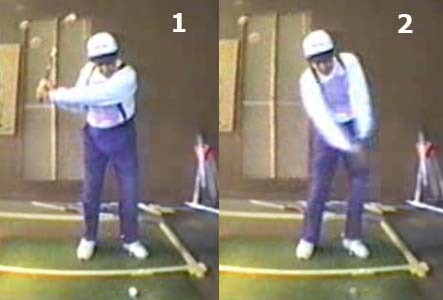
Here are two capture images of TT demonstrating his right arm throw action - from the Lee Dietrick number 2 video.
Image 1 shows TT at the top of his backswing and image 2 shows TT at impact.
I can see that his left arm is across his left pectoral area at the end-backswing (as if he has loaded PA#4) and I can see that it has opened at impact (as if he has released PA#4). What is the correct TGM description of his left arm movement? What causes his left arm to move?
Normally, PA#4 is released in a pivot-driven swing when the pivot subsides and the left arm is blasted into orbit (HK's description). However, TT does not use his pivot to drive the left arm into impact, and he also does not pull the left arm away from the left pectoral area. So, there must be some other force moving the left arm.
TT states that he "throws the right arm" down-and-out. If I accept his description of his swing action, then is it not correct to state that he is using a right arm-induced push-force to move the left arm? Also, would it not be correct in TGM terms to describe his swing action as triple barrel - as RAPF4:2:3 (where RAPF = right arm push force)?
I have shared Jeff's confusion in the past about the role of the right arm. Although I have worked with TT I am not interested in parsing his words. I know that Lynn's experience with HK qualifies him to explain the yellow book with authority. I had a badly malfunctioning right arm when I saw Lynn. I held on avoiding the motion and therefore release. I empasized PP 3 as I swung. Lynn had me load PP 2 and then drag it down accelerating the club longitudinally. Since my mind is in my hands during the swing I mainly think of PP 2. The trick for me was only to be aware of PP 3 and try to increase that pressure while maintaining a passive right arm, a soft flexible elbow joint and hopefully to experience the feel of "throw out " that had been so elusive. I wanted to feel the blood being propelled into my right and left fingers by Centrifugal force. Of course I had to maintain extensor action and try to feel I was driving my hands thru the ball at the same time Driving the hands and club thru the ball while swinging !. If I think I am doing that I have increased distance and great shots. But I am still not sure I've got it. I feel it is very confusing to understand the inter relationship of all of these feels and actions while swinging. I guess it would be easier for simpler brains just to hit it! Whats so hard about that. It must be easier. I seen a guy hit it with a bottle on his head and it doesn't even fall off. Anyway Jeff thanks for your persistance in this discussion, it's resulted in great stuff from Yoda. Oh somewhere along the line I was told that if you swung your right arm you might get pain the the right elbow.
I do not wish to add fuel to a fire that I suspect has little purpose other than to make hot air and increase greenhouse gas etc...but...
Could it be that TT was using, after an on-line hip slipe, his right triceps action pushing against PP1 and a "turned to the plane " PP3...but triceps push is working away from the target ...to a point on the plane line but about 5 yards behind the ball (ie. down and out and away from the ball??) In reality the hip slide and early right shoulder motion have started the downswing ( the bit where TT says that you have to reconnect when hands are above the shoulders)....but he uses right triceps with a turned PP3 and a very unusual aiming point??
ie. almost as though his right shoulder has a standard aiming point (so that the club actually hits the ball) ....but his "turned pp3" and pp1 have a secondary aiming point which allows his right triceps to thrust away from the normal aiming point??
Hitting being different - ie. use of right triceps with the pp3 is not turned and the straight line delivery path and thrust are directed towards ball/normal aiming point??
Just thoughts (tinkering with my dowel on a cold winters morning), not trying to rewrite the book...
Please do not print this out...the electricity required to add this post have already caused enough damage to the planet and I fear that trees/paper etc will further hasten the decline of our species...




 Linear Mode


