Bernt - If you prefer to see certain forces as existing without performing work, then you are free to perceive the world functioning in that manner. I think that if a force exists and it is operant, then it is performing work - even if the object remains stationary. So, in your example of a person standing stationary, you do not see any "work" because the object is stationary. I see "work" - because muscles forces are required to keep the person stationary and erect in the presence of gravity. If body muscles weren't actively working to oppose the force of gravity, then the person would fall to the ground.
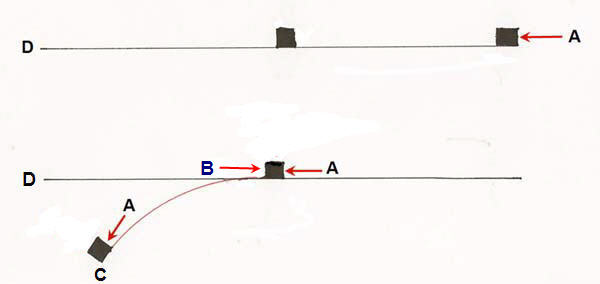
Consider this ice rink example.
In this example, person B is applying a push-force at a 180 degree angle to person A's push-force. If the push-forces are equal, then the object will remain stationary and not move in a straight line direction towards destination D or along a circular path towards position C.
If the object remains stationary, you may "feel" that person A and person B are not working. However, in my mental universe, both person A and person B are working just as hard as before (as in those previous examples) because they are supplying the same amount of push-force (energy) as before - the only difference is that their push-forces are working in perfect opposition thereby eliminating any possibility of there being any net force available to move the object on the ice rink.
According to Newtonian physics - forces can be in a state of balance that results in an object being stationary.
Note that it states the following with respect to Newton's first law of motion = An object at rest tends to stay at rest and an object in motion tends to stay in motion with the same speed and in the same direction unless acted upon by an unbalanced force.
In other words, it takes an unbalanced force to disturb a an object from its position of rest. If the forces are in balance, then the object will remain at rest - even though the forces are working.
You wrote-: "Regarding your curve pattern. You could put up a fence that forces the object to turn. The forces from this fence will not use any energy and they will not work. Still they will do the same "work" as the centripetal components in your examples."
The fence is working in a Newtonian sense - by providing an unbalanced force that deflects the object.
It states with respect to a person riding in a car.
"Have you ever experienced inertia (resisting changes in your state of motion) in an automobile while it is braking to a stop? The force of the road on the locked wheels provides the unbalanced force to change the car's state of motion, yet there is no unbalanced force to change your own state of motion. Thus, you continue in motion, sliding along the seat in forward motion. A person in motion tends to stay in motion with the same speed and in the same direction ... unless acted upon by the unbalanced force of a seat belt. Yes! Seat belts are used to provide safety for passengers whose motion is governed by Newton's laws. The seat belt provides the unbalanced force which brings you from a state of motion to a state of rest."
In this example the book on the table is at rest - because the table top is providing a force to balance the force of gravity.
Therefore, inanimate objects can provide an unbalanced force that changes a state of motion to a state of rest. An unbalanced force can also cause a change of direction - as in the examples I have previously supplied (where person B supplied the unbalanced force that deflected the object) or in the presence of a fence which provides the unbalanced force that deflects the object.
HB - you wrote-: "Circle path is a hand path. Endless belt is about #2. They are related but not the same thing."
I do not understand this point. I believe that circle path is left hand path, and that the endless belt is also left hand path. The clubshaft touches the endless belt at the position of the left hand which is fixedly attached to the endless belt, and during the straight line directional movement of the endless belt the left hand (which is fixedly attached to the endless belt) is moving in a straight line.
You wrote-: "Are you saying that there is no wrist cock with a circle path? Whatever the size of the pulley, if the left wrist cocks, there is a pulley."
I have no idea what you are describing. I do not think that the statement "if the left wrist cocks there is a pulley" makes sense. My understanding of the endless belt analogy is that the pulley has no necessary causal connection with the degree of left wrist cock. My idea of the pulley is the shape of the hand arc at the bottom of the swing.
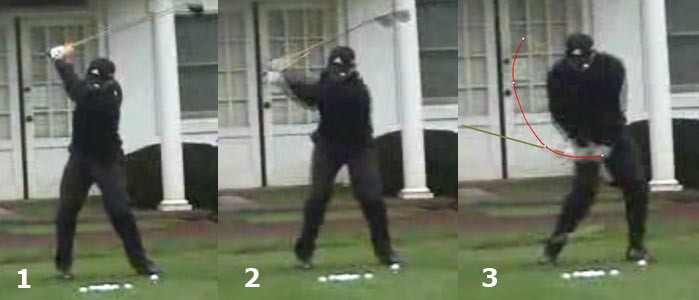
So in this photo of Sergio Garcia's hand arc - the pulley section of the endless belt is the lower rounded part of the U-shaped hand arc where the radius is smallest (tightest curve).
Surely the pulley relates to the hand arc's tight curve at the bottom of the hand arc, and not the degree of left wrist cock that may/may not be present when the hands pass through that section of the hand delivery path.
You wrote-: "How can the club path in the downswing be more circular when the left wrist is cocked for a large portion of the downswing (shrinking the radius from shoulder to clubhead) while the left arm remains straight (maintaining the radius from shoulder to hand)?"
Why not?
Here is the visual evidence?
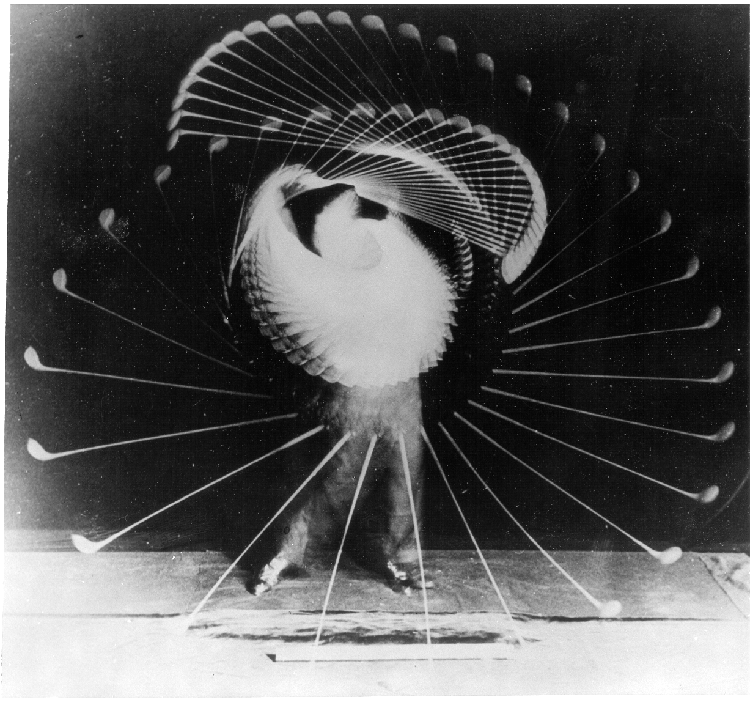
In this strobe photograph of Bobby Jones swing, isn't the clubhead arc as circular when the left wrist is cocked as it is when the left wrist becomes uncocked?
By the way, do you do not agree that many professional golfers have a 10-23-A or a 10-23-B hand path? Both those hand paths have a straight line portion (the only difference being that the angled line hand path requires a vertical drop of the hands down to the elbow plane before the hands move along its straight line path section).
Also, in Yoda's Alignment Golf DVD -disc 2 - he shows how to perform a straight line thrust action down towards the ground (down towards an aiming point on the ground). Do you think that his straight line thrust action is compatible with a perfectly circular hand path? What is the purpose of teaching that action - if not to produce a 10-23-A type hand delivery path?
Feel free to redefine basics physics all you want. But IMO you should really study the concept of work in the Newtonian sense before you throw it in the trash bin. So far Newton mechanics has been more than adequate for all my purposes related to mechanics.
Should I ever face a problem where Newton's doesn't deliver I will most likely turn to Einsteins theory of relativity. And perhaps also have a close look at quantum mechanics.
If I still haven't found what I'm looking for, maybe I will ask you for assistance
I wasn't redefining Newtonian physics. I was attempting to clarify it for your educational benefit. I apologize for not being successful in my multiple attempts, but I did make a serious effort (which involved a considerable amount of "work").
"Work" that is not successful in moving a person's mind is still work!
. . . in Yoda's Alignment Golf DVD -disc 2 - he shows how to perform a straight line thrust action down towards the ground (down towards an aiming point on the ground).
Thrust -- Lag Pressure -- is always Straight Line (ghosted arrow / 9-3-6).
Directly toward and through (10-23-A/B) the Aiming Point (6-E-2).
Even with Circle Path Delivery (10-23-E / usually restricted to short shots & S&T video) . . .
Why must the thrust be straight line towards an aiming point (the ball) in a circle hand delivery path? Doesn't that straight line thrust action affect the hand delivery path by virtue of its use of the aiming point concept - aiming at the ball? If not, what are the factors that allows a golfer to adopt a 10-23-A straight line hand path rather than a 10-23-E circle hand path.
Secondly, it is my understanding regarding the automatic release variants (10-24-C and 10-24-E) that one uses the aiming point concept to trigger the release. Is this different to the straight thrust action towards an aiming point that you described in your last post?
Yoda - you haven't answered all the other pertinent questions.
Doesn't a straight line thrust action towards the ball affect the hand delivery path? What are the primary factors that allows a golfer to move between a 10-23-A and 10-23-E hand delivery path?
My daughter received a Wii exercise game for Christmas. It is designed to help core strength and balance. It measures weight distribution on each leg and a series of exercises and games helps you learn to improve your balance. It would have great golf applications. Software could be developed to help one learn all of the various pivots i.e. Hogan, Stack and Tilt etc. The grandkids were wizards playing the ski jump, soccer and ski slalom games. Would appreciate your input. Perhaps this needs its own thread outside this maze of technical jargon that is unlikely to help one hit the ball better.
HB - you wrote-: "Circle path is a hand path. Endless belt is about #2. They are related but not the same thing."
I do not understand this point. I believe that circle path is left hand path, and that the endless belt is also left hand path. The clubshaft touches the endless belt at the position of the left hand which is fixedly attached to the endless belt, and during the straight line directional movement of the endless belt the left hand (which is fixedly attached to the endless belt) is moving in a straight line.
You wrote-: "Are you saying that there is no wrist cock with a circle path? Whatever the size of the pulley, if the left wrist cocks, there is a pulley."
I have no idea what you are describing. I do not think that the statement "if the left wrist cocks there is a pulley" makes sense. My understanding of the endless belt analogy is that the pulley has no necessary causal connection with the degree of left wrist cock. My idea of the pulley is the shape of the hand arc at the bottom of the swing.
So in this photo of Sergio Garcia's hand arc - the pulley section of the endless belt is the lower rounded part of the U-shaped hand arc where the radius is smallest (tightest curve).
Surely the pulley relates to the hand arc's tight curve at the bottom of the hand arc, and not the degree of left wrist cock that may/may not be present when the hands pass through that section of the hand delivery path.
You wrote-: "How can the club path in the downswing be more circular when the left wrist is cocked for a large portion of the downswing (shrinking the radius from shoulder to clubhead) while the left arm remains straight (maintaining the radius from shoulder to hand)?"
Why not?
Here is the visual evidence?
In this strobe photograph of Bobby Jones swing, isn't the clubhead arc as circular when the left wrist is cocked as it is when the left wrist becomes uncocked?
By the way, do you do not agree that many professional golfers have a 10-23-A or a 10-23-B hand path? Both those hand paths have a straight line portion (the only difference being that the angled line hand path requires a vertical drop of the hands down to the elbow plane before the hands move along its straight line path section).
Also, in Yoda's Alignment Golf DVD -disc 2 - he shows how to perform a straight line thrust action down towards the ground (down towards an aiming point on the ground). Do you think that his straight line thrust action is compatible with a perfectly circular hand path? What is the purpose of teaching that action - if not to produce a 10-23-A type hand delivery path?
Jeff.
Most pros are probably more like 10-23-C and D . . . .




 Linear Mode


