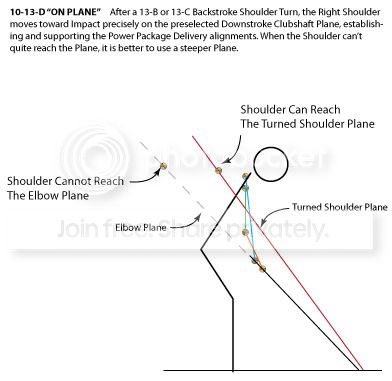
10-13-D “ON PLANE” After a 13-B or 13-C Backstroke Shoulder Turn, the Right Shoulder moves toward Impact precisely on the preselected Downstroke Clubshaft Plane, establishing and supporting the Power Package Delivery alignments. When the Shoulder can’t quite reach the Plane, it is better to use a steeper Plane.
One situation when ones Right Shoulder cannot reach the Plane, is when swinging on the ELBOW PLANE.
I'll repeat that for 12 Pc. Bucket.
One situation when ones Right Shoulder cannot reach the Plane, is when swinging on the ELBOW PLANE.
I think that Homer was speaking directly to Bucket and descendants of Ben Hogan. Use a Steeper Plane. Doing so will give your stroke Right Shoulder support for the Power Package and eliminate the need for a hazardous Plane Shift.
Quote:
10-6-B TURNED SHOULDER This reference point is primarily the point reached by the Right Shoulder after a Flat Backstroke Shoulder Turn. But any other controlled Shoulder Turn can also provide an acceptable reference point. See 10-13-0. This Plane Angle has far better performance characteristics than any other because any Plane Angle Shift is very hazardous. This procedure does not refer to the disruptive Shoulder Turn Takeaway – which is always too “Flat” and/or too “Low” making a Plane Angle Shift mandatory and usually unintentional and unsuspected. Study 7-3 and 10-24-F.
Quote:
- If the right shoulder cannot reach this plane.
- one situation is swinging on the elbow plane.
If you choose the elbow plane, then can the downstroke clubshaft plan be the elbow plane? Therefore the right shoulder no need to redirect to the TSP?
Also if swing back based on elbow plane then at the top should the right shoulder not on the TSP?
Can a hitter hit on both plane, directly straight down?
At address and through the ball for structural (RFFW) and tracing (the straight plane line) reasons the Right Forarm is ideally on the same plane as the clubshaft's lie angle.
The Right Forearm is said to be on this plane when the Right Elbow is on this plane. This is the Elbow Plane one employs through Impact. To accomplish this and a Level Left Wrist, adjustments must be made to your Head position, knee bend, waist bend, distance from the ball etc. These adjustments, if not done at Impact Fix will necessitate an identical adjustment dynamically when you are swinging......not the best thing for your consistency. This is a major cause of faulty Impact Alignments.
The Turned Shoulder Plane (TSP) is a line drawn from the Plane Line through the Right Shoulder when it's "turned" to its position at Top. This Plane Angle is dependent on many things including the type of Shoulder Turn employed. Generally the Flatter the Shoulder Turn going back the closer this Plane Angle is to the Shaft Plane or Elbow Plane. The Turned Shoulder Plane allows the Right Shoulder to take the Power Package down the TSP towards the Plane Line in Startdown. An On Plane move of the Power Package via the Right Shoulder referred to as an On Plane Shoulder Turn. Flat back and On Plane coming down. The shoulders dont turn on a single plane for the Standard Shoulder Turn anyways.
However the TSP is not the same Plane Angle as the Elbow Plane and so the Plane Angle of the Inclined Plane must shift to this lower Elbow Plane angle prior to Impact. This is achieved as easily as it was to shift to higher Plane Angle in the Backstroke if you Addressed the ball with a Level Left Wrist at Fix. It just sort of happens as the Right Elbow unbends, the reverse situation of Right Forearm Pickup. If you Pickup you must let it down, CF helps out in this regard.
The reference in 10-6-B to "any Plane Shift being hazardous" relates to a selection of an Inclined Plane Angle other than a TSP angle at Top which would necessitate a shift back to a TSP angle prior to an On Plane Shoulder Turn in Startdown.
Logic holds that any plane shift is hazardous yes but some shifting does happen. Keeping it to a minimum is what its all about while using your Right Shoulder to take the Power Package down plane as the initial move in Startdown. For this to happen you have to employ a TSP angle. The closer to the Elbow Plane angle the better.
How do I know if the Rt shoulder is on the right plane in the downswing?
Excellent Question........................
This is what Happens when your Right Shoulder, Clubshaft and Hands are on the same plane at Start down.
Without pulling the club with your arms, i.e. the club being pulled down by the Hip-Slide-Pivot, your Right Elbow will Forcibly move Down Plane. Your Right Elbow will feel like its DRIVEN down-Plane. When you first accomplish this, your Right Elbow may Slam into your Ribcage. Once you do that a few times, and adjust for Plane Line Tracing, your Elbow will be Driven to its Release Location with-out effort.
Yup, except the Right Elbow is not on the Shaft Plane and therefor neither is the Right Forearm. So no Right Forearm Flying Wedge structure there and since the Right Forearm is not pointing at the Base Line/Plane Line, the ability to Trace the Plane Line is severely handicapped.
Yup, except the Right Elbow is not on the Shaft Plane and therefor neither is the Right Forearm. So no Right Forearm Flying Wedge structure there and since the Right Forearm is not pointing at the Base Line/Plane Line, the ability to Trace the Plane Line is severely handicapped.
OB,
I see exactly wat you are saying. However, I think it's kind of like studying the pictures of Diane in the book. Look only at the point Mr. Kelly, or Daryl in this case, is trying to make without paying attention to positions that are not relevant to the point... That being said, I'll bet Daryl could incorporate what you are saying into a new pic?
I appreciate your work Daryl!
Kevin
__________________
I could be wrong. I have been before, and will be again.
How do I know if the Rt shoulder is on the right plane in the downswing?
Hey Jerry
Basically assuming you are employing a TSP, the Right Shoulders so called "right" Plane Angle will be the one that most closely approaches the Elbow Plane, assuming you have an Elbow Plane to get to.
Let me explain, all Alignments are derived from Impact Alignments! So to answer your question properly I must go back to Fix. You must adjust you machine at Impact Fix properly!!!!!!!!!!!!!!!! So many of us TGM'rs dont do this and we MUST. Get the Right Arm on Plane with the desired amount of shaft lean and clubface angle for the shot at hand. Then get the Left Wrist on the club and Level. This will require some adjustment to Knee Bend, Waist Bend, Head Position etc. These are the key Machine Adjustments that if not done at Fix or done dynamically during the motion will destroy your Impact Alignments!!!!!! Far better to do them at Fix than dynamically.
From there you have choices in regard to which TSP angle you are using assuming you are even using a TSP. But as I mentioned above Homers definition of a "Standard" Shoulder Turn is Flat going back and On Plane going down. But all of the TSP angles are On Plane by definition. Some are higher than others. Homer preferred an Angle that more closely approached the Elbow Plane or Shaft Plane.
I know the wording makes it all so confusing. Basically, ideally, get your Machine adjusted properly at Fix, then take your Right Shoulder back as Flat to the ground as is comfortable. If you get your Pressure Points on this same Plane Angle you are on a TSP! A Flat one at that. You are now all systems go to use your Right Shoulder to take the Pressure Points and the Power Package down this TSP angle which you have pre selected. Axis Tilt via Hip Action prior to Startdown will further tilt the Right Shoulder to a Plane Angle lower than your Flat back Shoulder Turn took it to. This gets you even closer to the Elbow Plane. That is the ideal if there is one. Although Homer would never talk in such terms there being so many usable patterns. Most every golfer comes in on a Higher Plane, especially the over the top types who Startdown with their Arms instead of their Right Shoulder and cross line it, outside to in.
The Pivot has to lead in Startdown but it tends to get in the way of the Right Elbow and redirect the Power Package OUT and over the Plane. Homers genius allowed him to identify this problem and its solution. Research Cleared Right Hip and Axis Tilt in connection with the topic at hand, the TSP and TGM opens up like the readable book it often isnt. This is what I see in Yoda's swing, Hogan's swing.
I see exactly wat you are saying. However, I think it's kind of like studying the pictures of Diane in the book. Look only at the point Mr. Kelly, or Daryl in this case, is trying to make without paying attention to positions that are not relevant to the point... That being said, I'll bet Daryl could incorporate what you are saying into a new pic?
I appreciate your work Daryl!
Kevin
I know what you mean Kev, I dont want come off as being "nit picky" or anything but then D should remove the type saying "Elbow Plane" and re name it the "Shaft Plane" cause it isnt an Elbow Plane.
And then that isnt Diane or Hogan or Brian Gay then at Address or at Impact either and all Alignments are derived from Impact Alignments after all. The RFFW and the On Plane Right Elbow being Impact Alignments make them relevant to the discussion of any Alignment! No?




 Linear Mode


